 look news india

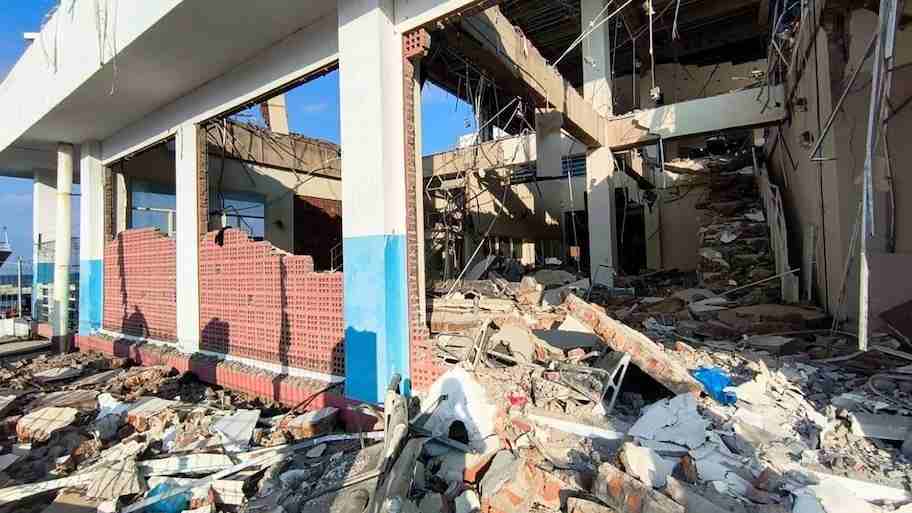
The Southeast Asian island nation of Indonesia has once again witnessed a severe wrath of nature. Within the last 24 hours, the earth shook strongly thrice in different parts of the country, causing panic to millions of people. The most recent and powerful aftershock measured 6.0 on the Richter scale.
The tremors of the earthquake were so intense that multi-storey buildings started swaying, cracks appeared in the walls and fans and items in the houses started shaking rapidly. As soon as the tremors were felt, people screamed and ran out of their homes, offices and shopping complexes towards open fields and roads. Due to the fear of continuous aftershocks, people in many coastal and sensitive areas were forced to stay under the open sky overnight. Local disaster management agencies and meteorological department (BMKG) are continuously monitoring the situation.
‘Pacific Ring of Fire’: The most sensitive maze of geological movements
To understand the frequent devastating earthquakes in Indonesia, it is essential to know its geographical and geological location. Indonesia is located directly above the ‘Pacific Ring of Fire’, the world’s most active seismic and volcanic region. It is a horseshoe-shaped area spread over about 40,000 kilometers around the Pacific Ocean, where more than 75 percent of the world’s active volcanoes are present and 90 percent of the world’s earthquakes are recorded here.
Beneath Indonesia’s soil there is a constant and intense collision of the Earth’s four major tectonic plates. These include the Indo-Australian Plate, the Eurasian Plate, the Pacific Plate and the Philippine Sea Plate. The Indo-Australian Plate is continuously moving northwards and sinking beneath the Eurasian Plate. Due to this friction of plates and subduction (one plate going under another), a huge amount of energy keeps getting accumulated inside the ground. When this energy suddenly rushes out through fault lines, the islands of Indonesia tremble with severe inundation.
Science of intensity 6.0: Why did the shallow center increase the possibility of devastation?
An earthquake measuring 6.0 on the Richter scale falls in the moderate to intense category, capable of collapsing weak structures and damaging stronger buildings. The Richter scale is a logarithmic scale, meaning that with each increase in whole number the ground vibration increases 10 times and the energy released increases approximately 32 times. That means a shock of magnitude 6.0 releases approximately 32 times more energy than a shock of magnitude 5.0.
Furthermore, the hypocenter (depth within the ground) of an earthquake plays the most important role in deciding its impact. Indonesia’s latest tremors were concentrated at shallow depth. Shallow earthquakes (10 to 35 km depth) occur very close to the surface, so the energy waves have very little distance to travel to reach the surface. Due to no dissipation of energy, the intensity of vibration on the ground is maximum, due to which not only the risk of loss of life and property increases manifold, but the possibility of tsunami also becomes stronger.
Tsunami shadow and activation of warning systems
In Indonesia, which consists of more than 17 thousand islands, whenever a shallow earthquake of 6.0 or more magnitude occurs in the sea or in the coastal areas, the biggest danger of tsunami looms. When the tectonic plates present at the bottom of the ocean suddenly move up or down, millions of tons of ocean water are rapidly displaced and surge toward the shores in the form of giant waves.
However, within 24 hours of the tremors, Indonesia’s Meteorology, Climatology and Geophysical Agency (BMKG) conducted a rapid seismic analysis and immediately dismissed the threat of a major tsunami, bringing a sigh of relief to the population living in coastal areas. Since the devastating 2004 tragedy, Indonesia has installed a state-of-the-art deep-ocean tsunami buoy and seismic sensor network in the Indian Ocean, which has the capability to issue alerts within minutes of any emergency.
Horrible History: Catastrophic earthquake that shook Indonesia
Indonesia’s history bears witness to the fact that this war of tectonic plates has repeatedly caused deep human and economic wounds to the country:
-
Sumatra–Andaman earthquake and tsunami of 2004: On December 26, 2004, a devastating earthquake of 9.1 to 9.3 magnitude occurred off the Sumatra coast. After this, the 30 meter high tsunami waves caused devastation in 14 countries including Aceh province of Indonesia, in which more than 2,30,000 people lost their lives.
-
Yogyakarta earthquake of 2006: This shallow earthquake of 6.3 magnitude that struck the island of Java killed more than 5,700 people and destroyed millions of homes.
-
Sulawesi (Palu) earthquake of 2018: The entire city of Palu collapsed due to the tsunami and severe soil liquefaction following the 7.5 magnitude earthquake, with more than 4,300 deaths recorded.
-
Cianjur (Java) earthquake of 2022: Despite having a magnitude of only 5.6, due to its extremely shallow center and densely populated area, the earthquake killed more than 300 people and leveled thousands of schools and houses.
Are these tremors the sound of a big ‘Sunda Megathrust’ earthquake?
For geologists, three consecutive earthquakes in 24 hours are a very sensitive signal. Scientists have been keeping an eye on the ‘Sunda Megathrust’ fault line located off the coast of Sumatra and Java for a long time. Scientists believe that there has been a large seismic gap in this area for a long time, where a huge amount of tectonic stress is trapped.
Frequent tremors of magnitude 5.5 to 6.0 indicate that there is continuous friction between the fault lines. The question arises whether these tremors are gradually releasing energy or are they a premonition of a coming megaquake. In such uncertain circumstances, the biggest challenge before the Indonesian government is to enforce strict earthquake-resistant building codes, conduct regular mock drills among the public and have strong evacuation plans in place in coastal areas to minimize loss of life in case of any future untoward incident.