 look news india

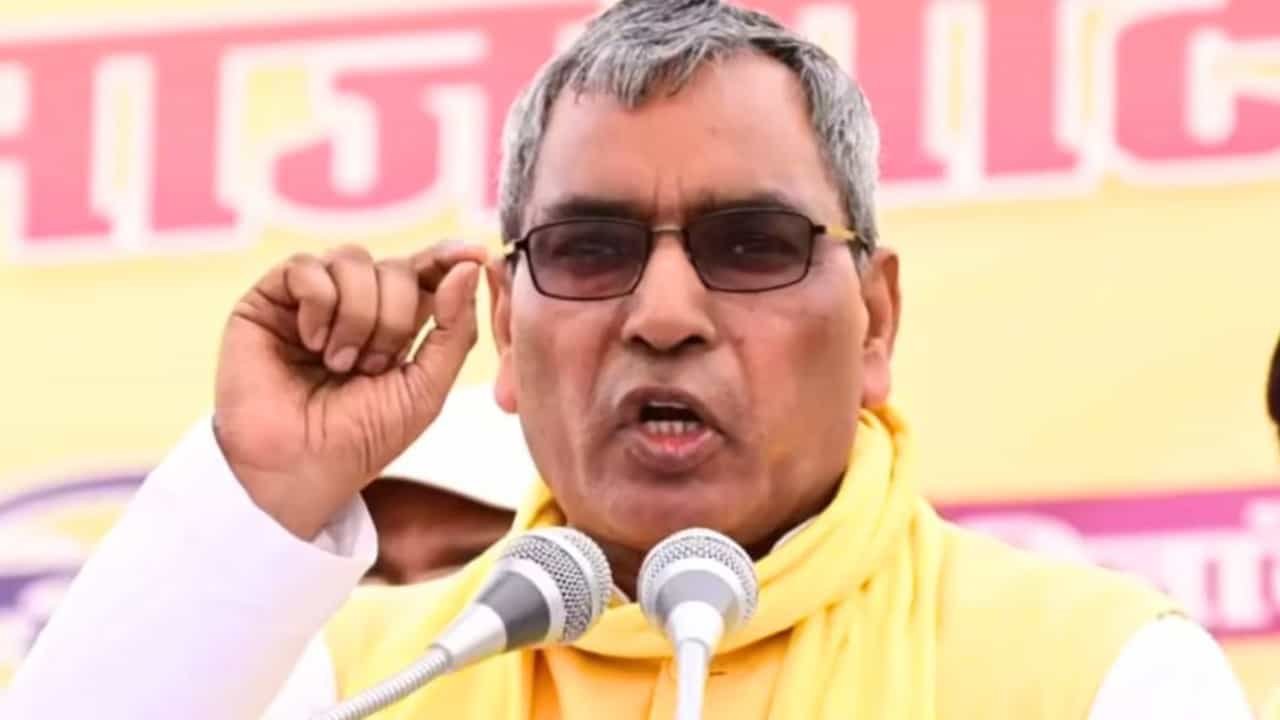
Amidst the excitement of preparations for the 2027 assembly elections in Uttar Pradesh, the phase of political statements has reached its peak. National President of Suheldev Bharatiya Samaj Party (SBSP) and Panchayati Raj and Minority Welfare Cabinet Minister in the Yogi government, Om Prakash Rajbhar, famous for his outspoken and shocking statements, has now left a new political hole regarding the reorganization of the state and sharing of power. Addressing the party’s ‘Social Harmony Conference’ organized in Deoria, the main political center of Purvanchal, Rajbhar claimed that in the coming times, division of Uttar Pradesh into four parts is certain. He roared from the stage and said that the day a separate Purvanchal state is formed, the son of the Rajbhar community will be the first to sit on the chair of its Chief Minister.
While giving a speech in front of a crowd of thousands of workers at the Janta Inter College (Sonughat) ground in Deoria district, Om Prakash Rajbhar made a big statement regarding the geography and administrative structure of Uttar Pradesh. Rajbhar said that for the sake of administrative ease and regional development, division of Uttar Pradesh into four states is certain in the future.
Infusing new enthusiasm among the workers, Rajbhar said that whenever Purvanchal comes into existence as an independent state, the first Chief Minister of that new state will be the son of Rajbhar community. This statement of Rajbhar is being seen as a planned strategy to consolidate the vote bank of his community in Purvanchal politics before the 2027 assembly elections and strengthen his political bargaining power within the NDA alliance.
Not only did the issue of division of the state arise from the forum, but Rajbhar also used his old and most favorite political weapon – ‘share in backward class reservation’. He said that the benefit of 27 percent reservation given to Other Backward Classes (OBC) has been limited to a few selected and strong castes for the last three decades.
Rajbhar, citing the recommendations of the Rohini Commission, demanded that sub-categorisation should be implemented within the 27% OBC reservation, so that extremely backward castes like Rajbhar, Bind, Mallah, Prajapati and Chauhan communities can get direct rights in government jobs and higher education in proportion to their population. Along with this, he said that he has met Prime Minister Narendra Modi regarding conducting caste-wise census in the country and he has received positive assurance. Only after caste census will every deprived class get its real rights and justice.
During the public meeting, Om Prakash Rajbhar vented his anger on Samajwadi Party and Congress. Targeting SP chief Akhilesh Yadav, he said that those who believe that their government is going to be formed, should not remain in Mughal power. Taking a dig at an MP and leaders belonging to SP from his own community, Rajbhar said in a very harsh tone, “Those who ask what Omprakash Rajbhar has done for the society, they should know that you people are not leaders but loaders. You work as laborers at someone’s place and are equated with the owner. Your leader has gone mad.”
Rajbhar reminded the famous Lucknow Guest House scandal of 1995 and the cases of changing the names of Dalit symbols and districts during the SP rule and alleged that SP’s love for Dalits and backward classes is just an election show. He claimed that during the SP government, recovery started as soon as jobs were created, whereas the current BJP government has given more than 9.5 lakh government jobs to the youth with transparency.
The demand to divide Uttar Pradesh into four parts – Purvanchal, Paschimanchal (Green Pradesh), Bundelkhand and Madhyanchal – is not new. In the year 2011, the government of the then Chief Minister Mayawati had passed the proposal to reorganize the state into four parts in the Uttar Pradesh Assembly by voice vote and sent it to the Central Government. However, no concrete decision could be taken on this at the central level and the matter went into abeyance.
Political analysts believe that this statement of Rajbhar is purely an exercise to prepare the election ground. The number of Rajbhar voters is decisive in Ghazipur, Mau, Ballia, Azamgarh, Jaunpur, Varanasi and Deoria districts of Purvanchal. In such a situation, by playing the emotional gamble of ‘Rajbhar’s son will become CM’, OP Rajbhar has hit many targets with one stone – on one hand, he has tried to break the PDA (backward, Dalit, Minority) formula of SP, and on the other hand, he has further strengthened his bargaining position in the alliance. Now it has to be seen what response the BJP and the main opposition party Samajwadi Party take to this new political tune of Rajbhar.