 look news india

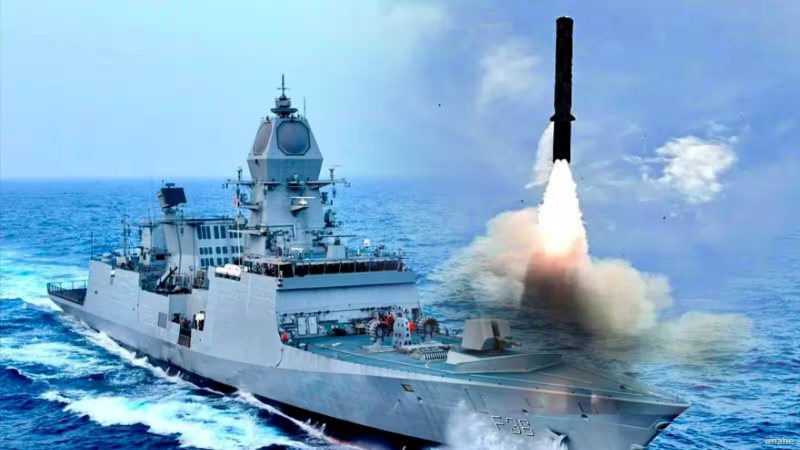
Amidst China’s increasing aggression in the Indo-Pacific region, the strategic relations between India and Japan have reached a new and technologically important juncture. Recently, a detailed report by Japanese defense media and military analysts has claimed that if the Indian Navy includes Japan’s advanced ‘Mogami-class stealth frigate’ in its future fleet and integrates India’s lethal ‘BrahMos’ supersonic cruise missile, then this synergy will make the Indian Navy an unstoppable force in the Indian Ocean and Pacific region.
Japan’s offer to transfer its most advanced naval technology and design of Mogami class frigate to India is being considered as a major strategic shift in the global defense market. The Mogami class frigate is known throughout the world for its unmatched stealth capability (ability to avoid radar), high automation and low crew requirement. On the other hand, India’s BrahMos is among the world’s fastest and accurate supersonic cruise missiles. The confluence of these two technologies can create a warship that will be capable of destroying enemy targets in the blink of an eye from hundreds of kilometers away without coming under the radar.
The Mogami class frigate is a mainstay of the Japan Maritime Self-Defense Force (JMSDF). The biggest feature of this warship is its stealth design, which keeps it hidden from the enemy’s sonar and radar signatures. Apart from this, this warship is equipped with state-of-the-art radar system, mine-sweeping capability and advanced sensor suite. When India’s BrahMos missile, which can attack at a speed of Mach 2.8 to 3, will be deployed on this stealth platform, the balance of naval warfare will tilt completely in favor of India.
Military experts believe that the stealth coverage of Mogami warship along with the speed and firepower of BrahMos missile will prove to be a nightmare for enemy warships and naval fleets. After this integration, the Indian Navy will not only be able to strengthen its hold in the Indian Ocean, but will also be able to establish its presence more effectively in strategic sea routes like the Strait of Malacca and the South China Sea.
Although this combination appears extremely powerful on paper and from a strategic perspective, in practice integrating the BrahMos missile into the Mogami class frigate is no easy task. The Japanese report has also acknowledged that this project faces many major engineering and technical challenges.
-
Huge size and weight of the missile: Japan’s Mogami frigate is primarily designed with its indigenous ‘Type 17’ anti-ship missiles. India’s BrahMos missile is much larger and heavier in size, diameter and weight compared to the Type 17 missile. To fit BrahMos into Mogami’s Vertical Launch System (VLS) or canister launcher, the warship’s internal design and structure (Structural Hull Design) will have to be extensively modified.
-
Weight Balance and Stability: Installing heavy missiles like BrahMos in the upper part of a warship can have an adverse effect on the center of gravity and sea stability of the ship, rebalancing which is a very complex naval engineering task.
-
Software and Fire Control System Integration: Linking the Combat Management System (CMS) of the Japanese warship and the Japanese radar with the fire control system of the BrahMos missile of Indian-Russian origin is a big software and electronics challenge. New protocols will have to be developed to make the systems of both countries run smoothly on the same command network.
Apart from technical problems, some legal and strategic hurdles also stand in the way of this potential defense deal. The Constitution of Japan has strict rules regarding the export of war and defense materials. Although Japan has relaxed its defense export rules (Three Principles on Transfer of Defense Equipment) in recent years, the transfer of lethal weapons and main warships to other countries still remains a point of political debate in Tokyo.
Additionally, the BrahMos missile has been developed by a joint venture between India and Russia (BrahMos Aerospace). It uses Russian technology and components. Given the current global geopolitical scenario, the integration of weapon systems with Russian-origin technology on Japanese platforms could also raise sensitive questions related to security treaties and intellectual property rights (IPR) between Tokyo and Washington.