 look news india

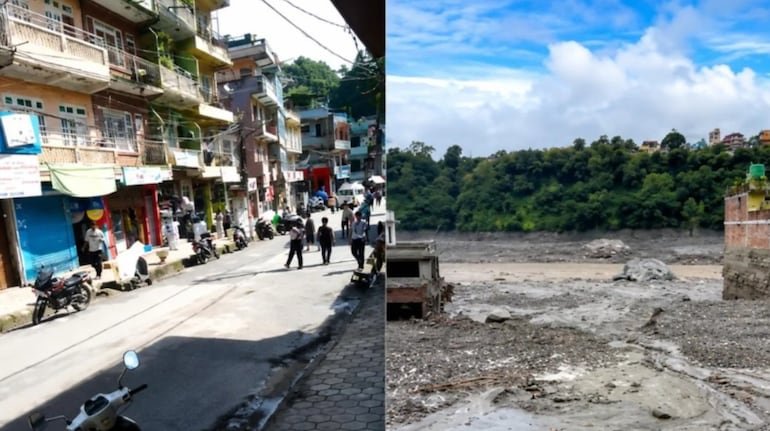
The havoc of nature on the border of Nepal and Tibet is not stopping. Following Wednesday’s massive glacier avalanche and debris flow, the breach of a huge natural barrier lake in the Tibet region has now been confirmed. After this latest development, Nepal’s Water Resources Department, National Disaster Risk Reduction and Management Authority (NDRMMA) and Nepal Police have declared ‘red alert’ in the entire country.
Nepal Police issued an official statement on social media platform ‘X’ saying that the huge water dam and lake located in the Tibetan part has burst once again. Due to this, a large amount of water and silt is moving downstream in the Bhotekoshi, Trishuli and Narayani river basins. The police administration has appealed to the security forces engaged in relief and rescue operations, NDRF teams and common citizens living on the river banks to immediately move to safe and higher places without wasting any time. After the warning, a stampede-like situation has arisen in the coastal areas of sensitive districts like Rasuwa, Nuwakot and Dhading and people are leaving their homes and running towards the mountains.
According to reports from geologists and satellite imagery, the crisis originated at the confluence of ‘Chhochen Khola’ and ‘Purepu Tsangpo’ rivers located in the southern mountainous region of Tibet. Due to the collapse of a huge glacier and mountain rock in the border area, a huge amount of boulders and debris were deposited in the river flow, which took the form of a huge artificial barrier lake (temporary dam).
According to the Ministry of Water Resources of China, more than 20 lakh cubic meters of water had accumulated in this lake and due to continuous rains and melting of glaciers, it was expected to be filled with 30 lakh cubic meters more water within the next three days. Due to heavy water pressure and weak sediment, this lake suddenly broke. China had already issued ‘Level-IV Emergency Alert’ for this. When this giant waterfall broke down, it entered the Nepalese border carrying with it millions of tons of mud, trees and huge rocks.
In view of the seriousness of the situation, the Nepal government has immediately stopped all ground rescue operations being conducted in the affected areas and has instructed the rescue teams to retreat. Nepal Police spokesperson and Chief District Officer (CDO) of Rasuwa Narendra Pariyar said that based on the input received from Chinese authorities, people are being immediately evacuated from the lower areas of the river.
Describing the gravity of the situation, Nepal Police officer P. Choudhary said that the water level is likely to rise suddenly very rapidly, hence all types of road construction and recovery works have been stopped. Heavy machinery, ambulances and vehicles engaged in rescue operations have been recalled to safe depots. Army helicopters from Tribhuvan International Airport and Dhunche base have been sent for aerial recce and aerial surveillance to assess the actual speed of water flow.
The recent deluge in Nepal has already caused severe devastation. Major border trading centers like Rasuwagadhi, Timure, Sayafrubensi and Dhunche adjacent to Tibet have been completely buried under a thick blanket of debris and mud. Many concrete bridges, hydropower tunnels, customs offices and national highways have been washed away in the flood flows.
According to official figures, more than 500 bodies have been recovered so far from various affected districts, out of which the maximum number of bodies have been found from Chitwan, Nawalparasi, Nuwakot, Gorkha and Dhading districts. Additionally, around a thousand people are still reported missing, including Indian pilgrims, foreign trekkers, local security personnel and workers working on hydroelectric projects. At such a time, a second breach of the lake’s dam could prove to be extremely disastrous for the relief operations and the lives of the survivors.
When Bhotekoshi and Trishuli rivers in Nepal meet Kali Gandaki at Devghat, they take the form of the huge ‘Naraini River’, which is called ‘Gandak River’ as soon as it enters India. As soon as the information about breaking of lake in Tibet and heavy water flow in Nepal was received, the administrative system in the border states of India has also been put on alert mode.
District Magistrates of West Champaran, East Champaran, Gopalganj, Siwan and Saran districts of Bihar have been instructed to remain alert. Special water level monitoring system has been activated at Valmiki Nagar Gandak Barrage. If there is a sudden huge uncontrolled discharge from Nepal, a plan has been made to control the excess water by opening all the sluice gates of the barrage so that flash floods do not spread in the low-lying plains of North Bihar. National Disaster Response Force (NDRF) and State Disaster Response Force (SDRF) troops have been asked to remain deployed near sensitive embankments.
According to environmental scientists and geologists, the disaster is a deadly combination of ‘Glacial Lake Outburst Flood’ (GLOF) and sudden landslides in the weak Himalayan terrain. Due to rising temperatures and uncontrolled weather events in the high Himalayan regions, glaciers are melting rapidly and forming unstable moraine-dammed lakes.
When huge avalanches or rock falls occur on these lakes, huge waves of water break the natural dams, causing what is called ‘tsunami-like flooding’. Scientists have warned that there are hundreds of such sensitive lakes in the Himalayan basin bordering India, Nepal and China, for which it is imperative to further strengthen real-time sensors, satellite radar mapping and international hydro-meteorological information sharing mechanisms.
Nepal Disaster Management and District Administration has asked the residents of Trishuli and Bhotekoshi Basin to remain calm and strictly follow the following guidelines:
-
Move away immediately from river banks, low bridges, slips and waterlogged roads and take shelter only in high mountain areas.
-
If the river water suddenly appears very muddy or the flow of water in the river stops for a few moments, then immediately understand that some blockage has broken or is being formed above; In such a situation, run to higher places without any delay.
-
Trust only official police and administrative bulletins and avoid unconfirmed rumors on social media.
-
Always keep important identity cards, medicines, torch and emergency helpline number active with you.
Nepali Army, Armed Police Forces and relief agencies of India are continuously monitoring the situation and high-level monitoring is ongoing.