 look news india

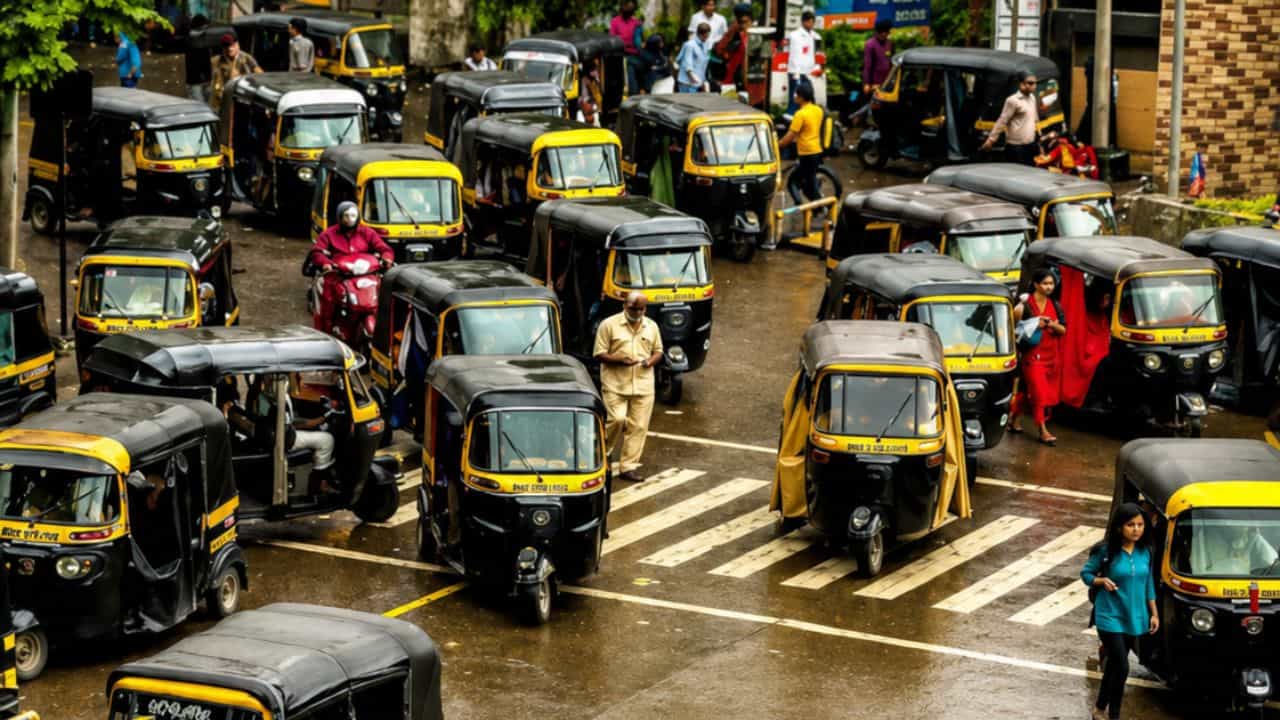
The Maharashtra government has made knowledge of working Marathi mandatory for auto, taxi and Ola-Uber cab drivers. After the deadline of August 15, a strict provision has been made to suspend the license for 3 months and cancel the permit if the rules are not followed. Know what is the opinion of Mumbai drivers on this decision, their concerns about livelihood and the complete reality of the ground report.
A major and policy decision related to the public transport system and livelihood of millions of drivers in Maharashtra has reached the threshold of full implementation. The state government has made it mandatory for all drivers operating auto-rickshaws, black-and-yellow taxis and app-based cabs (Ola, Uber, Rapido) across Maharashtra, including Mumbai, to have working knowledge of Marathi language. State Transport Minister Pratap Sarnaik has made it clear that the August 15 deadline given to non-Marathi speaking drivers to learn Marathi will not be extended. After this decision, a period of confusion, fear and mixed reactions has started among the auto and taxi drivers who transport lakhs of passengers daily on the roads of Mumbai.
Big change in Maharashtra motor vehicle rules: What is the new order of the government?
The Maharashtra government has drafted necessary amendments in the ‘Maharashtra Motor Vehicles Rules, 1989’ to give legal form to this system. After getting the green signal from the Law and Justice Department, its rules have been decided by the Home and Transport Department. Under the new provisions, every driver driving a commercial passenger vehicle in the state must be able to speak, read and understand Marathi at a basic level.
According to the proposed rules, if a driver is found not to have the required working knowledge of Marathi, the licensing authority of the transport department will first issue him a written notice. After receiving the notice, the driver will be given one month time to learn the language and prove his proficiency. If the driver fails to acquire basic knowledge of Marathi within the stipulated period, his driving license authorization may be suspended for a maximum of 3 months. Even after this, if the rules are not followed, strict action will be taken to permanently cancel the license and permit. Not only this, it will be mandatory to pass the Marathi test at the time of renewal of old permit and application for new commercial badge.
Rules will also apply to app-based cab drivers like Ola, Uber and Rapido
Till now, the issue of linguistic rules was mainly considered limited to traditional auto-rickshaws and black-yellow taxis, but this time the state government has widened the scope of the rules and also brought the drivers of digital aggregators i.e. Ola, Uber and Rapido under its ambit. The Transport Department says that for the safety of passengers, easy communication and respect for the local language, it is necessary that the drivers running cabs through mobile apps should also be able to communicate with the passengers in the local language.
Ground report from Mumbai streets: What do taxi and auto drivers think?
There are mixed reactions to this order of the government among the auto and taxi drivers, who are considered the lifeline of Mumbai. There is an intense discussion regarding this decision among the drivers at the auto-taxi stands of Bandra, Andheri, Kurla, Dadar, Thane and Mulund.
A large section of drivers who have been driving taxis in Mumbai for decades accept that while working in any state, one should respect the local language and culture there. Many drivers say that they have been living in Mumbai for years, so they can easily understand the Marathi of the customers and even speak Marathi to tell the fare or the route. However, he also says that by making it mandatory, it is completely unfair to show the threat of severe punishment like cancellation of license and suspension of 3 months.
Drivers say that driving an auto or taxi is not a high administrative post, rather it is a daily wage job which helps in supporting their families. If the license of a poor driver is suspended for 3 months, then the expenses for his children’s education, house rent and medicines for the elderly will be stopped. Drivers demand that the government should focus on incentives and practical training instead of adopting a punitive approach.
“70 to 80% riders speak Hindi themselves”: Drivers’ practical logic
Mumbai drivers have also expressed their views on the practical aspect of this rule. Auto drivers in Andheri and Bandra say that Mumbai is an international metropolis (cosmopolitan city), where people come from all over the country and the world. During daily travel, about 70 to 80 percent of the passengers themselves initiate conversations in Hindi or English.
According to drivers, many times even local Marathi speaking passengers give instructions in Hindi for directions, taking turns or using flyovers. Drivers say, “If the passengers constantly talk to us in Marathi, we will learn it much faster and easier. Language is a medium of communication, it should be promoted through mutual interaction rather than imposing it on anyone.”
Long queues in RTO and loss of daily wages: Ground reality of training center
A special training and verification campaign of Marathi language is being conducted by the Transport Department for drivers in Mumbai Central, Tardeo, Wadala and Andheri RTOs. But at the ground level, drivers are facing many administrative problems. Drivers allege that they have to stand in queues the entire day due to long queues at RTO offices, server glitches and delays in procedures.
One driver said that he misses two to three days of work to attend the training class and get the certificate. Between fuel (CNG) inflation and car EMI (EMI), spending days without earning is costing them financially. Auto unions have demanded that these training camps should be organized at gas stations, auto stands or locally through mobile vans instead of RTO offices so that the work of drivers is not affected.
Government’s stance and training program: What did the Transport Minister say?
The state government says that the objective of this entire campaign is not to snatch away anyone’s livelihood or to harass the drivers, but to identify non-Marathi speaking drivers and train them basicly. The Transport Department is running a 105-day special training program in collaboration with various literary and social organizations. According to the department’s data, so far more than 1.10 lakh non-Marathi speaking commercial drivers have successfully completed this training.
According to Transport Minister Pratap Sarnaik, the government is giving full opportunity and means to the drivers to learn. On August 17, special certificates will also be distributed by Deputy Chief Minister Eknath Shinde to hundreds of drivers who have completed the basic course of Marathi language. The government believes that knowledge of the local language will remove misunderstandings between drivers and passengers and improve tourism and transport services.
Local identity versus livelihood: What will be the middle path?
The issue of Marathi language has always been sensitive and emotional in Maharashtra. While on one hand this step is being said to be necessary to preserve the local language and identity, on the other hand, security of the livelihood of the migrant drivers who come from different states of the country and work as laborers in Mumbai is also a big humanitarian aspect.
Auto-taxi unions are now appealing to the government not to immediately initiate punitive action or confiscate licenses against any driver even after the August 15 deadline passes. Instead, a flexible system should be created in which the drivers working on the road get the opportunity to learn gradually so that both linguistic harmony and employment can be secured without any conflict.