 look news india

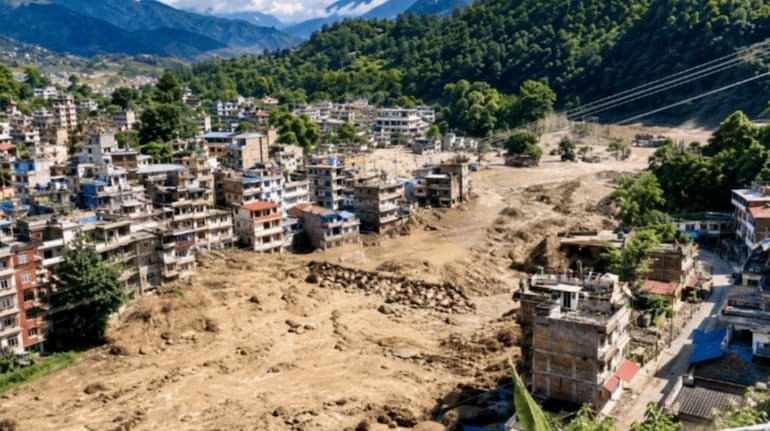
The catastrophic flash floods caused by the bursting of the glacier lake and natural dam on the Tibet-Nepal border have shaken the entire Nepal. The debris and strong flow of water in several districts including Rasuwa, Nuwakot, Dhading and Chitwan have claimed hundreds of lives and devastated the country’s key infrastructure. Now that the water is gradually receding and relief work is going on, the biggest challenge before the country is to get Nepal back on its feet after this disaster.
Amidst this great crisis, Nepal’s only Forbes listed billionaire and well-known industrialist Binod Chaudhary (Chaudhary Group Chairman Binod Chaudhary) has presented a very big and shocking assessment regarding the reconstruction of the country. In an international interview, he said that it would cost a huge amount of at least 5 billion US dollars to rebuild the bridges, roads, power houses and towns destroyed by this devastating flood. He clarified that considering the complex and inaccessible Himalayan terrain of Nepal, this reconstruction process may take several years.
Binod Chaudhary, Chairman of Chaudhary Group (CG Corp Global) said that this disaster is one of the toughest challenges in the history of Nepal not only from the financial point of view, but also from the logistics and engineering point of view. On August 26, the deluge that hit the mountainous China-Nepal border area completely wiped out customs offices, villages, main highways and hydropower projects in no time.
According to Binod Choudhary, this estimate of $5 billion is not based only on direct damage to infrastructure, but also takes into account the time and cost of transporting heavy machinery over Nepal’s difficult mountain roads, stabilizing collapsed geological structures and building climate-resilient infrastructure. He said official figures of deaths and missing were not yet fully available and the actual human and economic loss could be much greater than government estimates.
This latest flood has hit the hydropower sector, considered the backbone of Nepal’s economy, the most deeply. Many major ongoing and under-construction hydropower projects located on the Trishuli and Bhotekoshi river basins are buried under debris and water. Damage to turbines, headworks and transmission lines has resulted in a sudden halt in the generation of hundreds of megawatts of power, threatening to deepen a serious power supply crisis across the country.
Other than this:
-
Road and trade links broken: The ‘Rasuwagadhi-Kerung Highway’, the main trade corridor connecting Nepal to China, has been completely washed away, bringing bilateral trade worth billions of rupees to a standstill.
-
Strategic bridges and tunnels destroyed: Many large motorable bridges made of concrete and iron were washed away like straw in the strong current of water, due to which dozens of remote villages have been completely cut off from the capital Kathmandu.
-
Destruction of private property and schools: Thousands of residential houses, government schools, hospitals and local markets have been reduced to debris, leaving millions of people at risk of homelessness and livelihood.
Before industrialist Binod Chaudhary’s assessment, Nepal Finance Minister Swarnim Wagle had also expressed serious concern about the economic situation of the country. The Finance Minister had warned that the damage caused by the disaster could reach several billion dollars and the initial estimates were extremely worrying.
According to the Nepalese government, it will take at least one to two weeks to prepare a detailed post-disaster needs assessment report. However, it has become clear that Nepal cannot afford reconstruction on such a large scale with its limited domestic revenue and budget. A large portion of the country’s development budget for the current financial year now has to be diverted from development projects to emergency relief and rehabilitation, which will severely impact the overall GDP growth rate.
In view of this humanitarian and infrastructure disaster in Nepal, the global community has started extending a helping hand:
-
US emergency assistance: The United States has officially announced the sending of emergency financial assistance and technical disaster response advisors worth half a million dollars (500,000 USD) for rapid relief operations in Rasuwa and affected districts of Nepal.
-
Activity of the World Health Organization (WHO) and the UN: WHO has sent essential life-saving medicines, medical kits and water purification materials to Nepal to deal with the threat of the pandemic. United Nations (UN) agencies are busy providing food, pure water and temporary shelter to the displaced families.
-
India’s collaboration and engineering opportunities: India’s NDRF teams, medical teams and relief material are continuously reaching the border areas. Additionally, experts believe that India’s leading engineering and EPC companies, such as Larsen & Toubro (L&T), will play a vital role in rebuilding Nepal’s hydropower and infrastructure.
-
Chaudhary Group’s Relief Initiative: Binod Chaudhary’s family foundation ‘Chaudhary Foundation’, in collaboration with the Nepali Army and the local administration, has taken up the task of providing ration kits, medicines, educational materials for children and construction of temporary houses in the affected areas.
Geologists and environmentalists say that due to climate change and uncontrolled hill constructions, incidents of ‘Glacial Lake Outburst Flood’ (GLOF) and flash floods are increasing continuously in the Himalayan region. This $5 billion reconstruction campaign will not be enough to merely rebuild old structures, but will also require state-of-the-art infrastructure that can withstand future threats.
Nepal will now have to work with China and India to create a three-tier real-time early warning system, river basin management and satellite-based lake monitoring network. Unless international financial institutions—such as the World Bank, the Asian Development Bank (ADB) and the International Monetary Fund (IMF)—come forward with soft loans and grants, it will be a long and difficult ordeal for Nepal to get out of this $5 billion reconstruction maze.