 look news india

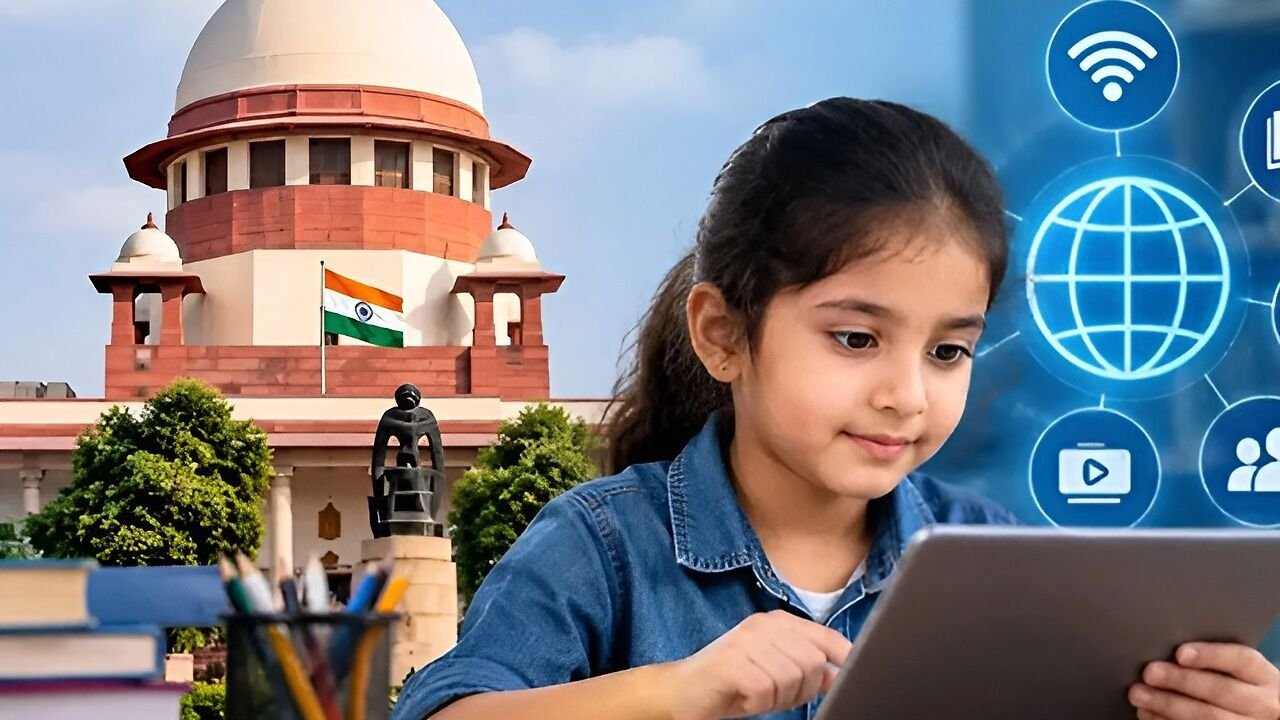
Amidst the growing influence of technology, smartphones and online education in the digital age, the Supreme Court of India has given a historic and far-reaching verdict. The Supreme Court has ruled in clear words that like adults, it is a constitutional fundamental right for children to use the Internet and access information. Justice J.B. Pardiwala and Justice K.V. Vishwanathan’s division bench emphasized that a blanket or blanket ban cannot be imposed on children on the use of the Internet merely on the grounds of fear of safety or screen addiction.
This decision of the court has come at a time when there is a heated debate around the world about controlling children’s screen time, banning social media and accountability of digital intermediaries. A complete ban was being advocated by many state governments and policy makers in the name of protecting children from online threats. But the country’s top court, while striking a balance in the debate of ‘security versus rights’, made it clear that the doors to a child’s knowledge, expression and development cannot be closed in the name of security. Let us understand what important arguments the Supreme Court has given in its decision, under which articles of the Constitution it has been considered a fundamental right and what it means for parents and the government.
The Supreme Court has refused to consider the Internet merely a luxury or a means of entertainment, calling it an integral part of life and dignity. The apex court interpreted this right of children by linking it to three major pillars of the Indian Constitution:
-
Article 19(1)(a) – Freedom of thought and expression: The Court underlined that in the modern democratic society, the Internet has become the primary medium for children to express their views, share art and creativity and gather information from around the world. No citizen can be completely deprived of this digital platform of expression on the basis of his age.
-
Article 21 – Right to life and personal liberty: The right to live a dignified life includes access to modern information systems. The mental and intellectual development of any person, especially the new generation, cannot be imagined without the Internet.
-
Article 21A – Right to Education (RTE): After the Covid pandemic and the implementation of the National Education Policy (NEP 2020), the school curriculum has now become highly dependent on digital portals like DIKSHA, SWAYAM and e-Vidya. In such a situation, if the internet is taken away from a child, it is a direct violation of his right to free and compulsory quality education.
The most important aspect of the decision is to reject the paternalistic thinking of state governments and officials, under which attempts are made to impose complete digital restrictions in the name of the well-being of children.
The bench clarified that:
-
Principle of Proportionality: Any policy measure must pass the test of proportionality to meet the constitutional test. If the disease is caused by mosquitoes, the entire house cannot be set on fire. Similarly, if some harmful content is present on the Internet, then imposing a blanket ban on the use of the entire Internet is unconstitutional and unreasonable.
-
Threat of digital divide: If state governments impose harsh and arbitrary restrictions on screen-time or internet usage, it will have the worst impact on poor and deprived children. Affluent families have other resources, but for children from weaker sections, affordable internet is the only way to learn, learn coding, prepare for competitive exams and access government scholarship portals.
The Supreme Court also made it completely clear that giving children the right to the Internet does not mean that they should be left in uncontrolled and unsafe cyber space. Along with granting the rights, the court has given very strict directions to the technology platforms and the Central Government to protect children from cyber bullying, grooming, online fraud and most seriously Child Sexual Abuse Material (CSEAM):
-
Strong Safety Filter Mandatory: Social media companies, tech giants (Google, Meta etc.) and internet service providers have been directed to mandate high-grade safety filters and parental control tools on children’s accounts by default.
-
National Database and Quick Action: It has been asked to establish a strong national CSEAM database under strict compliance of POCSO and IT Act and strengthen the legal system for immediate take-down of content that is harmful to children.
-
Ban on behavioral tracking: The need to strictly enforce restrictions on tracking the behavior of children under 18 (Targeted Advertising/Behavioral Profiling) under Digital Personal Data Protection (DPDP) rules was reiterated.
| Legal and practical dimensions | Previous position/conservative view | After the Supreme Court decision (new law) |
| Children’s Digital Rights | Privilege dependent on favor of parents or state | Statutory fundamental rights under Articles 19(1)(a), 21 and 21A |
| Screen-time and internet restrictions | Attempt to impose blanket ban through government orders | Complete ban unconstitutional; Only proportionate security measures are valid |
| Relationship between education and internet | Only books were considered an essential part of education. | Digital platforms and research considered an integral part of the right to education |
| Role of Internet Intermediaries | Removing content only when reported | Strict proactive monitoring, algorithmic security and legal accountability fixed |
| Digital Equality (Digital Inclusion) | Limited opportunities for rural and poor children | Duty of the state to provide safe and equal digital access to all children |
This decision of the Supreme Court has presented a very practical approach to parents and schools. Now children cannot be kept safe by scaring them from the digital world or by snatching away their smartphones. The solution does not lie in ‘Prohibition’, but in ‘Empowerment and Awareness’ (Digital Literacy & Empowerment):
-
Teach Digital Hygiene: Schools and families need to teach children which websites are safe, why not to share personal information with strangers and how to deal with the mental pressure of social media.
-
Communicate, don’t spy: Instead of excessively spying on children, maintain open communication with them so that they can seek help from parents without hesitation if they encounter any uncomfortable experiences on the Internet (such as cyberbullying or inappropriate messages).
-
Promote positive use: Internet in the hands of children should not just mean watching reels or playing games. They should be inspired to code, learn new languages, create science projects and explore world encyclopedias.
This decision of the Supreme Court is a progressive step taken keeping in mind the future of 21st century India. This makes it clear that the children of India are not just citizens of the future, but the rights holders of the present who cannot be thrown out of the ocean of knowledge of the digital world just because some waves in that ocean are dangerous. It is the job of the government and tech companies to provide a safe environment, but keeping the windows of knowledge open is the unbreakable resolve of the Constitution.