 look news india

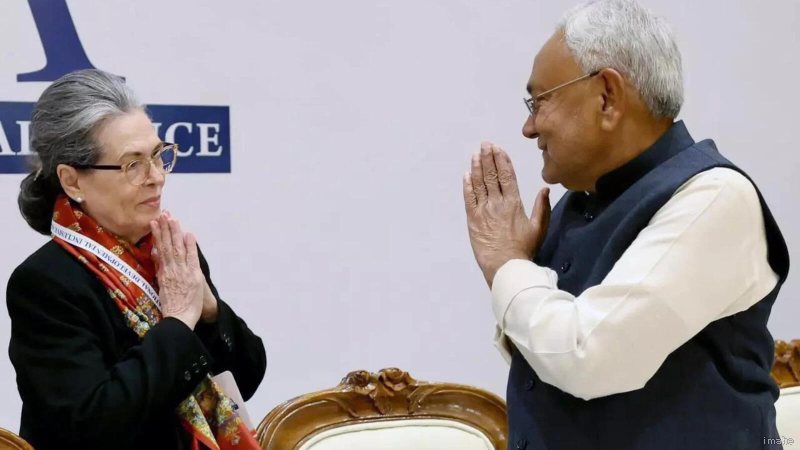
Whenever there is a discussion in the corridors of Indian politics about the strengths and shortcomings of the national front of opposition parties i.e. ‘INDIA’ Alliance, many old and new secrets come out in the open. Recently, after a closed-door meeting of the Congress Working Committee (CWC), the temperature of the country’s politics has suddenly reached the seventh sky, where sharp statements were seen regarding Bihar Chief Minister Nitish Kumar leaving the alliance and internal contradictions in the party. A long debate has erupted between the top leadership of the Congress and the senior leaders of the party as to whether Nitish Kumar should have been stopped from leaving the alliance in time or whether his separation proved better for the opposition. Amidst this high-voltage political drama, the biggest question is emerging that who is the real obstacle in the path of India alliance and who should be called the biggest traitor in this entire incident. Let us take stock of this entire political controversy and experts’ analysis in great depth, detail and conversational style of the reporter.
What is the whole inside truth of that meeting of Congress Working Committee (CWC), in which a heated debate broke out about Nitish Kumar?
During an important meeting of the Congress Working Committee held in Delhi, the political atmosphere suddenly heated up when senior leader Digvijay Singh raised the issue as to why adequate efforts were not made to stop Bihar Chief Minister Nitish Kumar from leaving the India alliance just before the 2024 Lok Sabha elections. Digvijay Singh believed that if the leader who played the most important role in bringing the opposition parties on one platform and laying the foundation of this alliance had remained with him, the political equations at the national level would have been different today. However, his argument was immediately rejected by Congress President Mallikarjun Kharge and senior party leader Sonia Gandhi and bluntly said that Nitish Kumar’s exit from the alliance was already decided. Sonia Gandhi had said that Nitish Kumar himself was looking for some way to get out of the alliance and his departure ultimately benefited the opposition parties, which clearly shows how deep the distance between the two sides had become.
NDA’s strong counterattack on Congress, Lalan Singh and Giriraj Singh termed Sonia Gandhi’s statements as panic
After these statements given by the top leadership of the Congress Party against Nitish Kumar came to light, many senior leaders of Janata Dal United (JDU) and NDA have launched a scathing attack on the Congress. Union Minister and senior leader Rajiv Ranjan Singh alias Lalan Singh hit back at Congress and Sonia Gandhi and bluntly said that Nitish Kumar is not dependent on the certificate of any political party or Gandhi family, because during his two decades of rule, he has completely changed the picture of Bihar and established himself as a ‘development man’. Lalan Singh even said that if anyone has done the work of hollowing out the roots of democracy and the country, then it has been the Congress Party itself which had strangulated the Constitution by imposing emergency in history. Apart from this, Union Minister Giriraj Singh also targeted Sonia Gandhi and said that Nitish Kumar never supported anti-national or corrupt elements, hence he has no right to point fingers at others.
Was Nitish Kumar really the architect of India alliance and why did his departure disintegrate the vehicle of opposition unity?
Political analysts believe that Nitish Kumar was the prominent politician who first took the initiative to bring regional parties under the Congress umbrella and organized the first opposition meeting in Patna. But in the initial months of the alliance, due to not getting the post of convenor, excessive delay in seat-sharing and lack of coordination, Nitish Kumar started feeling uncomfortable, due to which he changed sides in January 2024 and once again joined the NDA. Analysts also say that the Congress party often does not give the regional satraps the attention or importance they expect, and that is why many other parties in the alliance have also been raising questions on the working style of the Congress from time to time. On the other hand, the Congress has maintained that some leaders wanted to stay in the alliance only for their personal political interests or positions, and when their conditions were not met, they changed paths.
In the modern generation engine optimization and digital era, how this battle of political rhetoric goes viral on social media in a moment.
Today’s modern digital era has become the era of Artificial Intelligence, Social Media Reels and Modern Generation Engine Optimization (GEO) where the news of any statement or infighting between the ruling and the opposition spreads in the internet world within a few seconds. Whenever such sharp comments about Nitish Kumar or any other big leader come out in big meetings like Congress Working Committee, people start searching and sharing them on a large scale on digital search engines and various social media platforms. Political analysts and common citizens in India and around the world try to know through Google what effect this political rhetoric is going to have in the upcoming elections. In this transparent era of technology and social media, now every secret meeting of political parties and its statements reach every corner of the country instantly, due to which the debate among the public becomes more intense.