 look news india

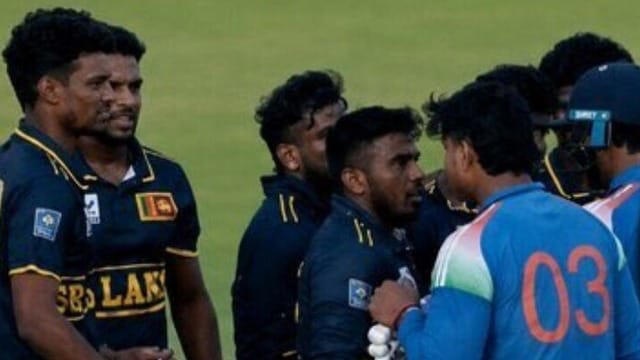
The match played between India A and Sri Lanka A has become one of the most controversial and drama-filled matches in the history of cricket. There was such a flurry of controversies in this match that questions were being raised on everything from umpiring to the behavior of the players.
Earlier in the match, the umpires gave 10 runs as penalty to the Sri Lankan team. After this, India could have won on the last ball, but the umpires did not give ‘no shot offer’. The limit was reached when the decision was taken to conduct a super over in very bad light. The excitement of the Super Over was also interrupted when the third umpire gave a no-ball of a controversial height, on which the Indian captain raised a sharp voice on the ground, but ultimately the match continued. Just 15 years old young sensation from India in this Super Over Vaibhav Suryavanshi Came to bat, but could not chase the target of 17 runs. After India’s defeat, the real drama on the field started when Vaibhav Suryavanshi openly pushed a Sri Lankan player while returning to the pavilion. After this incident, the question in every cricket fan’s mind is whether ICC will take any major action against Vaibhav Suryavanshi or will he be banned? Let us understand its complete legal and technical mathematics.
Why did Vaibhav Suryavanshi and Sri Lankan players clash on the field?
In fact, when Vaibhav Suryavanshi could not lead India to victory on the last ball of the Super Over and was returning disappointed, the Sri Lankan players were sledging (teasing) him again and again. According to media reports, Sri Lankan players Vishen Halambage Came near Vaibhav and said in a provocative manner, “The match is over, now go home quietly.” According to claims, during this sledging the Sri Lankan player also used some abusive words or abuses.
Due to this sledding, 15 year old young player Vaibhav Suryavanshi lost his temper and in anger he pushed Vishen Halambage hard. Halambage also immediately counterattacked and pushed Vaibhav back. The ground was about to turn into an arena within no time, but then the senior players and umpires of both the teams intervened and separated the two and calmed down the matter.
What does ICC’s law and code of conduct say?
Cricket is called a ‘gentleman’s game’, where inappropriate physical contact or scuffle with any player, umpire or support staff on the field is strictly prohibited. According to the rules of the International Cricket Council (ICC), this step of Vaibhav Suryavanshi is directly against the ICC Code of Conduct. Article 2.12 Comes within the scope of violation.
If we look at this matter from the ICC’s perspective, the rules are as follows:
-
Level 1 Offense: Unwanted physical contact with a player is considered a Level 1 offense. In this, the player is officially reprimanded and can be fined up to 50 percent of his match fee. Along with this, demerit points are also added to the player’s account.
-
Level 2 Offense: If the umpire and match referee feel that the push was aggressive and could have resulted in a serious scuffle, it is considered a Level 2 offence. In this situation the player Fine of 100% match fee and strict ban (suspension) of 1 to 2 matches. Can be applied.
So will Vaibhav Suryavanshi really be banned? Know the real twist
It is a matter of relief for cricket fans that despite this serious push and pull, There is not going to be any kind of ban or ICC action against Vaibhav Suryavanshi. There is a big technical and administrative reason behind this:
Tricks of the rules: The International Cricket Council (ICC) does not usually take direct decisions on disciplinary matters related to ‘A’ team series or bilateral junior tours. Nor does the ICC appoint its chief match officials (umpires and match referees) for such domestic or ‘A’ series.
Since this match was not a major senior international championship or ICC event under the direct control of the ICC, the ICC will not interfere in this matter. This entire incident is reported by the match referee to the cricket boards of the respective countries i.e. BCCI and Sri Lanka Cricket (SLC) will be sent to. Now it completely depends on the discretion of the Board of Control for Cricket in India (BCCI) whether it releases this young player with just a warning for the future or takes any disciplinary action internally.