 look news india

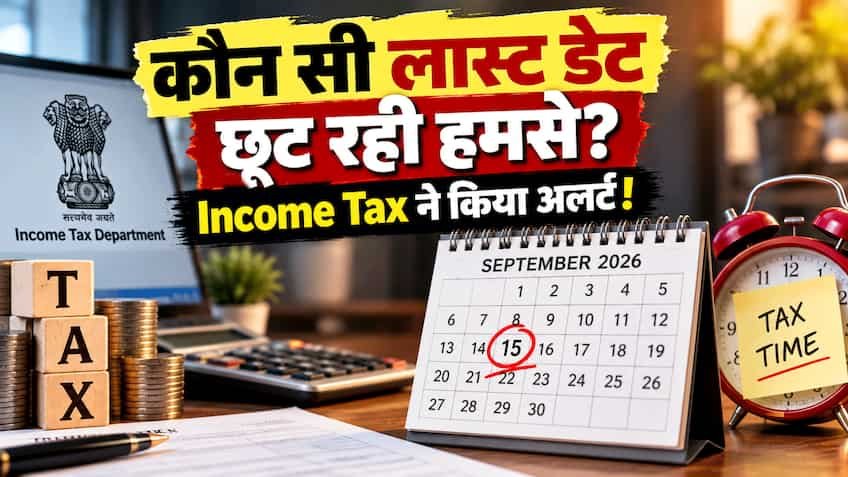
The Income Tax Department has issued an extremely urgent and time-sensitive alert for crores of taxpayers across the country. While sharing the post on its official social media handle ‘X’ (formerly Twitter), the department has written in clear words – ‘Just one day left!’ (Only 1 Day Left). This immediate warning is not about any ordinary Income Tax Return (ITR), but about the last date for depositing the second installment of ‘Advance Tax’ for the current financial year i.e. September 15. If you do not assess your tax liability in time and make this payment, the department will charge heavy interest and penal charges as per the rules. This is the time to be extremely cautious for businessmen, freelancers and salaried employees with additional income doing business in Uttar Pradesh’s capital Lucknow, Kanpur, Noida, Ghaziabad, Varanasi and big cities like Delhi-NCR, Mumbai and Bengaluru. It is both legally and financially necessary to complete this task before 11:59 pm tonight.
If understood in simple language, the principle of advance tax works on the concept of ‘Pay as you earn’. As per the provisions of the Income Tax Act, if the total estimated net tax liability (after deducting TDS/TCS and other tax exemptions) of an individual or business entity in a financial year amounts to Rs 10,000 or more, he or she is required to pay tax in advance in installments to the government without waiting for the end of the entire year. This rule is not only for big corporates or companies. Its scope includes proprietorship firms, partnership firms, LLPs, doctors, lawyers, chartered accountants, consultants, YouTubers, digital creators, real estate traders and all those employed people who have significant income from sources other than salary. Many people think that if the company is deducting TDS from their salary then they are not concerned about advance tax, whereas this misunderstanding later becomes the reason for notice from the Income Tax Department.
As per the advance tax calendar prescribed by the Income Tax Department, the tax liability of the entire year is divided into four fixed quarters. The first milestone for standard taxpayers was June 15, when it was mandatory to pay at least 15 percent of the total tax. Now September 15 is the historic date by which the taxpayer should deposit 45 percent of his cumulative estimated tax liability for the entire year in the government treasury. For example, if a taxpayer’s net tax liability for the entire financial year is Rs 1,00,000, then a total advance tax of Rs 45,000 should be deposited in his account by September 15. If he had deposited Rs 15,000 on June 15, he will have to pay the remaining Rs 30,000 in this second instalment. After this, the third milestone will be 15th December (in which payment up to 75% is mandatory) and the last and fourth milestone will be 15th March (in which it is mandatory to pay 100% of the tax liability).
If a taxpayer ignores this important deadline of September 15 or deposits less than 45 percent of the prescribed amount, then penal interest under Section 234C of the Income Tax Act becomes applicable. Under Section 234C, interest is charged at the rate of 1 percent per month (i.e. 3 percent straight for a three-month quarter) on the outstanding or short deposited amount. However, a small relaxation has been provided in the law that if the taxpayer has deposited at least 36 per cent of his total liability by September 15, then the interest under Section 234C for that particular quarter can be waived; But as soon as it falls below 36%, the interest meter starts working on the difference of 45%. Apart from this, if 90 percent of the total tax payable is not deposited as advance tax during the entire financial year, then from April 1 next year, an additional interest of 1 percent monthly under Section 234B also starts getting added, due to which your hard-earned money gets unnecessarily deducted in fine.
The biggest myth among salaried employees is that their employer is already deducting TDS as per Form-16, hence they do not need to worry about advance tax. But at present, the income of most middle class working people is not limited to salary only. If you have made a fixed deposit (FD) in banks or post office and are getting huge interest from it, or you are getting rental income from your house or shop, then it is important to consider it. Additionally, your company does not deduct TDS on income from the stock market, dividends from mutual funds, short-term or long-term capital gains, or additional income from side businesses and freelancing. When all these income sources are combined and the tax payable to the government even after deducting TDS comes out to be more than Rs 10,000, then it becomes mandatory for salaried employees to deposit 45 per cent advance tax by September 15 today.
In this stringent law, a huge and humanitarian relief has been given to senior citizens. Under Section 207 of the Income Tax Act, Indian resident senior citizens who are 60 years of age or above and do not have any income from any business or profession are completely exempted from the obligation to pay advance tax. Irrespective of their income from pension, bank interest or rental, they can deposit their entire tax without any penalty while filing regular ITR at the end of the year. Whereas for small traders and professionals, who opt for the presumptive taxation scheme under section 44AD or 44ADA, they do not need to pay installments four times a year; They can directly deposit 100 percent advance tax in lump sum on March 15. Tax experts recommend checking your Form 26AS, AIS and TIS today, making a rough calculation of your estimated income and generating the challan without any delay.
Now paying advance tax has become very easy and quick under Digital India. For this you do not need to go to any bank branch or stand in line.
First of all the official e-filing portal of Income Tax Department incometax.gov.in Go to.
Given in the Quick Links section on the homepage ‘e-Pay Tax’ Click on Options.
Enter your PAN number twice and complete the verification through OTP by entering the registered mobile number.
appearing on the screen after verification ‘Income Tax’ Click on the ‘Proceed’ button below the box.
It is very important to select the correct assessment year on the next page; Select the correct assessment year for the current financial year.
After this, from the dropdown menu in ‘Type of Payment (Minor Head)’ ‘Advance Tax (100)’ Select the option.
Different columns of tax (tax, cess, surcharge) will open on the screen; Enter your calculated tax amount there and click on ‘Continue’.
For payment, use Net Banking, Debit Card, RTGS/NEFT or as per your convenience. UPI Select the option.
As soon as the payment is successful, ‘Challan Receipt’ will appear on the screen, in which BSR code and challan number will be entered. Download the PDF copy of this receipt safely for future reference and ITR filing.