 look news india

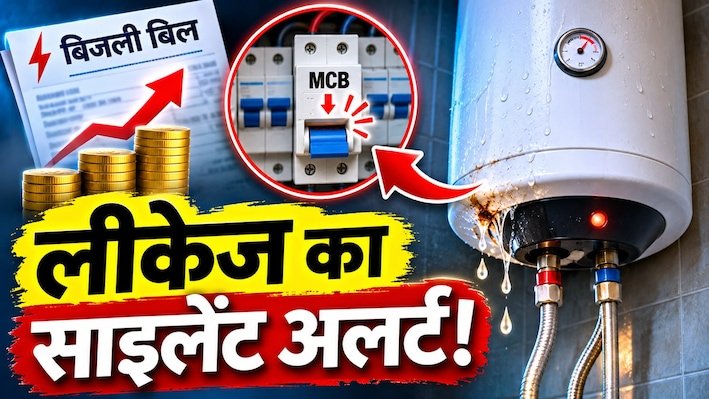
As soon as the severe cold starts, from the time you open your eyes in the morning till you sleep at night, the bathroom geyser becomes the most important companion of every house. But as the work pressure on geysers increases in winter, the same problem starts appearing again and again in many houses. As the water gets heated, the bathroom lights suddenly go off and the breaker of the main distribution board (DB Box) falls down. Most people think it’s a minor voltage problem and turn the breaker back up, but this is where the real trouble and risk begins. Most of the cases of electrical faults during winter in cities like Delhi, Lucknow, Noida, Kanpur and Jaipur are due to this negligence. If your geyser is tripping frequently, there could be a bigger culprit behind it, like a faulty heating element, scaling from salt water, or weak wiring. Identifying this problem in time not only prevents serious accidents like electrocution in the bathroom, but also prevents the burden of additional electricity bills on your pocket.
There are usually two types of safety switches installed in the electricity boards of our homes, which people often consider to be the same. The first is MCB (Miniature Circuit Breaker), which cuts the supply when the electrical load in the circuit exceeds the prescribed limit or there is a short circuit. The second device is RCCB (Residual Current Circuit Breaker), which is also seen in old houses as ELCB. The main function of RCCB is to catch earth leakage, because this leakage becomes the biggest reason for electric shock in a wet bathroom. RCCB is slightly wider in size than MCB and also has a test button written ‘T’ on it for testing. When you know in advance which breaker has tripped, half the problem is caught there. This saves time when the electrician comes and completes the repair in a single visit, which also avoids the expense of paying service charges again and again.
If RCCB is falling in your house, then this is the most common complaint of geyser and it directly means leaking current. Due to hard water i.e. salt water, white mineral layer (scaling) accumulates on the heating element, due to which gradually the outer protective layer of the element starts melting or bursting and the current starts reaching the water and metal tank. Apart from this, RCCB gets tripped due to water dripping from the pipe joint, steam freezing or water splashing while washing the bathroom reaching the thermostat and switches. Many times the insulation of the old cable gets stuck to the hot body of the geyser and gets worn out. If the RCCB falls after a few minutes of switching on the geyser, it is possible that the heating element may expand due to heating and then leakage may start. On the other hand, if the MCB is falling it means that the circuit is being overloaded. A 2 kilowatt (2kW) geyser draws approximately 9 amps of current and a 3 kW geyser draws approximately 13 amps of current, for which it is mandatory to have a separate MCB of at least 16A or 20A and a power socket of 16A. If a room heater or washing machine is also running on the same line, or the plug pin is loose and burnt, then the MCB falls immediately.
Geyser tops the list of most electricity consuming appliances in the house. For example, if a 2kW geyser runs only for one hour daily, it consumes about 60 units of electricity in a month. At the rate of around Rs 7 per unit, the monthly expense for the geyser alone comes to around Rs 420. Now imagine that if a thick layer of lime has accumulated on the heating element or it has become old, then the speed of heat reaching the water slows down. In such a situation, the geyser has to run 20 to 25 percent longer to heat the water to the same temperature, which leads to an additional bill of Rs 80 to 100 every month and more than Rs 1,000 in the entire winter. If the thermostat of the geyser does not auto-cut on time, then it keeps boiling the already hot water again and again and the wastage of electricity increases manifold.
It is always a beneficial deal to get any technical problem rectified in the beginning. In the market, a new heating element or thermostat for geysers of popular brands like Racold, AO Smith, Bajaj, Havells, Crompton and V-Guard is usually easily available for between Rs 400 to Rs 1,500, on which there is a separate service charge. It is even less expensive to tighten loose wires or replace a burnt 16 amp socket.
If this problem is ignored, a leaking element can accelerate the corrosion process inside the tank. Once the main tank starts leaking, its repair becomes impossible and you are forced to buy a new geyser by spending Rs 5,000 to Rs 15,000 or more. Keep in mind that if your geyser is under warranty period, the element is replaced free of cost by the company, so check the warranty card before calling a private mechanic.
Before calling a mechanic, turn off the wall switch of the geyser and reset the breaker; If the rest of the electricity in the house works normally, then the fault is in the geyser line only. Switch off the main supply and check for black marks of burning or water dripping on the plugs and sockets, but for safety reasons, never open the inner lid of the geyser yourself as there may be pressure of hot water in the tank and current in the wires. Also, to save energy on a daily basis, set the thermostat to 50 to 55 degrees Celsius instead of the maximum, get de-scaling done once a year in salt water areas and turn off the switch as soon as the water gets hot. If you are thinking of replacing your old geyser with a new one, always choose a model with 5-star BEE rating.