 look news india

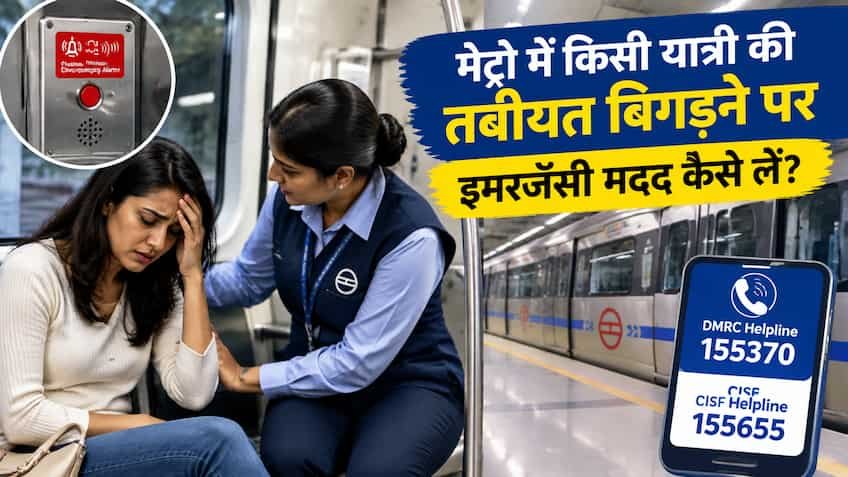
Every day lakhs of passengers travel by Delhi Metro (DMRC), which is called the lifeline of Delhi-NCR. Be it the busiest interchange stations like Rajiv Chowk, Kashmiri Gate or the long distance of Noida-Gurgaon route, many times during the journey, the health of the passengers suddenly deteriorates due to crowd, dehydration, low blood pressure or any chronic disease. In many cases, passengers become dizzy and fall or develop serious conditions like difficulty in breathing. At such moments, co-passengers present nearby often get nervous as to how to seek help inside the moving train. The reality is that the security and relief system of Delhi Metro is completely hi-tech. Strict protocols have been put in place to provide immediate medical support from inside the coach to the platform, as long as passengers know when and how to press the right button.
If you are inside a train carriage and a passenger traveling with you needs immediate medical help, the quickest and most direct way is to call the ‘Passenger Emergency Alarm’ or ‘Passenger Emergency Communication Unit’ (PEB/PECU). Every metro coach has this red emergency button or push-to-talk mic installed right next to the doors.
-
How to call: By pressing this button, two-way voice communication starts directly with the train operator (loco pilot).
-
What information to give: After pressing the button, tell the loco pilot in a clear voice on the mic which coach you are in and what is the condition of the patient (like unconsciousness, chest pain etc.).
-
Train will not stop, medical staff will be ready at the next station: Many passengers have a misconception that by pressing the alarm the train will stop suddenly in the middle of the tunnel or elevated track. This does not happen at all. The driver immediately flashes the emergency message to the Station Controller (SC) of the next approaching station. As soon as the train stops at the platform of the next station, there are already wheelchairs, first-aid kits and CISF security personnel ready at the door, who immediately take the patient out and provide first aid.
If you are unable to reach the call button inside the coach or face any trouble on the platform and station premises, the official helpline number of DMRC works round the clock:
-
Delhi Metro 24×7 Helpline Number: 155370 (This toll-free number connects instantly to any mobile or landline network).
-
Women Helpline Number: 011-23415440 (Special line for any emergency or medical assistance of women passengers).
-
Security Control Helpline (CISF Control Room): 155655 (For safety and quick rescue on platform or station).
As soon as you call the helpline, the control room executive notes down your current location, metro line (Red, Yellow, Blue, etc.) and train direction and tracks it through GPS and activates the Quick Response Team (QRT) of the nearest station.
When a sick passenger is deboarded from a train at a station, there are several levels of arrangements for immediate relief. The ‘Station Control Room’ (SCR) of every metro station is always stocked with basic first aid kits, glucose, pain-relief and BP checking instruments. Station staff and CISF personnel are given special training in providing emergency CPR and basic life support. If the condition of the patient is critical, the station controller without wasting a minute calls the government CATS ambulance (102/108) or the ambulance of the nearest private hospital. Every major station of Delhi Metro is in tie-up with its nearest government or big private hospitals, so that in case of serious condition, the patient can be transported to the ICU or emergency ward without any delay within the golden hour.
If a passenger’s health deteriorates before your eyes, it is important to take some precautions as a conscious citizen:
-
Do not crowd around the patient: Metro coaches already have a fixed ventilation flow of AC and oxygen. Do not stand in a circle around the patient, so that he continues to get fresh air.
-
Lay the patient down: If the passenger is feeling dizzy or faint, make him lie straight on the seat and raise his legs slightly, so that blood circulation can become smooth to the brain.
-
Do not give water without thinking: If the patient is completely unconscious, do not make the mistake of forcibly putting water or medicine in his mouth, because this can cause water to enter the respiratory tract.
-
Avoid making videos on social media: Often people in such situations take out their phones and start making videos. Instead first go ahead and press the PEB button or immediately inform the system by calling 155370. This one quick step of yours can save a person’s life.