 look news india

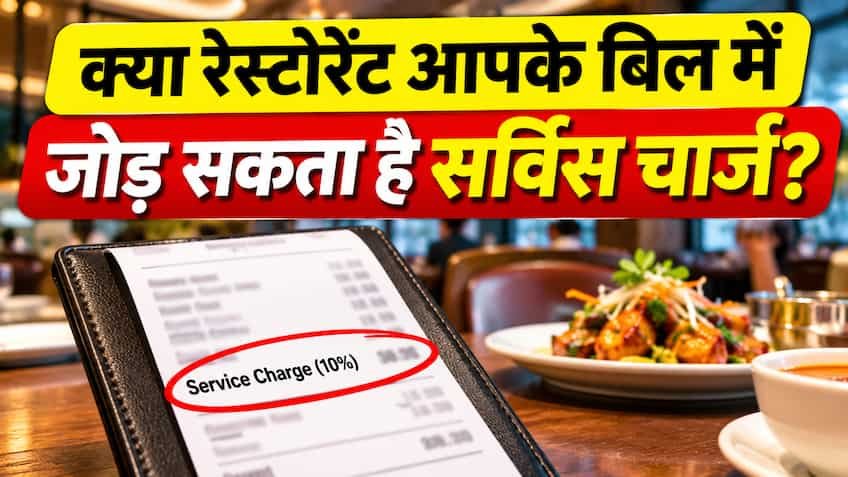
Whether having dinner with family on weekends or celebrating a special occasion with friends, going to hotels and restaurants has become a common thing these days. But often after a sumptuous meal, when the waiter hands over the bill, even the best of the best are shocked to see the total amount. The biggest reason for this is the ‘Service Charge’ of 5 percent to 15 percent added on top of the price of food. Most customers do not know whether paying this fee is mandatory or completely voluntary. Many times people consider it as government tax and pay it silently, whereas the truth is completely different from this. Under Indian consumer laws, automatically adding service charge to the bill without the express consent of any customer completely amounts to unfair trade practice. If you understand your consumer rights properly, you can not only save your hard-earned money but can also teach a lesson to the arbitrary restaurant operators.
The Central Government and the Central Consumer Protection Authority (CCPA) have issued very clear guidelines to curb arbitrary charging by restaurants and hotels. As per the rules, no hotel or restaurant can add service charge to the food bill by default or automatically. If any establishment tries to collect this amount under any other name or hidden charges, it will be considered a violation of the law. Apart from this, the restaurant operator cannot force any customer to pay service charge nor can any customer be prevented from entering the restaurant or providing services for refusing to pay this charge. Most importantly, Goods and Services Tax (GST) cannot be levied on the service charge in the restaurant bill by including it in the total amount. The service charge depends entirely on the customer’s wishes, just like the tip given to a waiter. If the customer likes the service, he can give any amount as per his wish, but no pressure can be put on him for this.
Often common customers get entangled in the words written on the bill and consider the service charge to be a government tax. It is very important to remove this confusion because there is a world of difference between the two. Goods and Services Tax (GST) is a mandatory government tax, which goes directly to the treasury of the Government of India and State Governments. As per current rules, only 5 per cent GST is applicable on food bills in normal non-AC and AC restaurants, which includes 2.5 per cent CGST and 2.5 per cent SGST. On the contrary, service charge is not a government tax, but it is a private fee collected by the restaurant management in the name of giving tip or bonus to its employees. Not a single rupee of this money goes to the government, rather it goes directly into the pocket of the restaurant owner. Therefore, while paying the bill, always check that you are being charged only legally valid GST and not any unnecessary service charge.
From the big metros of the country to the rapidly emerging Tier-2 cities, cases of disputes regarding restaurant bills are continuously coming to the fore. Complaints have been lodged against famous cafes and fine-dining restaurants in Delhi-NCR, Mumbai, Bengaluru, Pune, Kolkata and Hyderabad as well as Uttar Pradesh capital Lucknow, Kanpur, Noida, Ghaziabad and Varanasi for charging service charge of up to 10 percent from customers. Many establishments write in very small letters at the bottom of their menu cards that 10 percent service charge is applicable and then argue with customers on this basis. Consumer affairs experts say that merely writing it on the menu card does not make any illegal collection legal. It is completely wrong in the eyes of law to add additional charges to the bill without the express oral or written consent of the customer.
If you eat at a restaurant and there is already a service charge added to your bill, then instead of panicking or fighting, act calmly and wisely. First of all, call the restaurant manager or waiter and politely ask to remove the service charge from the bill. Tell them clearly that you do not want to pay this fee voluntarily and as per the rules it is voluntary. If the manager refuses to listen to you or argues, take a clear photo of the bill with your mobile phone, clearly showing the name of the restaurant, GST number and the service charge added. After this, if you are left with no option, register your protest on the bill or on the digital receipt while making the payment and immediately register your complaint by calling the National Consumer Helpline (NCH) toll-free number 1915. You can also lodge a complaint online by uploading a photo of the bill while sitting at home through ‘NACH’ mobile app or by visiting the official website of the Ministry of Consumer Affairs, consumerhelpline.gov.in. If found guilty, a heavy fine can be imposed on the restaurant concerned and action can even be taken to cancel its license.