 look news india

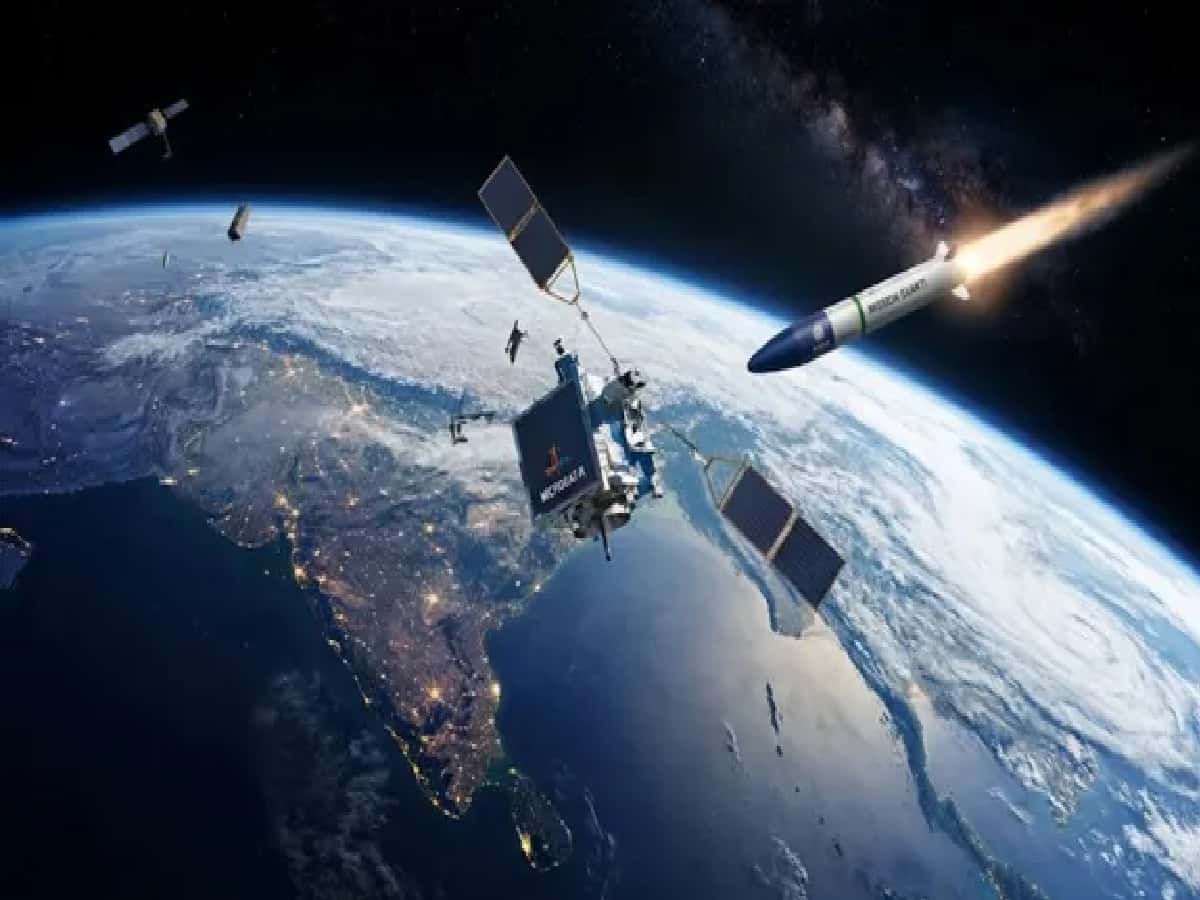
The long-running strategic tug-of-war between the global superpowers has now crossed the boundaries of the earth and reached the vacuum of space. The most dangerous and decisive front of the modern battlefield of the 21st century has now become low Earth orbit. Recently, there has been a sensation in the entire international defense world after the United States officially admitted that it has deployed space control weapons in an operational state in the Earth’s orbit. Since the Cold War era, satellites have been used primarily only for surveillance, espionage, communications, meteorology and guidance systems. The presence of military equipment outside the atmosphere was not new, but it was a first in history for a sovereign nation to publicly acknowledge the permanent deployment of direct attack weapons in orbit. This unprecedented admission by Washington has created panic in the defense establishments of Russia and China, due to which a new and destructive ‘Star Wars’ i.e. the deadly race of space militarization has formally started. Technologies ranging from jamming satellites, blinding them with laser beams and changing their orbit, to shooting them down outright are no longer just a part of science fantasy but have become a measure of real geopolitical power. Amidst this international tension and the possible clash of superpowers, the most serious and important question arises that how does India protect its strategic position in this global space war and whether we have the sure fire capability to disable the enemy’s aggressive satellites in seconds.
New battlefield of space: America’s aggressive acceptance and Russia-China’s secret space maze
After the end of the Cold War, it was believed that through international treaties like the Outer Space Treaty, space would be kept away from war and destructive arms race, but the increasing dependence on technology in modern wars has completely destroyed this peaceful balance. In today’s era, the Navy, Air Force and Army of any country are highly dependent on satellite based communication and navigation systems. America’s GPS system and India’s indigenous NavIC navigation system have become the backbone of military operations, precision missile strikes, drone operations and real-world location tracking of troops. In such a scenario, targeting the satellites of the enemy country and paralyzing its entire military communication system becomes the first and most effective strategy of any war. This is why the world’s top superpowers are now putting their entire scientific and financial strength into developing ‘counter-space capabilities’ instead of conventional warfare. The US, through its Space Force, has placed weapons in orbit that can burn out the sensors of enemy surveillance satellites, block their data links or disturb their orbit. This announcement is not just a display of technological achievement, but a direct message to Beijing and Moscow that challenging US hegemony in space will not be easy.
In response to this American aggression, China and Russia may have advocated peace by strongly opposing the weaponization of space at the UN forums, but the ground reality is that both the countries are not behind anyone in developing ultra-advanced technologies of space warfare behind the scenes. In the year 2022, China conducted a test through its Shijian-21 satellite which alarmed the Pentagon. With the help of a powerful robotic arm installed in its satellite, Beijing caught an inactive satellite floating in space and dragged it and pushed it into another orbit. Theoretically, it was said to be a test to clean space debris, but according to military experts, this technique is a perfect weapon to destroy any enemy country’s spy or navigation satellite by pulling it from its designated orbit during war. Similarly, it was claimed in American intelligence reports that Russia is working on nuclear-capable or electronic-pulse anti-satellite weapons to be deployed in space, which have the ability to destroy the electronic circuits of satellites present in a wide area in a short time by frying them in one stroke. This secret war in space has made it clear that future wars will be decided by blinding the satellites in space before the tanks clash on the ground.
‘Mission Shakti’ became India’s impenetrable shield: History was created in space with hit-to-kill technology
When the world’s superpowers were making secret plans to turn space into a battlefield, India had also anticipated the future security challenges. New Delhi’s clear and stated policy has never been to aggressively weaponize space or deploy permanent offensive weapons in space, but India has very strongly proved to the world its extraordinary deterrence power to protect its national interests, satellite systems and borders. On 27 March 2019, India’s Defense Research and Development Organization (DRDO) and Indian Space Research Organization (ISRO) jointly executed a top secret and historic operation, named ‘Mission Shakti’. Under this bold mission, India’s indigenous ‘Prithvi Defense Vehicle Mark-II’ (PDV Mk-II) interceptor missile was successfully launched from Dr. APJ Abdul Kalam Island in Odisha. This missile destroyed India’s surviving but inactive ‘Microsat-R’ satellite, which was rotating at a speed of about 28,000 kilometers per hour in Low-Earth Orbit (LEO) hundreds of kilometers above the Earth, with a direct hit.
The biggest technical feature of Mission Shakti was its ‘Hit-to-Kill’ principle. No chemical gunpowder or conventional explosives are required to shoot down a satellite in space, because the kinetic energy generated in a direct collision due to high speed is sufficient to destroy the target completely. India’s defense scientists, without any explosive warhead, based only on mathematical precision and indigenous guidance system, directly hit the tip of a high-speed missile rotating at a satellite. This achievement was technically equivalent to a bullet fired from a gun hitting another bullet flying in the air. With this historic success, India became the fourth sovereign nation in the world to have a successful and certified record of anti-satellite (ASAT) missile technology. Before India, only the United States, Russia and China had this strategic capability. This test established India on the global stage as a space superpower which became impossible for any rival to ignore.
What is ASAT weapon system? India’s strategic preparedness and diplomacy in future space warfare
The main objective of Anti-Satellite Weapon i.e. ASAT technology is to completely destroy or neutralize the enemy country’s space assets, especially military communication, spying, reconnaissance and missile tracking satellites during wartime. The most direct and accurate method is the ‘Kinetic Direct-Ascent ASAT’ missile, which is fired directly in the path of the enemy satellite from mobile launchers installed on the ground, high-altitude fighter aircraft or naval warships. When this interceptor missile crosses the atmosphere and enters space, its state-of-the-art on-board infrared and optical seekers track the exact position of the satellite and engage it directly within a few micro-seconds. As a result of this collision, the enemy satellite is immediately disabled and disintegrates, permanently breaking the digital link between its army’s ground radars, guided missile systems and combat troops.
After the spectacular success of Mission Shakti, India has deliberately not conducted any other direct destructive kinetic test. The main reason for this is India being a very responsible, mature and environment-conscious global power. Kinetic missile attacks in space create a huge threat of space debris, which can pose a serious threat to other civilian, commercial and scientific satellites in orbit, as well as manned space stations. India deliberately conducted its 2019 test in a very low-altitude low-Earth orbit, allowing most of the debris generated to burn up completely by natural friction after re-entering the Earth’s atmosphere within a few weeks and months. However, restraint on direct tests does not at all mean that India’s defense preparedness has relaxed. India has institutionalized its tri-service space defense capabilities by creating the Defense Space Agency (DSA), which coordinates and protects the space assets of the three services.
In future space wars, not only missiles, but also non-kinetic technologies such as directed energy weapons (lasers and microwave beams), cyber attacks and electronic jamming systems will play a decisive role. India is also continuously refining its scientific capabilities in this direction so as to keep its satellites safe (hardening) from enemy electronic attacks. The confirmation of America’s deployment of weapons in space and the activities of Russia and China have proved that peace in the future can be secured only by that country which has the undeniable ability to take revenge. India’s mission power has given a clear message to the entire international community and potential enemies that if any audacious force attempts to damage Indian satellites, India has the infallible technology, unshakable political will and infallible missile capabilities to destroy the enemy’s space infrastructure in the blink of an eye.