 look news india

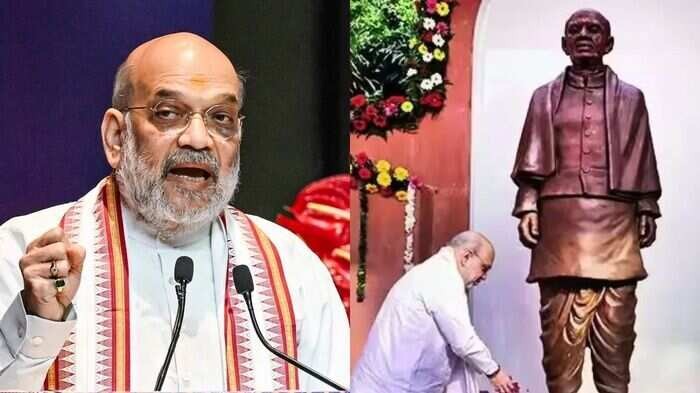
On the auspicious occasion of the 151st birth anniversary of ‘Iron Man’ Sardar Vallabhbhai Patel, the first Deputy Prime Minister and Home Minister of India, the entire country is paying tribute to him. Addressing ‘National Unity Day’ from the courtyard of the world’s tallest statue ‘Statue of Unity’ located in Kevadiya, Gujarat, Union Home Minister Amit Shah narrated the great historical saga of the unification of independent India, which laid the foundation of modern India. In his factual speech, Amit Shah explained in detail how at the time of independence, Sardar Patel created a united India by bringing more than 562 scattered princely states under one flag and one constitution. Along with this, he launched a scathing attack on the previous Congress governments and alleged that this unique and historic achievement of Sardar Patel was suppressed for decades and hidden from the people of the country, so that the importance of a particular political family could be maintained.
Amit Shah in his historic address said that when the country became independent on August 15, 1947, the British not only divided India but also fitted a huge time bomb of more than 562 independent princely states within the country. The British government had given the freedom to the kings and princely states that if they wanted, they could join India or Pakistan or declare themselves a completely independent country. In such a difficult and challenging environment, Sardar Patel took command and with indomitable will, excellent diplomacy and tough decisions when necessary, included all the princely states in the Union of India. The task of bringing together princely states like Travancore, Bhopal, Jodhpur and Udaipur was very delicate. Amit Shah clarified that it was due to the foresight of Sardar Patel that the nefarious plan of the British to disintegrate India could never succeed.
Referring to the integration of the princely states, the Home Minister also presented before the country the story of the military operations of Junagadh and Hyderabad (Operation Polo). The Nawab of Junagadh wanted to join Pakistan and the Nizam of Hyderabad was dreaming of his own separate power. But Sardar Patel, through his strong will and prompt military action, made both the princely states an integral part of India. Amit Shah said that Patel kept India’s sovereignty intact through the people’s referendum in Junagadh and the bravery of the army in Hyderabad. In the same sequence, he said that if Sardar Patel had been given complete freedom on the Kashmir issue and the then government had not stalled the issue by taking it to the United Nations, then the problem of Jammu and Kashmir would have ended decades ago.
During his speech, Amit Shah made a scathing attack on the main opposition party Congress. He alleged that the Congress governments that ruled the country after independence, as a deliberate strategy, tried to make the incomparable contribution of Sardar Patel disappear from the history books. The Home Minister said that awarding Bharat Ratna to Sardar Patel was delayed for decades and his monuments and ideas were kept away from the mainstream. Shah claimed that it was only after Prime Minister Narendra Modi came to power in 2014 that Sardar Patel got back the real and respectable place he deserved. The ‘Statue of Unity’ established in Kevadiya, Gujarat has not only become the world’s largest tourist and cultural center today, but it is also a symbol of the immense gratitude of the entire country towards Sardar Patel.
Amit Shah said that today’s strong, secure and rapidly emerging India is the India of Sardar Patel’s dreams. Patel was not only a great man who united the geography of the country, but he also strengthened the country internally by creating the structure of the Indian Administrative Services (IAS/IPS). The Home Minister called upon the youth of the country to not just remember history on ‘National Unity Day’, but also take a pledge to maintain the unity, integrity and internal security of India. He said that today when India is moving towards the goal of becoming a ‘Developed India’ by 2047, the thoughts of Sardar Patel and the path of integration shown by him are working as the biggest inspiration and beam of light for every countryman.