 look news india

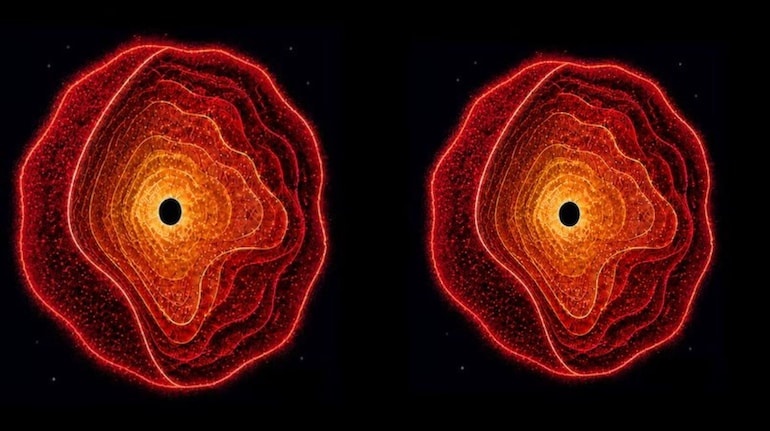
A revolutionary chapter has been added to the world of astrophysics and space science which has shaken the old notions of scientists. Scientists engaged in investigating the mysteries of the distant and ancient universe have recorded strong signals of an extraordinary and catastrophic celestial object, which in scientific language is called ‘Black Hole Star’ or ‘Quasi-Star’.
According to the received scientific data and simulation models, this giant star is approximately 1,00,000 (one lakh) times more massive than the Sun of our solar system and its energy production capacity is estimated to be approximately 100 billion times more powerful than that of normal stars. The discovery of this celestial monster, which existed just a few hundred million years after the birth of the universe i.e. the Big Bang (in the era of Cosmic Dawn), has astonished the entire international scientific community. This discovery can become direct evidence that the rules for the formation of stars and black holes in the early universe were completely different from today’s modern universe.
What is a quasi-star? Where there is no nuclear fusion, the black hole runs the star’s engine.
The Sun and all other normal stars in our galaxy shine due to nuclear fusion taking place at their center, where hydrogen gas changes into helium under extreme pressure and temperature and huge amounts of light and heat are emitted. But the internal mechanism of a ‘black hole star’ works exactly the opposite to this normal physics.
According to the concept of quasi-star, there is no normal stellar core at the center of this star, but a nascent ‘intermediate black hole’ is contained in its womb. The outer layers of the star are extremely dense, hot and made up of a giant hydrogen and helium gas shell (hydrogen envelope). When the black hole at the center begins to accretion the inner gas of the star around it, extremely powerful gravitational friction is created in the process. The radiation pressure from this intense friction pushes the star’s outer gas shell outwards, preventing the star from collapsing immediately due to its own immense gravity and continuing to exist as a stable but extremely bright ‘black hole powered star’ for millions of years.
Mass equal to 1 lakh suns and 100 billion times luminosity: understand its size in the words of data
The physical dimensions of this black hole star are so huge that it is almost impossible for the ordinary human brain to even imagine them:
-
Unimaginable Mass: The maximum mass of normal stars is usually limited to 100 to 150 solar masses, because any heavier than that the radiation pressure tears the star apart. But this quasi-star is of about 1,00,000 solar masses, which means it can accommodate one lakh suns.
-
Size spread in millions of kilometers: If this black hole star were placed in place of the Sun at the center of our solar system, its outer gaseous atmosphere would extend beyond the orbit of Mercury, Venus, Earth, Mars, and possibly even Jupiter.
-
100 billion times the light emission: The light and energy emanating from this body is many times more than the total light of even a small galaxy in the entire universe (which contains billions of stars). It operates at the highest level of physics’ Eddington Limit in terms of its brightness.
The Universe’s Biggest Mystery Solved: How Did the Initial Supermassive Black Holes Form?
For the last several years, the biggest puzzle facing astronomers has been that how did ‘Supermassive Black Holes’, equivalent to billions of suns, form just 500 to 700 million years after the origin of the universe? Traditional theories say that when a normal star dies, it creates a smaller stellar black hole (about 10 to 50 solar masses). If this tiny black hole grew slowly by eating gas, it would have needed billions of years to grow billions of times larger than they were in the very early stages of the universe.
The discovery of this ‘black hole star’ has unveiled this mystery. Scientists support the ‘direct collapse black hole’ (DCBH) model. According to this, when huge gas clouds without any heavy elements collapsed in the ancient universe, they directly gave rise to 1 lakh solar mass quasi-stars instead of smaller stars. The black holes that remained after the death of these quasi-stars, in the form of ‘seed’ (seed black holes) were already so huge that they evolved in a very short time and took the form of today’s giant supermassive black holes located at the center of galaxies.
The wonders of the James Webb Space Telescope (JWST) and state-of-the-art simulations
The James Webb Space Telescope (JWST), a joint effort of NASA, the European Space Agency (ESA) and the Canadian Space Agency (CSA), has captured unprecedented images of the early universe through infrared spectroscopy data from the far reaches of space.
Using deep cosmic redshift (z>10) analysis and supercomputer simulations, scientists found that when the gas clouds of ‘Population III’ stars formed in the early universe were exposed to ultraviolet radiation that destroyed molecular hydrogen, the gas did not cool and break into smaller pieces, but rather collapsed into a single giant super-body. This rare process gave rise to this 1 million solar mass black hole star, the spectral signature of which is now being decoded by advanced observatories.
The life cycle of a quasi-star and its cataclysmic end
Even though this black hole star appears to be the most powerful star in the universe, on the scale of a star its lifespan is very short. While our Sun will live for about 10 billion years, a quasi-star has a life span of only 1 to 2 million years.
As the black hole at the center continues to swallow the star’s interior, the black hole grows in size and the outer gaseous envelope gradually becomes cooler and thinner. There comes a time when the outer shell cannot handle the balance of the black hole’s powerful gravity and radiation. After this, the entire outer gas envelope either flies into space or gets directly absorbed into the black hole within a short time. Eventually, the star disappears completely, leaving only a giant intermediate-mass black hole in its place, ready to swallow the surrounding galaxies.
A new era in the understanding of the universe: further prospects
This discovery has bridged the gap between theoretical physics and observational astronomy. Major space agencies around the world are now busy mapping more such early celestial bodies through the James Webb Telescope, the upcoming Nancy Grace Roman Space Telescope and the Extremely Large Telescope (ELT) being built in Chile.
This discovery not only tells us how nature created such extreme and incredible celestial bodies in the early days of the universe, but it is also proving to be the most important link in understanding the story of the birth and evolution of ‘Sagittarius A*’, the supermassive black hole located at the center of our own galaxy ‘Milky Way’. For the first time in human history we have come so close to understanding the cosmic dawn that created the modern universe.