 look news india

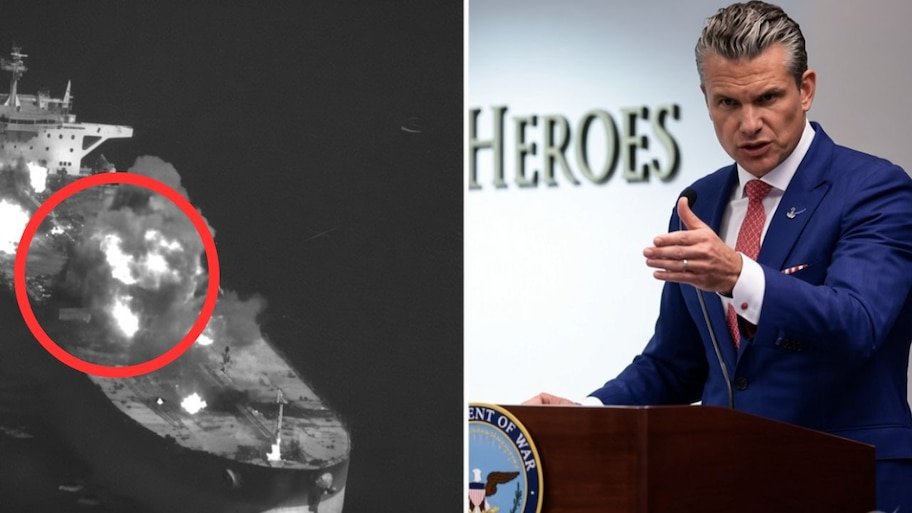
The naval conflict between the US and Iran in the Persian Gulf and the Strait of Hormuz has now reached an explosive point from where an uncontrolled world war can erupt at any moment. Washington’s stance has become unprecedentedly aggressive after the Islamic Revolutionary Guard Corps (IRGC) fired ballistic missiles at a US aircraft carrier and guided-missile destroyer patrolling in regional waters. US Defense Secretary (Pentagon Chief) Pete Hegseth has given a direct and open warning to Tehran’s top leadership and the Revolutionary Guards, saying that if Iran dares to touch or harm any US naval ship, sailor or strategic asset, the Pentagon will not delay even a second in sinking Iran’s entire commercial and military oil fleet to the bottom of the sea. Hegseth warned in clear words that the US military would not only adopt a defensive attitude, but would completely destroy the oil system, which is considered the backbone of Iran’s economy. This sharp statement issued from the Pentagon has made it clear that America has now resorted to a strategy of direct attack instead of proxy war.
Following an emergency review meeting with senior military commanders at the US Department of Defense, Pete Hegseth unveiled the US ‘Rules of Engagement’ to the media and international community. Hegseth said that Washington has been exercising restraint for decades to protect international waterways and unhindered movement of ships in the Gulf region, but Tehran has made a huge historical mistake of mistaking this restraint for America’s weakness. Hegseth said sharply, “We want to warn Iran in very clear terms—if you target even one of our ships or put the lives of our soldiers at risk, our response will not be proportionate but will be devastating. We will not only destroy your missile batteries, but turn into fireballs all of your ships, crude oil tankers and refinery hubs that underpin your regime. We have the firepower to We can bury Iran’s entire ‘Shadow Fleet’ in the depths of the sea in a matter of hours.” This statement of the Pentagon chief comes immediately after the action of three Iranian oil tankers (M/T Downy, M/T Stark 1 and M/T Kylo) already destroyed by the US Central Command (CENTCOM), which has proved that America is now in the mood for direct action beyond threats.
Pete Hegseth’s warning to directly target Iranian oil fleets is not a simple threat, but a planned strategy to strike Iran’s most sensitive economic center. Iran’s economy depends more than 90 percent on the export of its crude oil. Despite international economic sanctions, Iran sells millions of barrels of crude oil per day to China and other Asian countries through dozens of huge ships and ‘ghost or shadow fleets’ operating under foreign flags. With the black money earned from this oil, the Islamic Revolutionary Guards provide financial and military support to their ballistic missile project, nuclear enrichment program and proxy organizations like Hezbollah, Houthi and Iraqi militias.
If the US Navy and Air Force began destroying coastal terminals on Kharg Island and Iranian oil tankers in the deep sea, Iran’s foreign exchange reserves and fiscal structure would collapse within weeks. US intelligence agencies have already identified the exact locations and satellite coordinates of all known and secret oil tankers linked to Iran operating in the Gulf, the Sea of Oman and the Red Sea. Hegseth’s ultimatum means that the next Iranian missile test could directly lead to the end of Tehran’s entire maritime trade.
After this statement of Pete Hegseth, the military activity in the entire Gulf region has reached its peak. The US 5th Naval Fleet, under the leadership of Admiral Brad Cooper, head of the US Central Command (CENTCOM), has increased its patrolling at the mouth of the Persian Gulf manifold. US guided-missile cruisers and nuclear-powered aircraft carrier strike groups have deployed their air defense radars and interceptor missiles on high-alert. In the air, F-35 and F/A-18 Hornet fighter planes are continuously monitoring the sky.
On the other hand, reacting to Hegseth’s statement, the naval wing of the Iranian Revolutionary Guards has also started raising fire in its statements. IRGC commanders have claimed that if the US gets their hands on their oil ships, they will close the Strait of Hormuz forever and not a single barrel of oil from any Western country or their Arab allies will be allowed out of the region. The Iranian Army has opened the doors of its underground ‘Missile Cities’ in coastal areas and positioned the launchers of surface-to-sea ‘Noor’ and ‘Qadir’ cruise missiles. This armed conflict between the two sides has turned the entire Gulf region into a volcano that can erupt with any small spark.
This open warning from the Pentagon and the news of tankers being burnt in the sea has created a huge stir in the financial markets and energy sector around the world. The threat of missile attacks on warships and tankers in the Strait of Hormuz, through which one-fifth of the seaborne crude oil consumed globally passes, has alarmed international shipping companies. Major logistics and tanker firms have increased the war-risk insurance of their Persian Gulf-bound ships several times, while many ships have diverted their routes altogether.
Brent crude oil prices on commodity exchanges are headed for an uncontrolled surge. Energy experts estimate that if the US launched a decisive attack on Iran’s entire oil fleet as warned by Hegseth and Iran retaliated by laying naval mines in Hormuz, then oil prices could touch an all-time high of $150 to $200 per barrel. This situation will throw not only the Middle East but also all the big economies of Europe, America and Asia into severe recession and energy crisis. The United Nations and the Gulf Cooperation Council (GCC) countries are trying to reduce tension behind the scenes, but this latest ultimatum by Pete Hegseth has made it clear that Washington is now ready to give the final verdict of its power not at the negotiating table but on the waves of the sea.