 look news india

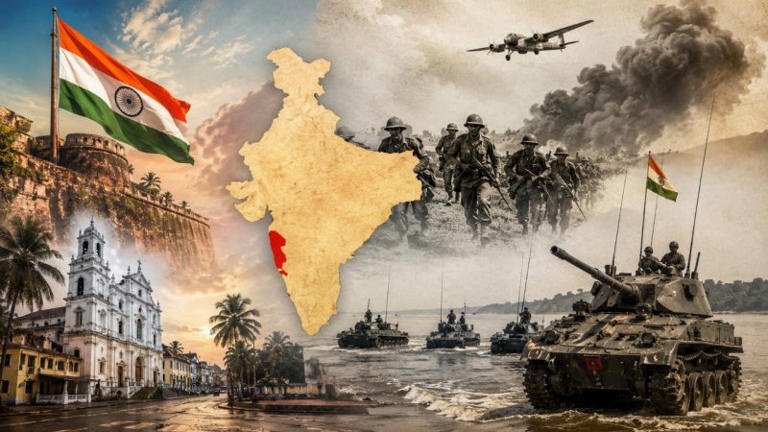
On August 15, 1947, when the whole of India was celebrating independence by breaking the shackles of 200 years of slavery of the British rule, the tricolor was not hoisted in the beautiful state of Goa located on the western coast of the country. Very few people are aware of the historical fact that the British were the last to come to India and the first to leave, but the Portuguese were the first European colonists to come to India (1510 AD) and were the last to be driven out of India (in 1961). Despite India’s sovereignty, Portuguese dictator Antonio de Oliveira Salazar had flatly refused to hand over Goa, Daman and Diu to India. After this, India had to wait for 14 years and finally conduct a decisive 36-hour military operation—’Operation Vijay’—to liberate its own land.
History of Portugal’s dogmatism and 450 years of slavery
The Portuguese governor Alfonso de Albuquerque captured Goa in 1510 by defeating Yusuf Adil Shah, Sultan of Bijapur. When the British left India in 1947, Portuguese dictator Salazar argued that Goa was not a part of India but an ‘Overseas Province’ of Portugal and being a member of NATO, he would not vacate it at any cost. The then Indian Prime Minister Jawaharlal Nehru initially chose the path of peaceful negotiations and international diplomacy. In 1950, India appealed to Portugal for formal talks, but Portugal completely closed the doors of talks. In response, India closed its embassy in Lisbon in 1953 and imposed economic sanctions on Goa.
Lohia’s Satyagraha and brutality on unarmed freedom fighters
The spark of liberating Goa was lit even before independence on 18 June 1946 by the strong socialist leader Dr. Ram Manohar Lohia by addressing a huge public meeting in Margao. In 1954 and 1955, thousands of Indian nationalists and Satyagrahis from Maharashtra and Gujarat attempted to enter the borders of Goa with the tricolor in their hands as part of the ‘Goa Liberation Movement’. On 15 August 1955, the Portuguese police opened indiscriminate fire on unarmed Satyagrahis, killing more than 20 Indian freedom fighters and seriously injuring hundreds. After this brutal massacre, huge public anger against the Portuguese erupted across the country and the demand for military action intensified.
18 December 1961: ‘Operation Vijay’ of land, water and sky started
After complete closure of diplomatic channels and firing on Indian merchant ships by the Portuguese Army, the then Defense Minister V.K. Krishna Menon and Prime Minister Nehru gave the green signal to military action. Major General K. The Indian Army, under the leadership of P. Kandeth, sounded the bugle of ‘Operation Vijay’ on the morning of 18 December 1961.
-
Army raid: The 17th Infantry Division and 50th Para Brigade of the Indian Army rapidly entered the borders of Goa from the north and east and destroyed the Portuguese posts.
-
Naval Valor: In the Arabian Sea, Indian Navy’s warships INS Rajput, INS Kirpan and INS Betwa destroyed the Portuguese warship ‘Albuquerque’ stationed at Mormugao port in a fierce firefight and captured Anjadeep Island.
-
Air Force’s precise attack: Canberra bombers of the Indian Air Force completely cut off the Portuguese from the rest of the world by accurately bombing the runway of Dabolim airport.
Surrender of Portugal in 36 hours and merger of Goa in India
The Portuguese army could barely survive for 36 hours in the face of the combined and aggressive attack by all three wings of the Indian Army. On the evening of 19 December 1961, Portuguese Governor General Manuel Antonio Vassallo e Silva signed the documents of unconditional surrender. With this, the 451-year-old oppressive Portuguese colonial rule on the land of Goa came to an end forever and the tricolor was proudly hoisted. The Government of India initially made Goa, Daman and Diu a Union Territory and later on 30 May 1987, Goa became the 25th full-fledged state of the Indian Union. 19th December is celebrated with great pride every year throughout Goa as ‘Goa Liberation Day’.