 look news india

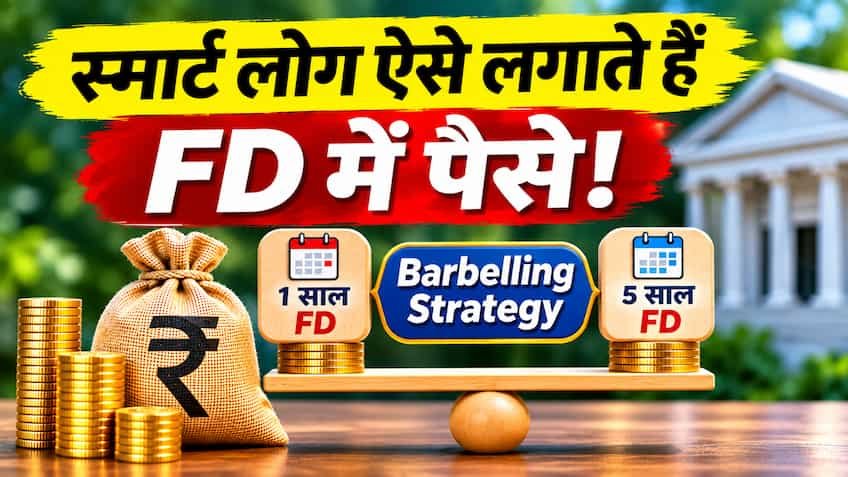
Fixed Deposit i.e. FD is considered to be the safest and most reliable investment option for crores of investors in India. But while investing money in FD, investors often face a big dilemma. If they lock their entire amount for a long period of 5 years or more in the greed of higher interest rates, then in case of sudden need of money, they have to break the FD, on which banks deduct premature withdrawal penalty. On the other hand, if they invest all the money in a small FD of 6 months or 1 year for the sake of liquidity, then they have to be satisfied with the low interest rate and there is a risk of re-investment. To deal with this problem, financial experts and smart investors around the world use a very effective technique, which is called ‘FD Barbelling Strategy’.
In the financial world, this strategy takes its name from the ‘barbell’ used for exercise in the gym. Just like a barbell rod has a heavy weight hanging at both the ends and the middle part remains completely empty, in the same way in this investment strategy, your total deposit is divided into two opposite ends i.e. extremely short-term and long-term FDs, while the medium term (like 2 to 3 years) is completely left out. In simple words, instead of locking your entire amount in a single FD, you keep half of the money in a short-term FD of 6 months to 1 year and the other half in a long-term FD of 5 years or more.
The working of this strategy can be easily understood with a practical example. Suppose you have a lump sum of ₹10 lakh to invest. Under barbelling strategy you will divide this ₹10 lakh into two equal parts i.e. ₹5 lakh and ₹5 lakh. The first ₹5 lakh you will invest in a short-term FD with a tenure of 6 months to 1 year, which will be immediately available for your emergency fund and near-term needs. You will invest the remaining ₹5 lakh in a long-term FD with a tenure of 5 years or more where banks are offering the highest interest rates (e.g. 7.25% to 7.75%). On one hand, this locks in the highest interest rate on half of your money, while on the other hand, if interest rates increase in the future when the short-term FD matures, you can reinvest that amount at the newly increased rates.
Often investors consider FD barbelling strategy and laddering strategy to be the same, whereas the way they work is different. In FD Laddering, the total investment is divided into equal steps of 1 year, 2 years, 3 years, 4 years and 5 years so that an FD matures every year. In contrast, in FD Barbelling, medium term FDs i.e. 2 to 4 years are completely ignored and the entire focus remains on only two ends (short term and long term). This strategy is especially beneficial for investors who expect significant fluctuations in interest rates in the future or who may need cash for a major expense within the next year.
According to financial planners, the FD barbelling strategy is highly suitable for salaried employees, businessmen and senior citizens who want to enjoy both high returns and liquidity without any stock market risk. If interest rates are at their peak and are likely to decline further, the long-term portion will continue to fetch you higher interest for years. If the interest rates increase further, then you will be able to avail the benefit of increased interest when the short-term FD matures. While adopting this strategy, it is important to keep in mind that you decide the ratio of short-term and long-term (like 50:50 or 40:60) as per your personal financial needs and also assess the TDS and tax slab rules.