 look news india

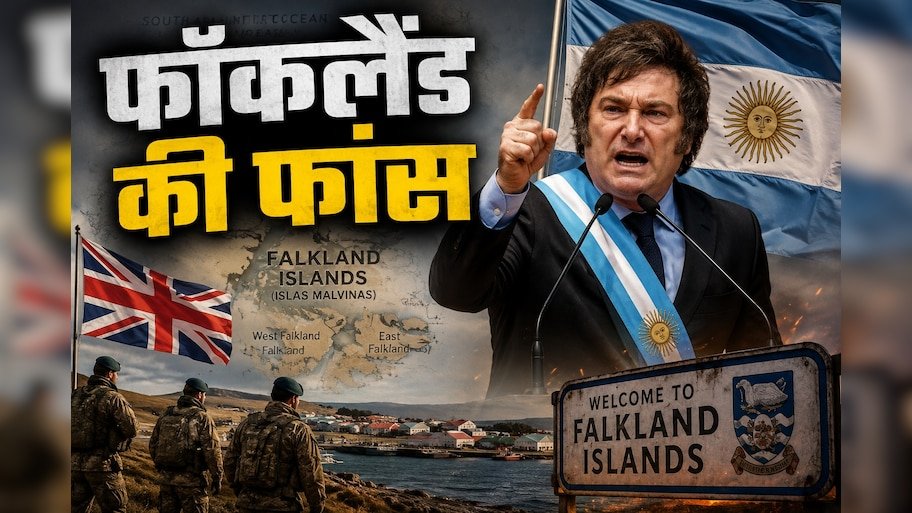
The ‘Falkland Islands’ are a small group of islands located in the icy South Atlantic Ocean, about 480 kilometers off the coast of Argentina and about 13,000 kilometers from London. Only about 3,500 permanent citizens live on this rocky and barren terrain spread over about 12,000 square kilometers, while the number of sheep is more than 5 lakh. But the question arises that why has there been such a deep ‘featur’ and diplomatic tension between Britain and Argentina for the last two centuries regarding these cold islands located in a remote corner of the world? Argentina considers it as its ‘Malvinas’ (Islas Malvinas) and a symbol of its national identity, while Britain is not ready to leave it as its British Overseas Territory at any cost.
The ownership of the Falkland Islands has been disputed since the 18th century:
-
Argentinian side: Argentina claims that it inherited these islands, which were under Spanish jurisdiction, when it gained independence from the Spanish Empire in 1816. Argentina says that geographically these islands are a natural part of its maritime continental shelf.
-
Britain’s control: Britain argues that in 1690, John Strong, a British sailor, made the first official landing here and named the strait after Viscount Falkland. In 1833 the British Navy formalized its military control over these islands and began settling British citizens there.
From then till today, Argentina has been calling it colonial occupation, while Britain says that it has been running a peaceful and legal administration here for more than 190 years.
This diplomatic dispute escalated into a fierce military confrontation on 2 April 1982. At that time, the Military Junta led by General Leopoldo Galtieri was in power in Argentina. To divert public attention from the domestic economic crisis and protests against human rights violations, Argentina’s military suddenly attacked the Falklands and captured them.
Argentina felt that Britain, sitting thousands of miles away, would not enter into a war for a small island. But the then British Prime Minister Margaret Thatcher considered it a direct attack on Britain’s sovereignty and dispatched a huge task force of her Royal Navy 8,000 miles away.
-
74 days of fierce battle: Advanced naval ships, submarines, Harrier fighter planes and ATR missiles were used in this war.
-
outcome: On June 14, 1982, the Argentine army had to surrender unconditionally.
-
Casualties: In this short war, 649 Argentine soldiers, 255 British military personnel and 3 local civilians were killed. This defeat led to the overthrow of the military dictatorship in Argentina and the restoration of democracy, while making Thatcher’s political position in Britain unassailable.
The conflict between the two countries over the Falklands is not just limited to old history or national pride, but the immense natural resources hidden beneath it are also a major focus of modern geopolitics:
-
Sea Lion Oilfield (Sea Lion Basin): Large quantities of crude oil and natural gas reserves have been confirmed in the Falkland North Sea Basin. It is estimated that about 1.7 billion barrels of oil is present here, once commercial exploitation of which starts, this area can become an important player in the global energy market. Argentina considers British exploitation of these resources illegal.
-
Rich area of fisheries: The Exclusive Economic Zone (EEZ) around these islands is the world’s largest and most expensive area for squid and tuna fish. The Falklands government receives millions of dollars in revenue annually from selling fishing licenses, making the island completely self-sufficient in its economy.
-
Gateway to Antarctica: Geostrategically, the Falkland Islands serve as a strategic naval base to monitor the Antarctic continent and Southern Ocean trade routes.
The most decisive turning point in the dispute on international forums came in March 2013, when the local government of the Falkland Islands held a historic referendum in the presence of international observers.
The public was asked a direct question whether they wanted to retain their political status as an overseas territory of Britain?
-
The total voting percentage was 92%.
-
In surprising results 99.8% voters voted in favor of Britain. Out of 1,517 valid votes, only 3 votes were cast against Britain.
Citing the ‘Right to Self-Determination’ enshrined in the Charter of the United Nations (UN), Britain says that as long as the local population of the island wants to live with British citizenship and flag, there is no question of any negotiation on sovereignty with Argentina. In contrast, Argentina says that under UN decolonization resolutions the principle of ‘territorial integrity’ comes first and that the opinions of resettled citizens cannot override the rights of the country of origin.
In recent years, Argentine President Javier Mellí has repeatedly called for the return of the Malvinas through diplomatic means in international forums. He has suggested a model of talks on the lines of Hong Kong, but the British government has clearly refused any kind of talks every time. Britain has deployed modern Typhoon fighter aircraft, radar systems and permanent garrison there to protect the island. Amid history, national pride, billions of dollars of oil reserves and contradictions of international law, the Falklands remains an unresolved geopolitical arena in the waves of the South Atlantic.