 look news india

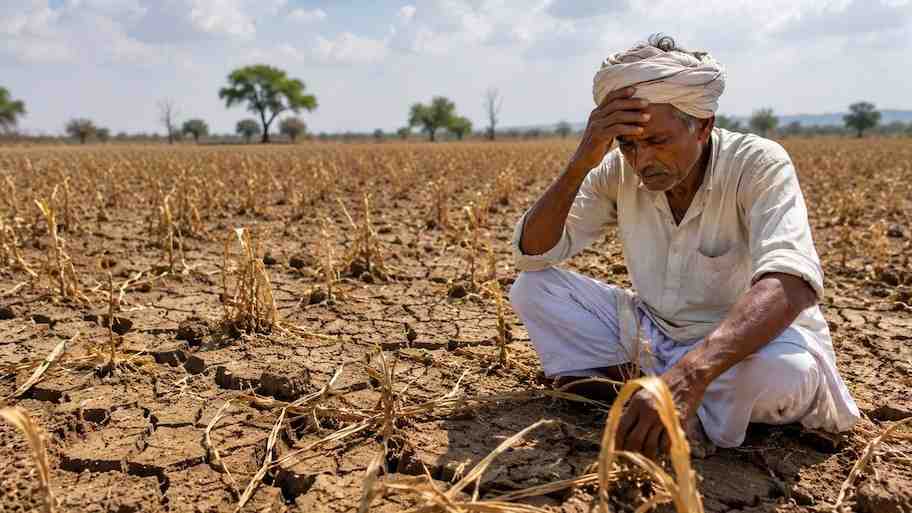
There was a time when the arrival of monsoon in India meant floating paper boats in the streets filled with rain water, enjoying a cup of hot tea and pakodas. For most Indians, the rainy season was no less than a celebration. But this situation has changed with time. Today, on hearing the name of monsoon, lines of worry are drawn on the foreheads of the general public as well as the government and policy makers.
According to meteorologists, late arrival or weakening of monsoon is no longer limited only to farmers and agriculture. Its direct impact is on the prices of food items (vegetables and ration), electricity bills, income of the common man, inflation and even the policy decisions of the Reserve Bank of India (RBI). Scientists have issued a big warning saying that in the Pacific Ocean ‘El Niño’ The situation is developing rapidly, which may lead to drought-like conditions this year.
Less than normal rainfall expected this year, weakest monsoon since 2015!
Talking about the last decade, India has been continuously struggling with changing weather patterns and decreasing monsoon rains. This year’s severe heat wave in the pre-monsoon season has already caused huge damage to crop production, increasing the load on power grids and making everyday life stressful.
The Indian Meteorological Department (IMD) in its latest forecast has only 90% rainfall is estimated to occur. If this estimate proves true, the country will see a ‘below normal’ monsoon for the first time in the last three years. Also, this year may prove to be the weakest monsoon season since 2015.
After all, what is ‘El Nino’, due to which the whole world is trembling?
According to scientists, El Niño is a complex global natural climate phenomenon. Under this, the surface water of the central and eastern parts of the Pacific Ocean becomes much warmer than normal.
-
General condition: On normal days, sea winds turn hot water into steam and push it towards the west i.e. towards Asia (including India) and Australia, due to which we get good rains.
-
El Nino conditions: When El Nino becomes active, these seasonal winds completely weaken or change their path. Due to this, the steam formed from hot water moves towards the east (towards America) instead of coming towards Asia. Due to this the entire global atmospheric circulation deteriorates.
History of El Nino: This cycle is active once every 2 to 7 years and affects the environment for approximately 9 to 12 months. Its history in India has always been associated with weak monsoons and droughts. Since 1950, the country has seen a total of 16 El Nino years, out of which 7 years the country had to face severe drought and extremely low rainfall.
Monsoon stuck in Maharashtra: 41% less clouds than normal
The month of June is about to end, but the pace of monsoon remains very slow. After entering the country, monsoon winds are currently stuck in the areas of South Maharashtra.
According to the data, only 42.6 mm rainfall has been recorded in the country between June 4 and June 18, whereas the normal level for this period should have been 72.2 mm. i.e. in the country 41% less rain than normal Has happened. The sector wise shortage figures are as follows:
| Area | Decline in rainfall (%) |
| central india | 67% less rain |
| Eastern and North-Eastern India | 42% less rain |
| south peninsula | 22% less rain |
| north-west india | 06% less rain |
The World Meteorological Organization (WMO) has estimated that the probability of El Nino being active between June and August is 80% to 90%. Keeping this in view, IMD has also reduced the graph of monsoon rain from 92% to 90%. Due to this weak monsoon, 12 big states of the country including Uttar Pradesh, Tamil Nadu can be seriously affected, which will directly affect the sowing of Kharif crops and the income of farmers.
Prices of tomatoes and vegetables may touch the sky; RBI worried
The first and sharpest impact of weak monsoon and continuously increasing heat wave is going to be on your kitchen budget. Due to extreme heat, the production of essential vegetables like tomato, green chilli and cabbage has reduced drastically in the fields, due to which their prices have started increasing due to less arrival in the markets. The prices of vegetables, fruits, edible oils and spices are continuously becoming expensive.
According to a report by ‘SBI Research’, if the El Nino outbreak continues like this, then in the coming weeks Tomato prices at record level Can reach. Sensing this serious situation of inflation and uncertainty in the country, the Reserve Bank of India (RBI) has also taken a big step. The central bank has increased its previous estimate of retail inflation (inflation rate) for the financial year 2026-27 from 4.6%. 5.1% This directly means that there is very little hope of a cut in interest rates in the market in the coming days.