 look news india

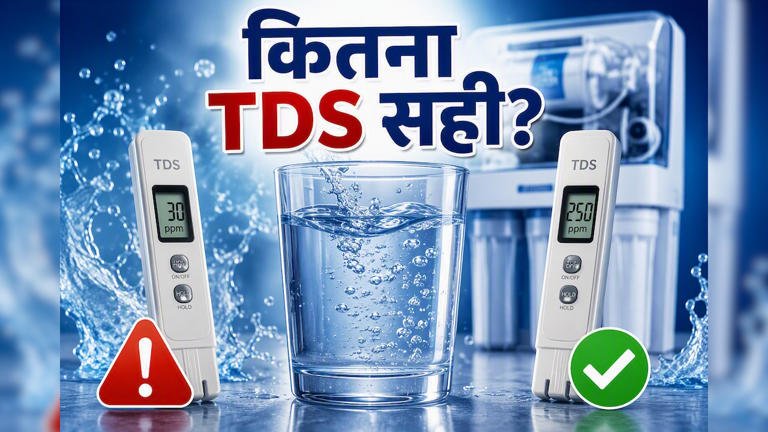
Water is life, but in the modern era, impure and contaminated water has also become the root of many serious diseases. Due to this fear, today reverse osmosis i.e. RO water purifier has been installed in almost every house in the country. In cities like Delhi, Lucknow, Patna, Jaipur, Mumbai or Bengaluru, people often believe that the lower the TDS of water, the purer and healthier the water will be. In many homes, RO technicians reduce the TDS level to 30, 40 or 50 PPM and people consider it to be the ‘cleanest’ water and drink it.
Medical science and water scientists clearly say that drinking water with extremely low TDS causes severe deficiency of essential minerals in the body, which weakens the heart, bones and immunity from within. Let us know what TDS is and what should be its ideal parameter from health point of view.
Full name of TDS Total Dissolved Solids Is. It simply means the amount of total solids dissolved in water. It is measured in ppm (parts per million – PPM) or milligrams per liter (mg/L).
These solid elements dissolved in water include two types of components:
-
Essential Minerals (Good Minerals): Calcium, magnesium, potassium, sodium, and bicarbonate—which are essential for the normal functioning of the body’s bones, muscles, and nervous system.
-
Harmful Contaminants: Lead, arsenic, mercury, fluoride, nitrates and heavy metals derived from industrial waste.
As per the guidelines of World Health Organization (WHO) and Bureau of Indian Standards (BIS – IS 10500:2012) the TDS level of drinking water is classified as:
-
Less than 50 (highly harmful): If the TDS of your water is below 50, it becomes ‘dead water’ or mineral-free distilled water. Such water is astringent and acidic in taste, which pulls out the essential electrolytes from the body instead of absorbing them in the intestines.
-
80 to 150 PPM (acceptable but slightly less): This water is safe to drink, but the amount of calcium and magnesium in it is significantly reduced.
-
150 to 300 PPM (best and ideal level): According to health experts, cardiologists and nutritionists, the level of 150 to 250 (maximum 300) ppm is considered to be the most excellent for the human body. At this level the taste of water remains sweet and balanced and the body gets the essential minerals required for daily needs only from water.
-
300 to 500 PPM (drinkable): This water is considered completely safe, although its taste may be a bit heavy.
-
More than 500 PPM (bad): Water between 500 to 1,000 ppm is hard water and water above 1,000 is not considered potable.
| TDS level (PPM/mg/L) | water quality | health effects |
| Highly reduced (De-mineralized) | Harmful: Bone weakness and electrolyte imbalance | |
| 50 – 150 PPM | medium | Safe, but partially deficient in minerals. |
| 150 – 250 PPM | Excellent | Ideal: Best for taste, digestion and overall health |
| 250 – 300 PPM | very good | Suitable for daily use and balance of minerals |
| 300 – 500 PPM | normal/acceptable | Safe, without any serious side effects |
| >500ppm | Hard Water | Use of RO purifier is mandatory |
Often people get the TDS of RO below 50 for the sake of taste. According to the World Health Organization (WHO) report, continuously drinking de-mineralized water with low-TDS can cause the following problems in the body:
-
Bone hollowness and joint pain: When there is zero calcium in the water, the body begins to pull calcium from the bones to maintain the pH level of the blood. This leads to premature osteoporosis and joint pain.
-
Risk of heart diseases: Magnesium present in water helps the heart muscles to beat normally. Drinking magnesium-free water for a long time can increase the risk of hypertension and heart attack.
-
Constant fatigue and muscle cramps: Due to lack of sodium and potassium, the balance of electrolytes in the body gets disturbed, due to which there are complaints of lethargy and headache throughout the day.
-
Increase in acidity: The pH level of low-TDS water falls below 6.5 and becomes acidic, causing persistent stomach irritation and risk of gastric ulcers.
There is a clear direction from the National Green Tribunal (NGT) and scientists that RO is not required for every source of water:
-
If supply water is less than 300 PPM: If your house gets municipal or water supply and its TDS is between 200 to 300, then there is no need for RO at all. The best option there is to just use a simple UV and UF purifier or boil water and drink it.
-
If TDS is more than 500 PPM: Use RO only if you are directly using submersible, borewell or highly saline groundwater whose TDS is between 500 to 1500.
-
TDS Controller and Mineral Cartridge: If RO is installed in your house, then ask the mechanic to set its TDS controller between 150 to 200 ppm and also get a good ‘mineral cartridge’ or ‘alkaline filter’ installed.