 look news india

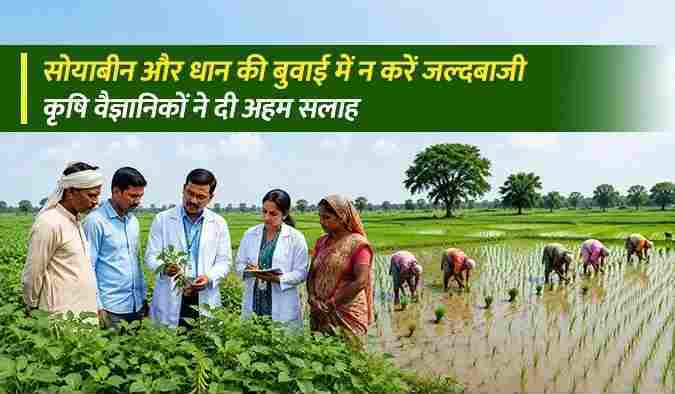
The sowing time of Kharif season has started, but there is still not enough rain in many parts of Madhya Pradesh. In such a situation, despite low moisture in the fields, sowing soybean and paddy in a hurry can prove to be very harmful for the farmers. In view of this, Farmer Welfare and Agricultural Development Department, Madhya Pradesh has issued an important advisory for farmers based on the advice of agricultural scientists.
Director of Agriculture Department, Umashankar Bhargava has instructed the field staff to be in constant touch with the farmers and make them aware to carry out agricultural work as per the weather conditions. The department says that in the districts which have received less than normal rainfall so far, the best decision would be to postpone sowing till sufficient moisture arrives.
When to sow Kharif crops in the field?
According to agricultural scientists, the decision of sowing should not be taken only by looking at the calendar dates, but by testing the actual moisture of the field.
-
Wait for ‘Batar’ situation: Experts say that sowing is considered safe only when sufficient moisture reaches the soil to a depth of about 4 inches (about one child) and a ‘water’ condition is created in the field.
-
Disadvantages of low moisture: If seeds are sown in low humidity, germination may be affected. Many times the seeds rot inside the soil, due to which farmers have to sow again and the cost doubles.
Farmers with irrigation facilities should make these preparations from now on
Farmers who have access to irrigation facilities can use this time to increase the fertility of their fields.
-
Use of green manure: The Agriculture Department has advised to sow green manure crops like Dhaincha or Sanai in the fields, so that the amount of organic elements in the soil can increase.
-
Proper nutrition: Apart from this, while preparing the field, it will be very beneficial to use rotted cow dung, vermi compost, single super phosphate, muriate of potash, zinc sulphate and gypsum as per soil test and advice of agricultural experts.
4 scientific advice for soybean and paddy cultivation
-
Germination test is necessary: Before sowing soybean, do a germination test of the seeds. Use only seeds with 70 percent or more germination capacity for sowing.
-
Seed Treatment: It is important to treat the seeds with fungicides and bio-fertilizers just before sowing, so that the crop can be protected from pests and diseases in the initial stage. Along with this, select only those varieties which require less water and are disease resistant.
-
Modern Technology for Paddy: Instead of traditional manual transplanting, farmers cultivating paddy should Sri Method (SRI) Or Direct Seeded Rice (DSR – Direct Sown) It has been advised to adopt technology. These technologies save huge amounts of water and also reduce production costs.
-
Use of modern agricultural machinery: The department has advised farmers to use modern agricultural equipment like ridge and furrow seed drill, broad bed and furrow (BBF) seed drill and manual seed dibbler. With these techniques, drainage in the field remains better and the crop remains safe even in adverse conditions like drought or excessive waterlogging.
Adopt intercropping and crop insurance to reduce risk.
In view of the uncertainty of the weather, the Agriculture Department Intercropping Emphasis has been laid on adoption. Weather related risks are reduced by sowing two or more crops (eg pigeon pea with soybean) or different varieties of the same crop in the same field. If due to some reason one crop is affected, the farmers get support from the other crop. Along with this, to compensate for the financial loss in case of natural disaster, make sure to get your crops insured on time under the Prime Minister Crop Insurance Scheme.
What farmers should do and what not to do (Quick Guide)
| What to do | what not to do |
| Sow only after there is sufficient moisture (4 inches depth). | Do not sow immediately after the first light drizzle or first rain. |
| Before sowing, ensure proper seed treatment of seeds. | Do not sow seeds without checking their germination capacity (at least 70%). |
| Choose short-maturing and pest-resistant varieties. | Avoid planting seeds in completely dry or low moisture soil. |
| Constantly keep an eye on the weather department’s forecast and alerts. | Do not make the mistake of sowing the entire field at once in a hurry. |
Frequently Asked Questions (FAQs)
Question 1: What is the best time for sowing soybean and paddy?
Answer: According to the Agriculture Department, sowing should be done only when sufficient moisture reaches about 4 inches in the soil of the field and ‘Batar’ (sowable condition) is created in the field.
Question 2: Can sowing be done in less rainfall or in dry soil?
Answer: no way. Due to sowing in insufficient moisture, seeds do not germinate properly, due to which the number of plants remains low and farmers may have to bear heavy expenses for re-sowing.
Question 3: What are the advantages of direct sowing of rice (DSR) technology?
Answer: By cultivating paddy using Direct Seeded Rice (DSR) technology, the cost of nursery preparation and transplantation is saved. This saves huge amount of water and gives good production at low cost.