 look news india

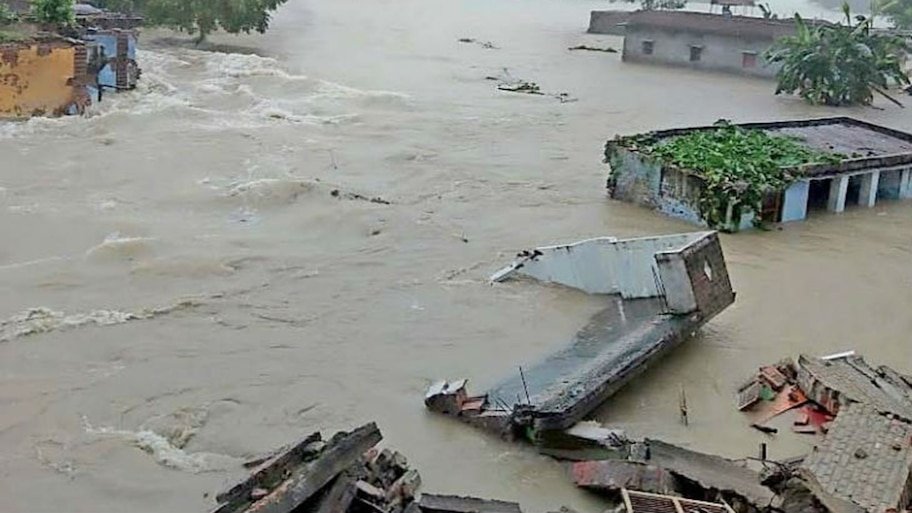
Due to monsoon rains in Bihar and millions of cusecs of water being continuously released from the catchment areas of Nepal, the flood crisis has taken a very serious form in more than 18 districts of the state. Ganga, Gandak, Budhi Gandak, Kosi, Son and Punpun rivers are in spate together and are flowing 1 to 2.5 meters above the red mark (danger mark) at dozens of places. Rural and coastal areas of the capital Patna, Vaishali (Hajipur), Samastipur, Begusarai, Bhojpur, Buxar, Saran and Bhagalpur have been completely submerged.
According to the latest data from the Disaster Management Department and Central Water Commission (CWC), more than 10 lakh population of the state has been directly affected by this unprecedented deluge. Hundreds of villages have become islands surrounded by flood water from all sides. Farms, barns, roads, schools and health centers have been submerged in water, due to which lakhs of people along with their cattle and essential household items have been forced to take shelter under the open sky by stretching tarpaulins on the banks of National Highways (NH), high dams and railway tracks.
The flood situation in the capital Patna and its rural subdivisions has become extremely critical. The water level of Ganga at Gandhi Ghat in Patna has crossed 50.57 meters, leaving behind the historical record of the devastating flood of 2016. Even in Digha Ghat, Hathidah and Maner, river Ganga remains stable well above the red mark. Ground connectivity of more than 50 panchayats of Diara areas of Danapur and Maner has been completely lost.
Along with Ganga, Punpun and Dardha rivers passing through the southern part of Patna have given sleepless nights to the administration. Punpun river in Sripalpur is flowing at a dangerous level of 53.16 meters, 2.56 meters above the danger mark (50.60 meters). There is heavy water pressure on the left embankment and ring dam of Punpun. If this embankment is damaged, flood water can directly enter the residential areas of Kankarbagh, Bypass and Sampatchak of Patna city. After water entered Lakhna, Chandasi and Fatehpur villages, technical teams of the Water Resources Department are working 24 hours to save the ring dam with sandbags.
The confluence of Ganga and Gandak rivers has wreaked havoc in Hajipur of Vaishali district. Hajipur’s Moksha Dham ‘Kaunahara Ghat’, which has historical and religious importance, has been completely submerged and even the crematorium has been filled with water. Flood water is flowing 2 to 3 feet on Kaunhara Bypass Road and the main road leading to Ramchaura Temple, due to which urban traffic has come to a complete standstill. The road leading to DRCC has also been flooded.
The most dreadful effect of the rise in the water level of Ganga is being seen in Tersia Diara area of Raghopur and Hajipur. Hundreds of pucca and kutcha houses in Tersia have been submerged up to the first floor, due to which thousands of people have become homeless. Local people are camping at high places near Gangabridge police station and along the approach road of Mahatma Gandhi Setu to save their lives. Due to acute shortage of boats in Diara area, villagers are somehow migrating to safer places by building Chachari bridge of bamboo-bat and banana thumb boats.
River Ganga continues to be rough in Mohiuddinnagar, Mohanpur, Patori and Vidyapatinagar blocks of Samastipur district. According to Water Resources Department Dalsinghsarai, the water level of Ganga at Sarari Camp was recorded at 47.75 metres, which is 2.25 meters above the danger mark (45.50 metres). The flow of water is so fast that a large part of the under-construction Tajpur-Bakhtiyarpur four lane has been covered with flood water, due to which the construction work has come to a complete halt and connectivity has been lost.
Thousands of villagers from the southern Dumri, Baghra, Bariyarpur, Rajpur Jaunapur, Matiur and Vishanpur Beri panchayats of the block have taken shelter with their entire families and cattle at the Hajipur-Bachhwada Waterways Dam.
On the other hand, Ganga water has also entered the houses in Diara area of Matihani, Bachhwara, Shamho and Teghra blocks of neighboring district Begusarai. Shamho block’s contact with the district headquarters has almost been cut off. Farmers’ crops of maize, banana, paddy and green vegetables grown in hundreds of acres have been completely destroyed, due to which food providers are facing a severe crisis of ration and cattle fodder for the year.
In view of the dire flood situation, Chief Minister Nitish Kumar has held a high-level review meeting with top officials and has instructed the District Magistrates of all the affected districts to operate relief camps on a war footing.
The details of relief work going on on the ground are as follows:
-
Rescue Operations: In the flood affected areas, more than 8 teams of National Disaster Response Force (NDRF) and contingents of State Disaster Response Force (SDRF) along with motorboats are continuously rescuing the stranded elderly people, women and children and taking them to safe places.
-
Government boats: To maintain smooth traffic, operation of more than 690 government and private registered boats has been started in the affected areas.
-
Community Kitchens: Dozens of community kitchens have been started at relief camps and dams for displaced families, where arrangements for pure drinking water and two hot meals a day are being made.
-
24 hour guarding of embankments: Assistant and junior engineers of the Water Resources Department have been deployed every 3 kilometers to protect the sensitive embankments. Constant patrolling is being done on the embankments at night by installing high-mast lights so that any leakage (seepage) can be stopped immediately.
-
Relief Material: Thousands of polythene sheets, dry ration (chuda, jaggery, sattu, matchsticks) and chlorine tablets have so far been distributed among the displaced people.
Due to stagnation of flood water and rotting on roads, the risk of water-borne diseases has increased manifold in the affected areas. The health department has deployed medical mobile vans and special teams of doctors in the affected panchayats. Cases of diarrhea, cholera, fever and skin infection have started being reported among the victims. Apart from this, in view of the increase in incidents of poisonous snakes and insect bites in flood affected areas, orders have been given to ensure adequate availability of anti-venom injections at all primary health centres.
The district administration has appealed to the common citizens to always boil drinking water, keep children away from swollen rivers and ghats and for any emergency assistance, immediately contact the helpline numbers of the District Disaster Control Room. The Meteorological Department’s rain forecast for the next two days has made it clear that the water level in the rivers of Bihar will remain high for a few more days, due to which it may take time to overcome the crisis.