 look news india

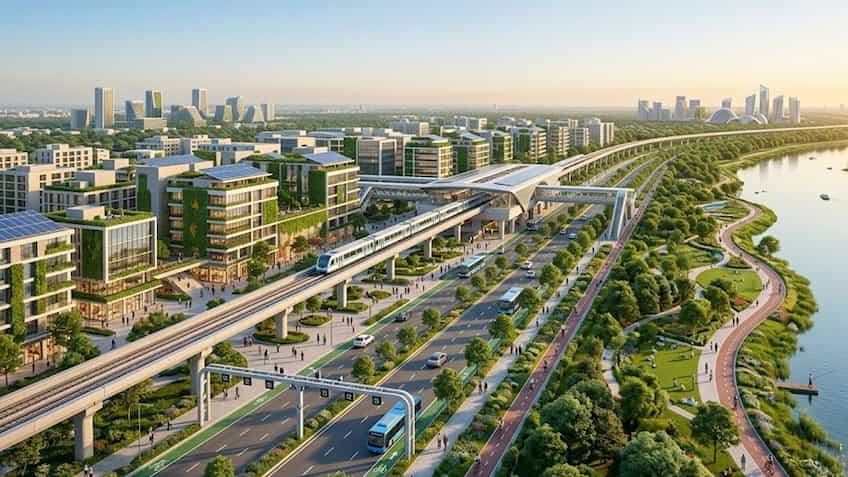
A big and relief action plan has been prepared for the lakhs of Delhiites who are troubled by the hours-long traffic jams, crawling vehicles and the poisonous smoke produced every day in the country’s capital Delhi. The Delhi Government, Lieutenant Governor’s Secretariat, Delhi Development Authority (DDA) and Unified Transport Administration (UMTA) have together drawn up a comprehensive multi-modal transport policy to make the capital’s roads jam-free and environment-friendly. Under this new policy, while there is a preparation to impose congestion charge on private vehicles entering highly busy roads and commercial hubs during peak hours, 52 km long dedicated cycle and pedestrian track will be developed on both banks of Yamuna to promote non-motorized transport.
Preparation for congestion charge in 13 major bottlenecks and commercial hubs
It is proposed to implement a congestion pricing model during peak hours on 13 of the most congested and sensitive major corridors of Delhi, on the lines of global metros like London, Singapore and Stockholm.
-
Automated Tolling and RFID Technology: Under this system, no barriers or toll plazas will be installed on the roads, rather vehicles will be identified and charged automatically with the help of hi-tech Automatic Number Plate Recognition (ANPR) cameras and FASTag/RFID scanners.
-
Restrictions on private vehicles during peak hours: Dynamic congestion charge will be applicable on private cars and taxis entering heavy traffic areas like Connaught Place, ITO, Karol Bagh, Lajpat Nagar, Nehru Place, Ashram and Dhaula Kuan during morning rush hour (8:30 AM to 11:30 AM) and evening rush hour (5:30 PM to 8:30 PM).
-
Complete exemption to public transport: Buses, ambulances, fire brigades and non-polluting electric two-wheelers will be completely exempted from this fee so that people use metro and city buses more instead of private vehicles.
52 km long dedicated cycle track on Yamuna riverfront
Keeping in mind green mobility and environment protection, Delhi Development Authority (DDA) has decided to build a massive Non-Motorized Transport (NMT) corridor on the Yamuna floodplain and riverfront.
-
Extension from Wazirabad to Okhla Barrage: This modern 52 km long cycle track will start from Wazirabad Barrage and extend on both sides to Okhla Barrage via ISBT Kashmiri Gate, Rajghat, ITO Barrage, Mayur Vihar and Kalindi Kunj.
-
Completely safe and green corridor: This entire track will be kept completely separated from the main motor highway. Shady trees, water stations, LED solar lights, public toilets and emergency SOS booths will be built on both sides of the track.
-
Public Bike Sharing and Last Mile Connectivity: This 52 km track will be connected to major metro and RRTS stations like Kashmere Gate, Shastri Park, Sarai Kale Khan and Mayur Vihar. Smart electric bicycle rental docks will be installed at the entry and exit points of the track, so that office goers can easily complete last-mile connectivity.
Bottleneck Free Delhi: Re-engineering of 77 major intersections
Civil re-engineering work is being undertaken to fix 77 deadliest traffic bottlenecks identified by Delhi Traffic Police and UMTA. It mainly includes:
-
Free Left Turn and Slip Roads: Free left turn slip roads will be constructed at all major crossings to eliminate traffic jams caused by vehicles turning due to red lights at intersections.
-
Network of flyovers and underpasses: Signal-free corridors are being created by expeditiously connecting the remaining missing links at junctions like Ashram-DND Extension, Punjabi Bagh Club Road Flyover, Anand Vihar ROB and Mukarba Chowk.
-
Smart Signaling System (ITMS): Artificial Intelligence (AI) based Intelligent Traffic Management System is being deployed across Delhi, which will automatically increase and decrease green light timings depending on the traffic density.
Crackdown on parking mafia and dynamic on-street parking charges
Illegal parking on the roads of Delhi emerges as the biggest cause of traffic jams. Under the new master plan, Municipal Corporation of Delhi (MCD) and NDMC are making a rule to make the rates of on-street parking expensive during peak hours in all major markets, while concessional rates will be given for parking in underground and multi-level automated parking (MLCP). The process of issuing heavy challans and vehicle confiscation for parking vehicles in no-parking zones on main roads will be made stricter.
Direct impact on air quality and pollution control
According to studies by the Center for Science and Environment (CSE) and the Central Pollution Control Board (CPCB), about 30 to 40 percent of Delhi’s total PM 2.5 and PM 10 pollution is caused by vehicle exhaust and frequent start-stops in traffic. When vehicles are parked in traffic jams, they emit three times more carbon monoxide and nitrogen oxides than normal. This combined model of congestion tax and 52 km cycle track is expected to reduce the pressure of private vehicles on the roads of Delhi by about 20% and significantly reduce the emissions of poisonous gases.