 look news india

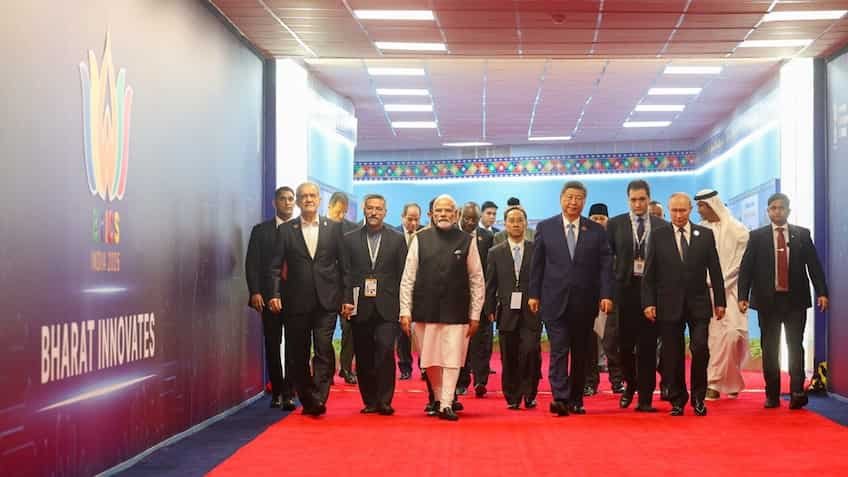
After the 18th BRICS Summit (18th BRICS Summit 2026) held in New Delhi, India’s diplomatic influence is being echoed in global geopolitical analysts and think tank reports. Recent international reports and diplomatic reviews have made bold claims that during the summit, India successfully prevented the BRICS forum from becoming an ‘anti-West weapon’ of China and Russia. Despite the presence of Chinese President Xi Jinping and Russian President Vladimir Putin, India was completely successful in maintaining its balanced foreign policy and strategic autonomy at the centre. This is being seen internationally as an extraordinary and historic diplomatic victory for New Delhi.
After the expansion of the BRICS group, it was feared that Beijing and Moscow would use this platform to create an aggressive political front against the Western countries and the G7. However, the ‘New Delhi Declaration 2026’, unanimously adopted on the very first day of the summit, completely changed this narrative:
-
Non-Alignment and Balance: India made it clear that BRICS should not become an instrument of dividing the world into two opposing camps. India steered the organization towards independent global economic reforms while protecting its economic and security relations with Western countries.
-
Pragmatic stance on dollar boycott: While China and Russia were under pressure for a complete boycott of the US dollar and a quick alternative currency, India insisted on a pragmatic policy of ‘creating alternatives’ and increasing bilateral trade in local currencies without adversely affecting global financial stability.
-
Message of making the global system inclusive, not destroying it: Due to India’s stance, the demand for multilateral reforms and fair representation was given prominence in the manifesto instead of waging a war against the existing world order.
In this summit, Prime Minister Narendra Modi gave a clear message that emerging economies and the ‘Global South’ will have to become not just global rule-takers, but global rule-makers.
-
Support on Security Council Reform: In the New Delhi Declaration, China and Russia—who are permanent members of the United Nations Security Council (UNSC)—formally reaffirmed their support for a greater role for India and Brazil in the United Nations and the Security Council.
-
Priority to human-centred development: India placed food security, innovation, supply chain strengthening and humanitarian development at the top of the agenda rather than defense or geopolitical alliances.
During the conference, it was extremely challenging to build a consensus on the ongoing military conflict and tension in the Middle East (West Asia). Despite regional differences between the new BRICS members—Iran, Saudi Arabia and the United Arab Emirates (UAE)—India took advantage of its neutral ties to include in the declaration a joint pledge of ‘maximum restraint’ and protection of international maritime trade routes in the Red Sea.
Even during Chinese President Xi Jinping’s first visit to India after 2019, India did not compromise with its sovereignty and strategic interests. In the bilateral talks between the two leaders, India made it clear that peace and stability along the Line of Actual Control (LAC) is the first pre-condition for normal relations. Due to this firm stand of India, China had to agree to move forward on the basis of ‘mutual respect and mutual sensitivity’ on trade and regional issues.
Global think tanks believe that in the 18th BRICS Summit, India has proved that the diplomacy of the 21st century does not lie in blindly following any one group, but in keeping its national interests paramount by becoming a bridge between different power centers of the world.