 look news india

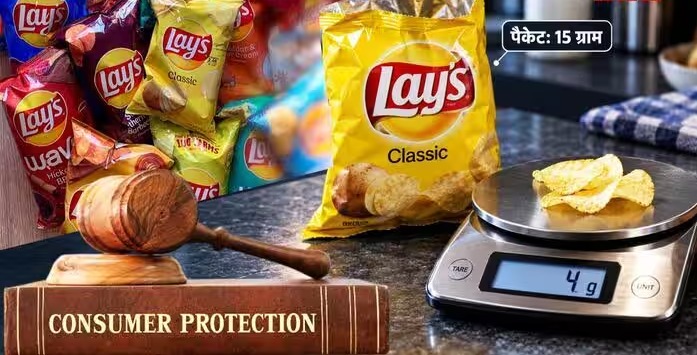
People often complain on social media or in discussions among friends about the presence of too much air and less material in packets of food items and snacks, but when a conscious citizen challenges it legally, even the biggest multinational companies have to bow down. A similar case has come to light where the famous snack manufacturing company PepsiCo India has been held guilty by the Consumer Forum for selling ingredients less than the weight mentioned on the packets of chips. The court has not only ordered the company to compensate the loss suffered by the consumer but has also ordered it to pay a strict compensation of ₹ 8000 for mental torture and court expenses. This decision has become an example for all those consumers who often remain silent even after becoming victims of such frauds in the market.
The whole matter started when a customer bought a packet of chips of PepsiCo company from the market. The net weight was clearly marked on the outside of the packet, but when the customer doubted the quantity when he took the packet in his hand, he brought it home and checked it on a digital weighing machine. The result turned out to be shocking, as the actual weight of the chips inside the packet was found to be much less than the claim written on it. This clearly constituted a case of unfair trade practice and misleading packaging under the Packaged Commodities Rules and the Consumer Protection Act. The complainant first contacted the customer care of the company and lodged a complaint, but when no satisfactory response or solution was received from there, he directly approached the District Consumer Disputes Redressal Commission to protect consumer rights.
When the hearing began before the consumer commission, PepsiCo representatives and lawyers tried their best to defend themselves by citing the packaging process, the technology of automated machines and the tolerance limits that occur during production. However, the complainant presented strong evidence before the court, which included video of the weighing, receipt of the packet and the exact measurement of the weighing machine. The consumer court, after closely examining the arguments and evidence from both sides, held that no matter how big a brand is, it cannot mislead consumers by recording wrong information on the packet. The court held that giving less weight than the quantity mentioned in the product is a betrayal of consumer trust and is a direct violation of rights.
After considering all the facts and evidence, the consumer forum ordered PepsiCo India to pay ₹8000 to the aggrieved customer as mental compensation and expenses incurred in the legal proceedings. Along with this, instructions were also given to return the actual price of the packet. Although from a financial point of view the amount of ₹8000 may not seem very big for a multinational company, but from a legal and ethical point of view this decision gives a big message. This judgment proves that consumer protection laws empower common citizens and if any brand is negligent in the quality or quantity of the product, it can be held accountable.
Under the Packaged Commodity Rules 2011 in India, it is mandatory to mention accurately the weight, manufacturing date, expiry date, MRP and customer care details on any unopened packet. Legally, companies are allowed to vary the weight to a very small extent, but if this difference is found to exceed the prescribed standards then it is considered a legal offence. Food and Civil Supplies Department and Legal Metrology Department conduct raids and investigations in such cases from time to time. Consumer affairs experts say that due to such carelessness during packaging, companies unknowingly or knowingly earn profits worth crores of rupees, because most of the customers ignore the difference of a few grams.
After this decision, it has become very important for the common consumers to understand that they should be completely cautious while purchasing any canned goods from the market. If you ever notice any discrepancy in the weight, quality or price of any packaged food, grocery or other item, then first of all keep its bill and packet safe. You can register your complaint on the National Consumer Helpline (NCH) toll-free number 1915 or report online through the ‘Consumer App’. Apart from this, you can file a petition yourself in the District Consumer Forum of your area with a very nominal fee and without any lawyer. This case teaches us that awareness of our rights is the most effective weapon to protect us from all kinds of frauds in the market.