 look news india

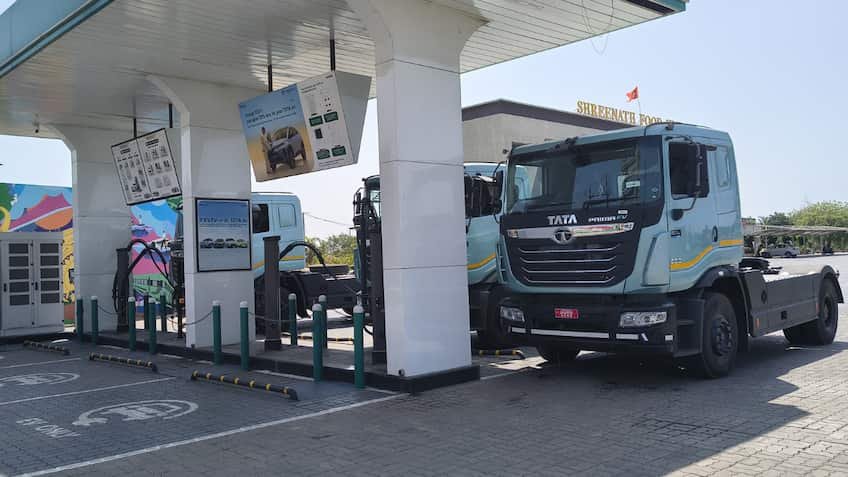
The largest and most historic commercial agreement has come to the fore in India’s electric vehicle (EV) infrastructure sector. CHARGEZONE, the country’s leading EV supercharging network, has secured long-term energy contracts worth more than $1 billion i.e. approximately ₹10,500 crore for intercity electric buses, heavy commercial trucks and fleet cars. On the basis of this historic deal, the company is starting work on the master plan to install 1,000 new state-of-the-art supercharging stations on the major National Highway Corridors of India. This strategic step is expected to give unprecedented impetus to the electrification of intercity freight and public transport in the country.
The main focus of this massive deployment by ChargeZone will be the busiest National Highway corridors of the country. At present, range anxiety i.e. the fear of running out of battery on the way remains the biggest obstacle in the minds of electric car or bus drivers. The company aims to create high-speed supercharging hubs every 50 to 100 kilometers on major expressways and business routes like Delhi-Mumbai, Mumbai-Ahmedabad, Bengaluru-Chennai, Delhi-Amritsar and Kolkata-Varanasi. Once the new 1,000 charging stations go live, interstate electric buses and long distance trucks plying on the highways will get quick charging facilities without any delay, saving time on logistics and public transport between cities.
Generally, the biggest challenge in setting up a public EV charging station is whether there will be enough traffic after the infrastructure is ready or not. ChargeZone has changed this traditional model by adopting a ‘demand-first’ approach. This ₹10,500 crore energy contract has been signed with commercial fleet operators, interstate bus services and delivery companies with fixed routes and assured daily power consumption. The company estimates that through these contracted fleets, more than 15,000 electric vehicles will be charged per day at the new stations. With this, the average network utilization rate of stations is expected to increase from the current 14 percent to 30 percent.
After the completion of this major expansion drive, the total capacity of ChargeZone’s charging network will increase by a whopping 180 megawatts (MW). With this, the total network capacity of the company will directly increase from the current 120 MW to the level of 300 MW. When fully activated, the entire network will deliver approximately 700 gigawatt-hours (GWh) of energy annually and will be able to easily handle more than 15,000 charging sessions per day. Such a huge energy capacity will stop the consumption of millions of liters of diesel in the country and will reduce carbon emissions to a huge extent.
The company has also strengthened its fund raising phase to give financial impetus to this capital-intensive infrastructure project. ChargeZone has secured funding of ₹250 crore ($25 million) through debt financing from leading Indian commercial banks. Additionally, the company is in the process of raising fresh capital of $100 million (approximately over ₹830 crore) through equity and additional debt during FY 2026-27. This entire capital will be invested in the construction of new supercharging stations, micro-grid infrastructure, development of modern energy management software and hardware technologies.
Merely installing charging points is not enough, but controlling the pressure on the grid is also a big technical challenge. ChargeZone is connecting solar power and battery energy storage systems (BESS) directly to the grid at its new high-speed supercharging stations. The advantage of this will be that during peak hours, when many heavy buses and trucks will plug-in for charging simultaneously, there will be no excessive load on the local grid. The electricity generated by the solar panels during the day will be stored in these BESS batteries and used for superfast charging of heavy vehicles at night, making the entire ecosystem eco-friendly and in line with net-zero carbon targets.
Till now the impact of the electric revolution in India was mainly limited to two-wheelers, three-wheelers and intra-city cars. Converting long-haul trucks and heavy goods vehicles to EVs was considered a distant dream, as they require megawatt-level high-power chargers. This historic contract of ₹10,500 crore makes it clear that large logistics fleets are now ready to switch from diesel to electric. Electrification of heavy trucks can reduce the operating cost of freight by 40 to 50 percent, which will have a direct positive impact on the country’s economy, inflation and industrial development.
Expansion of public charging network is on top priority under the PM E-DRIVE scheme and National Electric Mobility Mission of the Central Government. This ₹10,500 crore private sector initiative of ChargeZone will act as a catalyst in implementing government policies. Experts believe that when a network of reliable and superfast charging is ready on the highways in a country, automobile manufacturers will also be inspired to launch heavy electric commercial vehicles in the market on a large scale. This expansion of ChargeZone will position India as a key leader in the global EV revolution.