 look news india

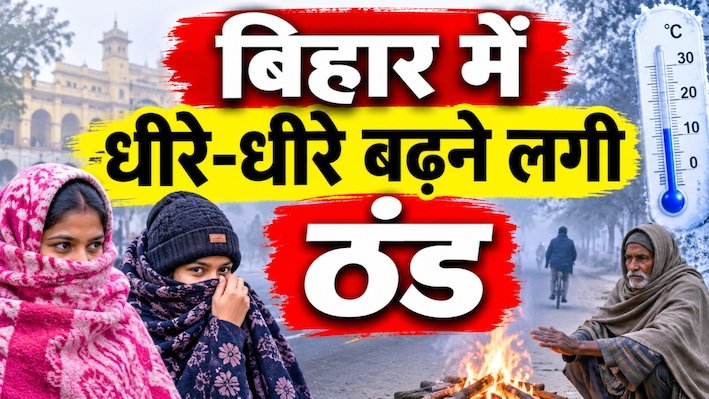
With the beginning of the second fortnight of November in Bihar, the weather has started changing rapidly. In almost all the districts of the state including the capital Patna, the feeling of cold in the morning and at night has increased considerably as compared to before. However, due to clear sky and bright sunshine during the afternoon, people are experiencing slight warmth and normal weather during the day. According to the latest forecast released by the Meteorological Center Patna (IMD Patna), the flow of westerly and north-western winds has become active in the state, due to which a major drop of 1 to 3 degrees Celsius can be recorded in the minimum temperature in most parts of the state within the next 48 hours. Due to this increasing difference in temperature between day and night, blanket of mist and moderate fog is being seen across the state in the morning.
The Meteorological Department has warned that during the next 72 hours, there will be light to moderate fog in the morning in North, Central and South parts of Bihar. Especially in rural areas, open plains and coastal areas of other rivers including Ganga, the density of fog is likely to be higher than urban areas. On Monday, relative humidity of 91 percent was recorded at 8.30 am in the capital Patna, due to which the lowest visibility of only 200 meters was recorded here in the state. Due to low visibility, the speed of vehicles has slowed down on national highways and major roads in the morning. Meteorologists say that after sunrise, as the sun gets stronger, the fog will disappear and the weather will become completely clear in the afternoon.
If we look at the temperature data, there is a difference of about 10 to 15 degrees Celsius between the maximum and minimum mercury in different parts of the state. During the last 24 hours, the lowest minimum temperature in the state was recorded at 16.4 degree Celsius in Arwal district, due to which the coldest was felt there at night. The highest maximum temperature in the state was recorded at 33.3 degrees Celsius in Bhabua in Kaimur district. Talking about the capital Patna, the maximum temperature here was recorded at 28.9 degrees Celsius and the minimum temperature was 19.9 degrees Celsius. According to weather center scientist Shankar Anand, there is no possibility of any major change in the maximum temperature of the state for the next four to five days and it will remain stable between 28 to 32 degrees Celsius, while the fall in mercury at night will increase the temperature.
On one hand, cold is increasing in Bihar due to dry winds, on the other hand, the weather system forming in the Bay of Bengal is ready to bring another change in the weather of the state. According to the Meteorological Department report, the deep depression over the south-east and adjacent west-central Bay of Bengal has now transformed into Cyclonic Storm ‘Akvan’. Till November 19, the weather will remain completely dry in all the districts of Bihar, but after this the movement of clouds will increase in the state due to the partial effect of the cyclonic storm. The Meteorological Department has predicted light rain at one or two places in 13 districts including Patna, Gaya, Nalanda, Nawada, Jehanabad, Sheikhpura, Lakhisarai, Begusarai, Bhagalpur, Banka, Jamui, Munger and Khagaria on November 20 and 21. Apart from this, sporadic rainfall may also occur in 12 districts of North-East Bihar including Supaul and Araria on November 22.
Due to continuous fluctuations in temperature and humidity in the morning and evening, the air quality of many cities of Bihar also remains a matter of concern. The average Air Quality Index (AQI) of the capital Patna has crossed the level of 200 to 300 and reached the ‘poor’ category. Due to increase in moisture in the air, fine particles of dust and smoke (PM 2.5 and PM 10) are accumulating in the lower surface of the atmosphere, causing double whammy of smog and pollution. Health experts and doctors have advised children, elderly and respiratory patients to take special precautions during the changing weather. People going out for morning walks have been suggested to wear warm clothes, use fog lights while driving in morning fog and farmers have been suggested to keep their harvested crops in a safe place in view of possible rain after November 20.