 look news india

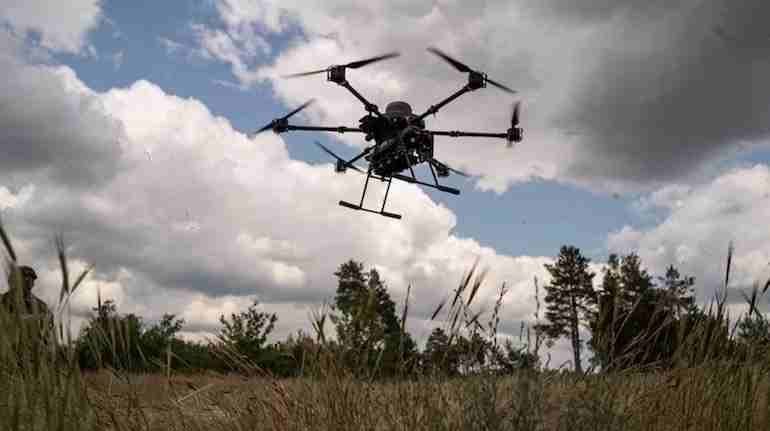
From the Russia-Ukraine war to conflicts in the Middle East, drones and loitering munitions (suicide drones) have changed the course of warfare in the modern battlefield. India’s ‘Operation Sindoor’ also proved how decisive the role of Unmanned Aerial Systems (UAVs) would be in future wars. India has achieved a big and indigenous milestone in timely and timely destruction of these enemy air threats and swarm of drones in the air. The name of this new indigenous technology is-Bhargavastra.
Demonstration took place in Nagpur facility in front of Indian Army
Bhargavastra was successfully demonstrated at the Solar Defense and Aerospace Limited (SDAL) facility in Nagpur on July 24 in front of senior Indian Army officers. Developed under the Make-II program, it is a vehicle-mounted layered hard-kill counter-drone system. During the demonstration, the system successfully detected a swarm of enemy drones, generated a real-time air picture and identified the target without any human error.
Identification of enemy drones from 10 kilometers away
Bhargavastra works on a highly advanced C4I (Command, Control, Communication, Computer and Intelligence) architecture. Three-tier sensor technology has been installed in it:
-
Detection Ability: It can detect large UAVs from a distance of 10 kilometers and small drones at a shorter distance.
-
Sensor Technology: It has electro-optical/infrared (EO/IR) sensors for accurate tracking both day and night.
-
Passive RF Sensor: It tracks enemy radio-frequency signals without revealing its location.
‘Hard-kill’ technology ahead of electronic jamming
Traditional counter-drone systems rely primarily on electronic jamming or signal blocking, but modern autonomous drones are not affected by jamming. Bhargavastra especially ‘hard-kill’ Has been equipped with technology. This means that it physically destroys enemy drones by attacking them directly in the air with a combination of unguided micro-rockets and highly accurate guided micro-missiles.
Deployed from desert to 5,000 meter high mountains
Bhargvastra has been designed according to all types of inaccessible areas of India. It can be easily deployed in hot deserts, plains and even on snowy peaks more than 5,000 meters (about 16,000 feet) high. It integrates instantly with the existing command-and-control networks of the Indian Army, providing a significant edge in future network-centric warfare.
Saving crores from cheap rockets
It is often seen that to bring down cheap enemy drones worth a few lakh rupees, armies have to fire surface-to-air missiles (SAMs) worth crores of rupees, which is economically very harmful. The biggest advantage of Bhargavastra is its low cost. It destroys enemy drones using cheap micro-rockets, which will significantly reduce the defense expenditure of the Indian Army.
India’s step towards becoming a global drone hub
According to the vision of Defense Secretary Rajesh Kumar Singh and Defense Minister Rajnath Singh, India is targeted to become the global hub of the world in indigenous drone manufacturing and anti-drone technology. This successful performance of Bhargavastra proves that with the help of Artificial Intelligence (AI), robotics and automation, India is now ready to be completely self-reliant in protecting its borders.