 look news india

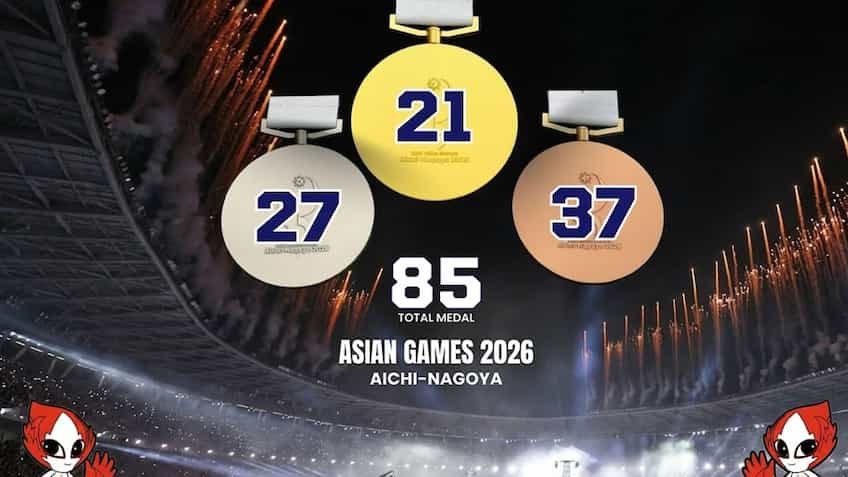
In the 20th Asian Games 2026 held in Aichi-Nagoya, Japan, Indian athletes have added another golden chapter to the pages of history with their indomitable courage, extraordinary discipline and superb sportsmanship. In this Mahakumbh, which ran from 19 September to 4 October 2026, the Indian contingent won a total of 85 medals (21 gold, 27 silver and 37 bronze). This has proved to be India’s second best performance so far in the more than 75-year history of the Asian Games after Hangzhou 2022 (107 medals). In this biggest sporting event at the continental level, India retained the fourth position in the medal table amidst tough competition from top players from 46 countries of Asia. Throughout the tournament, the Indian contingent not only maintained its dominance in traditional sports like shooting, athletics, archery and wrestling, but also won historic medals in emerging sports like Mixed Martial Arts (MMA), Rowing and Squash, proving that the Indian sports ecosystem has now become multi-faceted and world-class.
At the conclusion of this unprecedented campaign of the Indian team, Prime Minister Narendra Modi congratulated all the medal winners and participating players of the country. In his message on the social media platform X (formerly Twitter), the Prime Minister wrote that the performance of our athletes in the 20th Asian Games will fill every Indian with pride. PM Modi said that this historic achievement of 85 medals is a direct result of the years of tireless penance of the players, the dedication of their coaches and the strengthening sports ecosystem of the country. He underlined that from track and field to shooting range and ring, the sportsmanship and never-say-die spirit displayed by our youth will be a great inspiration for the future sporting generation of the country. The Union Sports Minister and top officials of the Indian Olympic Association (IOA) also warmly welcomed the entire contingent, terming it a very solid and significant milestone in the direction of the Indian Olympic campaign ‘Mission 2028 Los Angeles’.
If we analyze this historic journey of India’s 85 medals, the contribution of Indian shooters and athletes was most important. While in the 21 gold medals, accurate shots were heard from the shooting range, in athletics, Indian runners, jumpers and throwers spread golden glow on the track. Among the 27 silver medals, the historic medal won by Sawan Barwal in men’s marathon on foreign soil after 44 years, Shri Shankar Murali’s silver in long jump, Parul Chaudhary’s 3000 meter steeplechase and Tajinderpal Singh Toor’s silver medal in shot put were the main attractions. Gulveer Singh created new history by winning multi-disciplinary medals in long distance races (1500 meters, 5000 meters and 10,000 meters). The 37 bronze medals included the historic first medals of the women’s skeet team and mixed skeet team in shooting, the first historic medal of MMA in the history of Asian Games by Suchika Tariyal and the historic medal of double sculls pair of Satnam Singh and Salman Khan in rowing.
In the final stage of the tournament, India’s men’s and women’s teams further cemented their dominance on the field. Indian women’s and men’s hockey teams brought glory to the country by securing top positions on the podium on the basis of their aggressive play and strong defence. Apart from this, in the cricket competition also, Indian teams proved their clear superiority and won gold medals. In archery, the pair of Dheeraj Bommadevara, Neeraj Chauhan and Kumkum Anil Mohod gave tough competition to the Korean giants by finishing on the podium in both recurve and compound categories. On the wrestling mat, Deepak Punia and Sunil Kumar won medals for India in both Greco-Roman and freestyle styles. On the squash court, Anahat Singh gave a historic performance in women’s singles and won the silver medal, which is India’s best performance in this event so far in the Asian Games.
The biggest strength of India’s second best performance on foreign soil has been the central government’s grassroots sports schemes—Target Olympic Podium Scheme (TOPS) and Khelo India. In the last few years, young talents emerging from Tier-2 and Tier-3 cities of the country were provided world-class foreign coaches, state-of-the-art Sports Science Labs, mental conditioning and international exposure. Many medal winners come from rural and remote areas that did not even have basic sports facilities a few years ago, but government scholarships and modern training testbeds have made them strong medal contenders on the Asian stage. The direct result of the institutional investment made on nutrition, injury management and psychological support of the players was that even in the pressure-filled final matches, the Indian players did not panic but were seen turning the tables in the last moments.
This historic milestone of 85 medals at Aichi-Nagoya 2026 is not just the end of a tournament, but a new beginning in India’s journey to become a superpower on the global stage. Although 85 medals is a huge achievement, but sports analysts believe that we need to speed up preparations for the upcoming 2028 Los Angeles Olympics by learning from the unexpected setbacks in some sports like badminton and boxing. After standing firmly at the fourth position, the next big goal of the Indian sports world is to break into the top 3 club of Asian sports superpowers like China, Japan and South Korea. The Indian contingent that returned from Aichi-Nagoya is being given a historic welcome across the country, and the eyes of crores of sports lovers in the country are now eager to see these young stars hoisting the tricolor on the Olympic podium.