 look news india

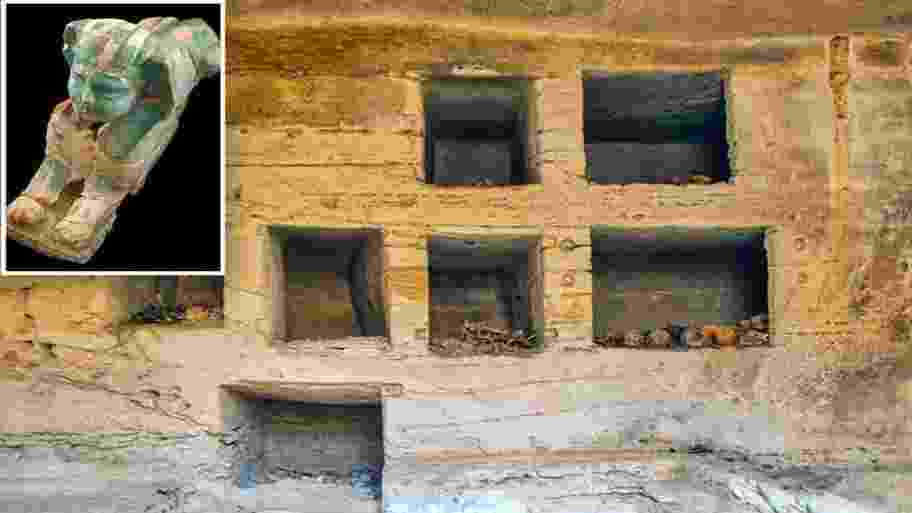
The ancient history of Egypt and its mysterious architecture have once again surprised scientists and archaeologists all over the world. An entire ancient city from the Byzantine era has been discovered buried under the sands of Egypt’s Western Desert. The most surprising thing is that despite being buried underground for centuries, this city has been found very safe and in excellent condition. During this historic discovery, fourth century residential houses, religious buildings and many ancient mysterious tombs with ‘golden tongue’ near Alexandria have also been discovered.
The city was built on a grid system, a fine network of intersections and roads was found.
According to Hisham al-Leithy, Secretary General of Egypt’s Supreme Archaeological Council, ‘The Guardian UK’ report confirms that this ancient city was settled in a very modern and systematic manner. Excavations have revealed that the entire city was based on a ‘grid system’, where the main roads running north-south intersected the roads running east-west at right angles. This excellent urban planning led to the creation of open squares and large public spaces in the center of the city, which reflects the advanced architecture of that period.
Grand Basilica Church and high towers found at the end of the settlement
Giving information about this important discovery, the head of the archaeological mission, Mahmood Masood, said that at the end of this entire settlement buried in the soil, a huge ‘basilica-style’ church was found, whose main door opened towards the main roads of the city. Along with this, to protect this entire area from external attacks and infiltrators, remains of two very huge and tall towers have also been found on the outer boundary of the settlement, which tells about the strong security arrangements.
House of church priest ‘Tisous’ and bronze coins of emperors recovered
A fort with thick and strong defensive walls built for protection and several luxurious houses have also been revealed during the excavations. Within these houses, large halls (reception rooms) and ancient vaulted ceilings were built to welcome guests. One of these houses found by archaeologists belonged to a person named ‘Tisous’, who worked as the deacon (pastor) of this church at that time. Bread ovens, kitchens, grain grinding tools and rare bronze coins with portraits of Byzantine emperors, Latin inscriptions and Christian symbols have been found in these houses.
Gold coins and ancient ostraca from the period of Constantius II
According to the official statement issued by the Egyptian Ministry of Archeology, a large group of gold coins has also been found in the excavation. Experts believe that these gold coins belong to the reign of the famous Roman emperor Constantius II (337-361 AD). Apart from this, Dia Zahran, head of the Islamic, Coptic and Jewish Archeology Department, said that the team has found about 200 pieces of pottery, which were used for writing instead of paper in that period. In history these were called ‘Ostraca’, and on them are written details of business transactions, letters and daily life of that period.
8 meter deep graves and the mysterious ritual of the ‘Golden Tongue’
Apart from the city, a total of 18 ancient tombs have also been discovered at the ‘Marina al-Alayman’ archaeological site, located about 100 kilometers west of the Mediterranean port city of Alexandria, bringing the total number of tombs found so far at the site to 48. Mission chief Iman Abdel-Khaliq said 11 of these tombs were carved out of solid rock, with an average depth of 8 meters (about 26 feet). Near these tombs, pottery, amphorae, lamps and a huge granite sarcophagus (stone coffin) 2.5 meters long were found, inside which were present the remains of a human skeleton and a Sphinx statue made of plaster.
The most mysterious part of this discovery was found from the jaws of the skeletons of some of the dead. Archaeologists found small pieces of gold inside the mouths of some skeletons, which are called “Golden Tongue” in scientific language. According to historians, this was a special religious and funerary belief of the Greco-Roman era, under which it was believed that having a golden tongue would enable the deceased to easily communicate with the gods in the afterlife.
Why did this city suddenly disappear after the fourth century?
Scientists believe that this historical site was actually the ancient Greco-Roman port city of ‘Leukaspis’, which was settled for the purpose of trade along the coast during the second century. This city remained at its peak in terms of trade and prosperity till the fourth century, but after that due to various unknown reasons like a major earthquake, sea storm or epidemic, this entire city disappeared from the pages of history and with time got buried forever under the desert sand.