 look news india

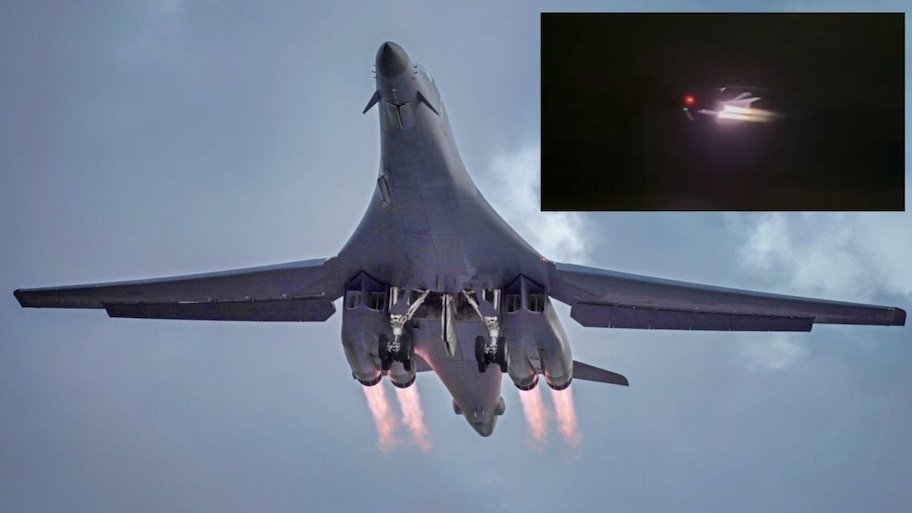
The battlefield of West Asia (Middle East) has once again come to the brink of a great war. The US Air Force’s most destructive and deadly strategic bomber amid regional tensions, fears of missile attacks and proxy conflicts B-1B Lancer The latest deployment and long-range flight of the IAF (known in military circles as ‘The Bone’ and ‘The Beast of Weapons’ due to its lethal capability) has caused a huge uproar across the Middle East.
On behalf of the Pentagon, landing this supersonic heavy bomber in the airspace near the conflict zone is not just being considered a routine exercise, but is being seen as an open declaration of war and a direct warning against Iran-backed militia groups and regional opposition forces. As soon as this giant plane took off with a huge arsenal of weapons, the Gulf countries and global defense experts were left breathless.
The B-1B Lancer, developed by Rockwell (now Boeing) is the backbone of the US long-range strategic bomber fleet. It is a supersonic, variable-sweep wing heavy bomber, which has the ability to fly faster than the speed of sound (approximately Mach 1.25). The most intimidating feature of this aircraft is its payload capacity, which is much more than any other fighter aircraft in the US Air Force’s inventory.
The super-destroyer can carry about 34,000 kg (75,000 lb) of modern ammunition and precision guided weapons in its internal weapons bay and up to 23,000 kg (50,000 lb) on external hardpoints. This includes GPS-guided JDAM bombs, Joint Air-to-Surface Standoff Missiles (JASSM) and Long-Range Anti-Ship Missiles (LRASM). That means, in a single flight, this bomber has the power to turn dozens of underground bunkers, radar stations, missile launch pads and command centers into piles of debris in the blink of an eye.
Washington has taken its show of force policy to its extreme after the recent attacks on US military bases, commercial ships and targets of allied countries in West Asia. The US Central Command (US CENTCOM) has given the message by sending this deadly bomber on a non-stop intercontinental flight from the American mainland (Mainland US) that the US military can deliver accurate and destructive strikes from any corner of the world within a few hours.
With the help of aerial refueling aircraft, the B-1B Lancer traveled thousands of miles without stopping and established its presence in the sensitive airspace of the Middle East. Defense strategists believe that the main objective of this step is to force the opposing camps to retreat from any major audacity and to assure Israel and the Gulf allied countries of the unwavering guarantee of American military security.
This region of the Middle East is directly linked to the interests of India’s energy security, trade and expatriate citizens. Lakhs of migrant workers from states like Uttar Pradesh (especially Lucknow, Kanpur, Gorakhpur, Purvanchal region), Delhi-NCR, Bihar, Kerala and Punjab are providing their services in Gulf countries like UAE, Saudi Arabia, Qatar and Kuwait.
If this flight of the B-1B Lancer proves to be the beginning of a major air attack or a widespread war, the first brunt will be on air travel. The routes of commercial flights going to Europe and West Asia from Lucknow’s Amausi International Airport and Delhi’s IGI Airport may be changed, which will lead to a huge increase in travel time and air fares. Along with this, increasing tension in the Strait of Hormuz may affect the supply of crude oil to India, which may lead to a new crisis of inflation due to increase in domestic fuel prices and freight costs.
The most dangerous strategic strength of the B-1B Lancer is its low-altitude terrain-following radar. This heavy aircraft has the expertise to enter into the enemy air defense zone at very low altitude, passing through hills and valleys and avoiding radar sightings. When it flies just a few hundred feet above the ground, even the most modern anti-aircraft radars fail to track it in time.
Apart from this, the advanced electronic warfare and jamming suites installed in it are fully capable of diverting the tracking signals of enemy missiles. This capability of this bomber has been specially designed to destroy underground military bases, centrifuge centers and missile depots, which has stirred the military leadership of many countries in the region.
Strategic experts assess that this aggressive flight by the Pentagon is like a double-edged sword. On one hand, this step has been taken to push the adversaries on the back foot, on the other hand, the presence of such a deadly heavy bomber on the cusp of war increases the risk of breaking out into a full-scale war due to any small miscalculation.
If the opposing groups consider this show of force as a challenge and launch a retaliatory strike on any American base or warship, then the presence of the B-1B Lancer will not be merely a warning, but this aircraft can be seen carrying out the largest and most destructive air strikes in modern military history. The coming few days are going to prove to be very decisive for the stability of the entire world and global peace.