 look news india

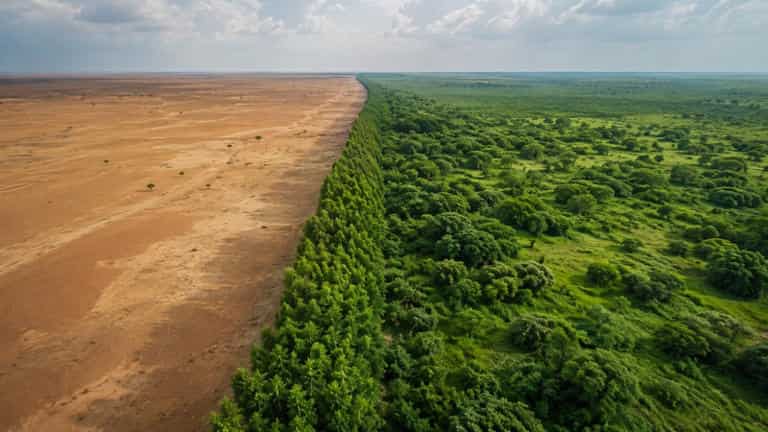
Africa’s ‘Great Green Wall’ campaign, one of the world’s most ambitious environmental projects, is currently attracting the attention of the entire world. This historic initiative, approximately 8,000 kilometers long, starts from the Atlantic coast of Senegal in West Africa and extends to Djibouti in East Africa. The main objective of this entire scheme is not just to plant trees, but to make those areas green and vibrant again which have been facing severe drought, increasing spread of desert and climate change for decades. The African Union started this visionary project in the year 2007.
Initially the plan was only to plant trees, then the whole strategy changed like this
In the early days, the idea of scientists and planners was to create a straight, long and wide belt of trees along the southern border of the Sahara Desert, so that the desert winds and sand could be stopped from moving further. However, as time passed, environmental experts and scientists studied and found that merely planting rows of trees is not a permanent solution to this serious crisis. After this, a fundamental change was made in the strategy of the project. Now its main focus is on reviving the entire ecosystem. Under this, forests, natural grasslands, agricultural lands, wetlands and local species of vegetation are being re-established.
Why did the Sahel region need this huge green wall?
The Sahel region of Africa has been facing major environmental crises for many decades. Here the extent of the desert increased, famine and drought conditions persisted for a long time, the fertility of the soil decreased and due to the impact of climate change, the timing and cycle of rain became completely uncertain. A large population of the Sahel depends entirely on traditional farming and animal husbandry. Due to decreasing soil fertility and lack of rain, crop production was badly affected, leading to a serious food crisis in the area and people lost their means of earning. This is the reason why through this campaign, efforts are being made to improve the health of the soil, increase the ability to retain moisture and water in the soil and make farming profitable again.
Not just a row of trees, a strategy prepared according to local needs
Although ‘Green Wall’ may be associated with the name, it is not a straight or uniform strip of trees. In fact, it is a systematic set of hundreds of small and large restoration projects adapted to the needs of local areas. Wherever required, work is being done – at some places local trees are being planted, at some places the natural vegetation growing on its own is being protected. In many areas, emphasis is being laid on preventing soil erosion, promoting rainwater harvesting, greening grasslands and adopting new methods of sustainable farming. In this way, different strategies have been adopted according to the geographical location and climate of each area.
What is the main goal to be achieved by the year 2030?
Under the Great Green Wall project, some very concrete and big targets have been set for the year 2030:
-
To make about 10 crore hectares of degraded and barren land fertile again.
-
Naturally absorbing about 250 million tonnes of carbon dioxide from the atmosphere.
-
Creating approximately 10 million new green jobs in Africa.
-
Strengthening the food security and livelihoods of millions of people living in the Sahel region.
More than 20 African countries are working together in this huge campaign. Along with this, many major international organizations, global development banks and organizations related to environmental protection are also providing financial and technical support in this.
How much work has been done so far and what are the challenges on the ground?
It is true that the project has not yet reached its final goal, but it has shown great results in many partner countries. Till now millions of trees have been planted in Senegal and the largely barren land there has become green again. Ethiopia has also launched large-scale land reform programs at its own level. In countries like Nigeria and Niger, positive changes have taken place through sustainable land management.
According to recent government and environmental assessments, approximately 30 million hectares of land have been successfully reclaimed so far. However, environmental experts clearly believe that achieving 100% of all targets by 2030 will require more international investment, better coordination among regional countries and peacekeeping in areas affected by security challenges.
The project became a boon for nature as well as the general public.
This revival of barren land and greenery is not limited to saving nature only. A healthy and strong ecosystem prevents soil erosion, improves groundwater levels and sequesters deadly carbon from the air. This also creates a better protected natural habitat for local insects, birds and other wildlife. On the other hand, local farmers and pastoralists are guaranteed better crop yields, adequate fodder for cattle, and regular income. Even in adverse conditions like severe drought, such cultivated land lasts for a long time.
Why is this African model very special for the whole world?
Today, the Great Green Wall is counted among the world’s largest ecosystem restoration projects. Its importance is not limited only to the African continent, because challenges like land desertification and global warming are common problems of the entire world. If this model is completely successful, it will prove to be an excellent example for other arid and semi-arid regions of the world. This project proves that environmental protection and economic development are not contradictory to each other, but complementary.
A unique wall of hope connecting humans and nature
History is witness to the fact that most of the walls in the world were built to divide humans and draw boundaries, but this ‘Great Green Wall’ of Africa is a unique attempt to reconnect humans and nature. The real success of this massive campaign will be measured not just by how many trees are planted, but by how much barren land becomes suitable for growing food grains again, how many families’ living standards improve, how much biodiversity improves and how much local communities become able to withstand the shocks of climate change. This is why this Green Wall is not just today’s campaign, but a strong foundation for the social and economic change of the future.