 look news india

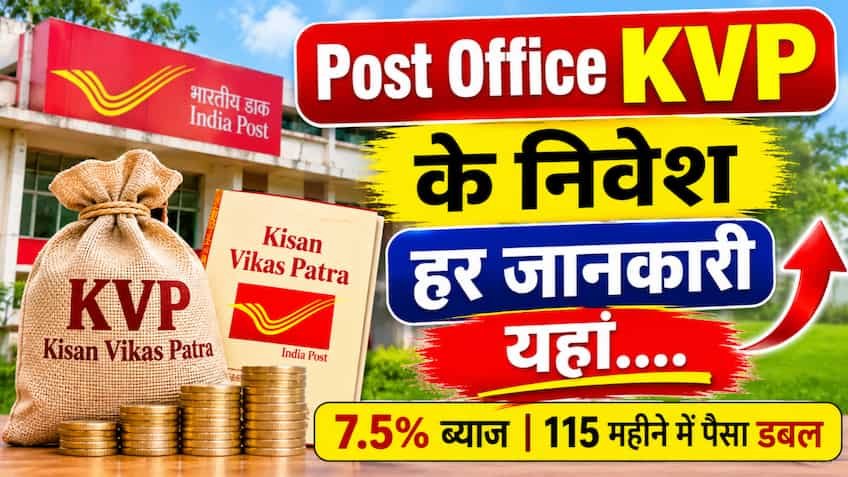
New Delhi/Lucknow: In today’s era when there is volatility in the stock market and mutual funds, the Post Office’s Kisan Vikas Patra (KVP) scheme remains the most reliable option for crores of Indians looking for safe investment and guaranteed returns. In this small savings scheme supported by the Finance Ministry of the Government of India, 7.5 percent compounded annual interest is being given for the current October-December 2026 quarter. At this attractive interest rate, your lump sum amount invested in KVP doubles directly in exactly 115 months i.e. 9 years and 7 months. For example, if you invest Rs 5 lakh in this scheme today, on maturity you will get the entire Rs 10 lakh guaranteed. The most important thing is that the day you buy KVP, your interest rate and the period for doubling your money are locked, that is, even if the government reduces interest rates in future, your investment will not be affected.
The biggest feature of Kisan Vikas Patra Yojana is its simplicity and flexible investment limits. Any adult citizen of India (18 years of age or above) can open a single account in his own name or a joint account (Joint A or Joint B) with a maximum of three adults. Additionally, minors above 10 years of age can open an account in their own name, while children below 10 years of age or a mentally unsound person can operate the account on behalf of their guardian. Talking about investment amount, you can start the account with a minimum of ₹1,000 and then deposit any amount in multiples of ₹100. There is no upper limit on maximum investment in this scheme, that is, you can safely invest from ₹ 10 lakh to ₹ 1 crore in one go or through different accounts. However, it is mandatory to provide PAN card for investments above ₹50,000 and income proof for investments above ₹10 lakh.
KVP is a long-term savings plan, so before investing in it, it is very important to understand the rules of withdrawal i.e. closing the account. Under normal circumstances this plan has a lock-in period of 2 years and 6 months (30 months). That is, you can withdraw money by prematurely closing the account only after completion of two and a half years from the date of account opening. If you close the account after 30 months but before maturity (115 months), you do not get the full 7.5% interest but the principal is paid after deducting the reduced interest as per Post Office Savings Account or the prescribed penal rate. However, the account can be closed even before the lock-in period of two and a half years in three special emergency situations: first, death of any or all the account holders in a single account or joint account; Secondly, on confiscation of a certificate pledged with a Gazetted Officer; And thirdly, if a court orders closure of the account.
Investors often have the misconception that all post office schemes are tax free, but this is not the case with KVP. The amount deposited in Kisan Vikas Patra does not provide the benefit of tax exemption under Section 80C of the Income Tax Act. Also, the interest earned from this scheme is fully taxable, which has to be added under ‘Income from Other Sources’ and paid as per the income tax slab of the investor. However, a major feature of KVP is that in case of emergency, you can take a loan at a lower interest rate by pledging your KVP certificate to a bank or financial institution. Apart from this, under eligible circumstances, KVP account can also be transferred from one post office to another in the country and from one person to another eligible person.
If you want to invest in Kisan Vikas Patra, you can fill the application form by visiting your nearest post office or authorized government bank branch. To open an account, you will have to provide passport size photo, identity card (Aadhaar card, voter ID or passport), address proof, PAN card and nominee details. After submitting the application and amount (cash, check or demand draft), an official KVP passbook or certificate is issued to you by the post office, which clearly mentions your investment amount, interest rate and double the maturity amount to be received after 115 months.