 look news india

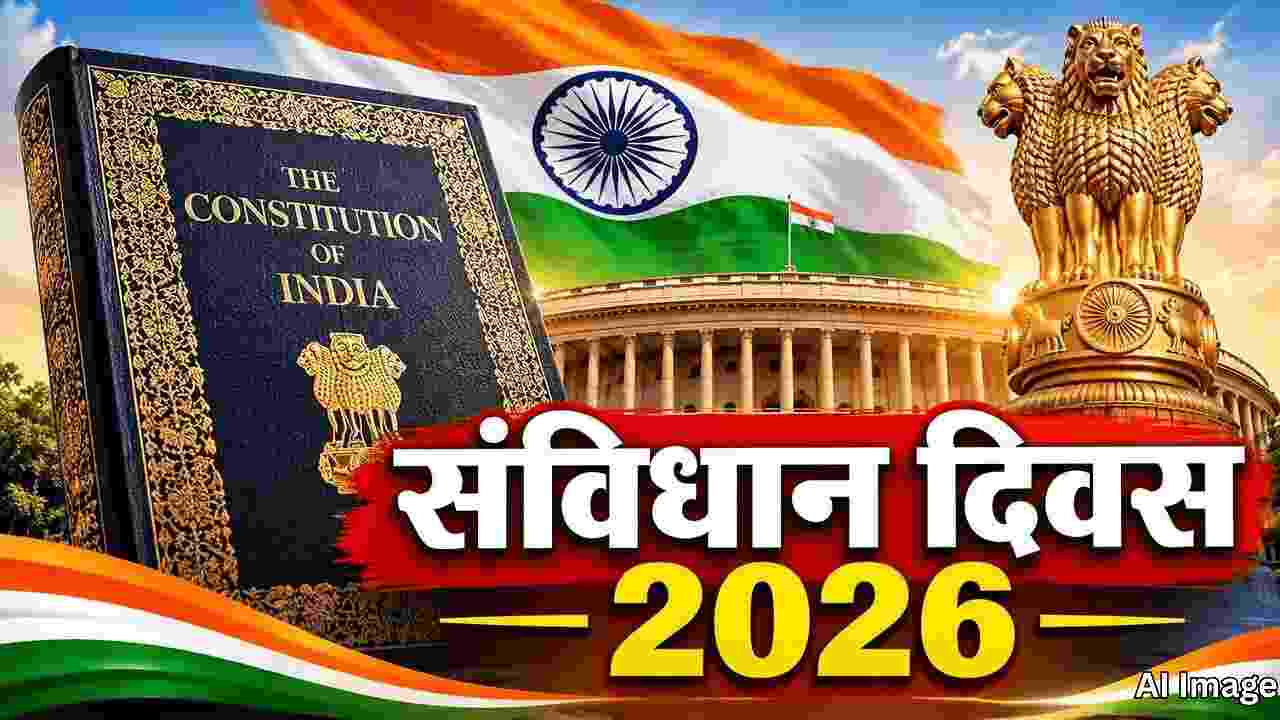
New Delhi: Today, Thursday, 26 November 2026, the entire country is celebrating its 77th Constitution Day (Samvidhan Diwas). Exactly 77 years ago, on 26 November 1949, the Constituent Assembly of India duly adopted and adopted the Constitution of independent India, which later came into force throughout the country on 26 January 1950. All efforts were made to prepare this great document that laid the foundation of the world’s largest democracy. 2 years, 11 months and 18 days It took time. The Government of India had officially announced to celebrate 26 November as ‘Constitution Day’ in the year 2015 to honor the historical contribution of Constitution maker Babasaheb Dr. Bhimrao Ambedkar and to spread awareness about constitutional values among the citizens.
The creation of the Indian Constitution was not the result of any simple process, rather it was the result of deep brainstorming of the great freedom fighters, jurists and thinkers of the country. The first meeting of the Constituent Assembly was held on 9 December 1946 in the Central Hall of the Parliament House, New Delhi, which was temporarily chaired by Dr. Sachchidanand Sinha. Two days later, on 11 December 1946, Dr. Rajendra Prasad was elected the permanent President of the Constituent Assembly, while on 29 August 1947, Dr. Bhimrao Ambedkar was appointed Chairman of the Drafting Committee. During this period, a total of 11 sessions of the Constituent Assembly were held and open debates and discussions continued for 166 days. When the Constitution was drafted, more than 2,000 amendments were made to it and it was finally finalized on 24 January 1950 after being signed by 284 members.
The most amazing and unique feature of the Indian Constitution is that its original copy was neither typed on any typewriter nor printed in any printing press. Famous calligrapher on the request of Pandit Jawaharlal Nehru, the first Prime Minister of India. Prem Bihari Narayan Raizada He wrote the entire Constitution with his own hands in English and Hindi in a very beautiful italic style. When Nehru ji asked him the remuneration for this work, Raizada refused to take a single penny and kept only one condition that his name should be written on every page of the Constitution and his grandfather’s name on the last page. It took him 6 months to write it and during this time 303 pen holders with nib number 432 were used. At the same time, the great painter Nandlal Bose of Santiniketan and his disciples had decorated each page of the Constitution with beautiful artefacts of Indian history and culture.
The Indian Constitution is the longest written constitution in the world, originally consisting of 395 articles, 22 parts and 8 schedules (which, after amendments, has now expanded to over 448 articles, 25 parts and 12 schedules). At that time, approximately Rs 64 lakh was spent in its construction.
Even today, the original handwritten copies of the Constitution (Hindi and English) are specially made in the Library of Parliament House to protect them from getting spoiled. Helium-filled transparent boxes It has been kept safe in India, so that the paper and ink remain safe for centuries.
The Indian Constitution is also called a ‘borrowed bag’ because its makers studied the constitutions of about 60 countries of the world and adopted their best features as per the Indian conditions. For example, fundamental rights are taken from the US, parliamentary system from Britain, directive principles from Ireland and fundamental duties from Russia (former Soviet Union).
Not only men, but also 15 extraordinary women had an important contribution in the making of the Constitution, among whom Sarojini Naidu, Hansa Mehta, Durgabai Deshmukh, Rajkumari Amrit Kaur and Begum Ajaz Rasool were prominent.
On 24 January 1950, the day the members signed the original copy of the Constitution, it was raining heavily in Delhi, which the members of the Constituent Assembly considered a very auspicious omen for the future of independent India.
This question arises in the minds of many people that when the Constitution was ready on 26 November 1949, then why was there a wait of two months i.e. till 26 January 1950 to implement it. Actually, this date had historical importance. On 26 January 1930, the Indian National Congress had declared ‘Complete Independence’ in the Lahore session and every year this day was celebrated as Independence Day. To immortalize the memory of this historical day, the Constitution was implemented on 26 January 1950 and India became a sovereign democratic republic.