 look news india

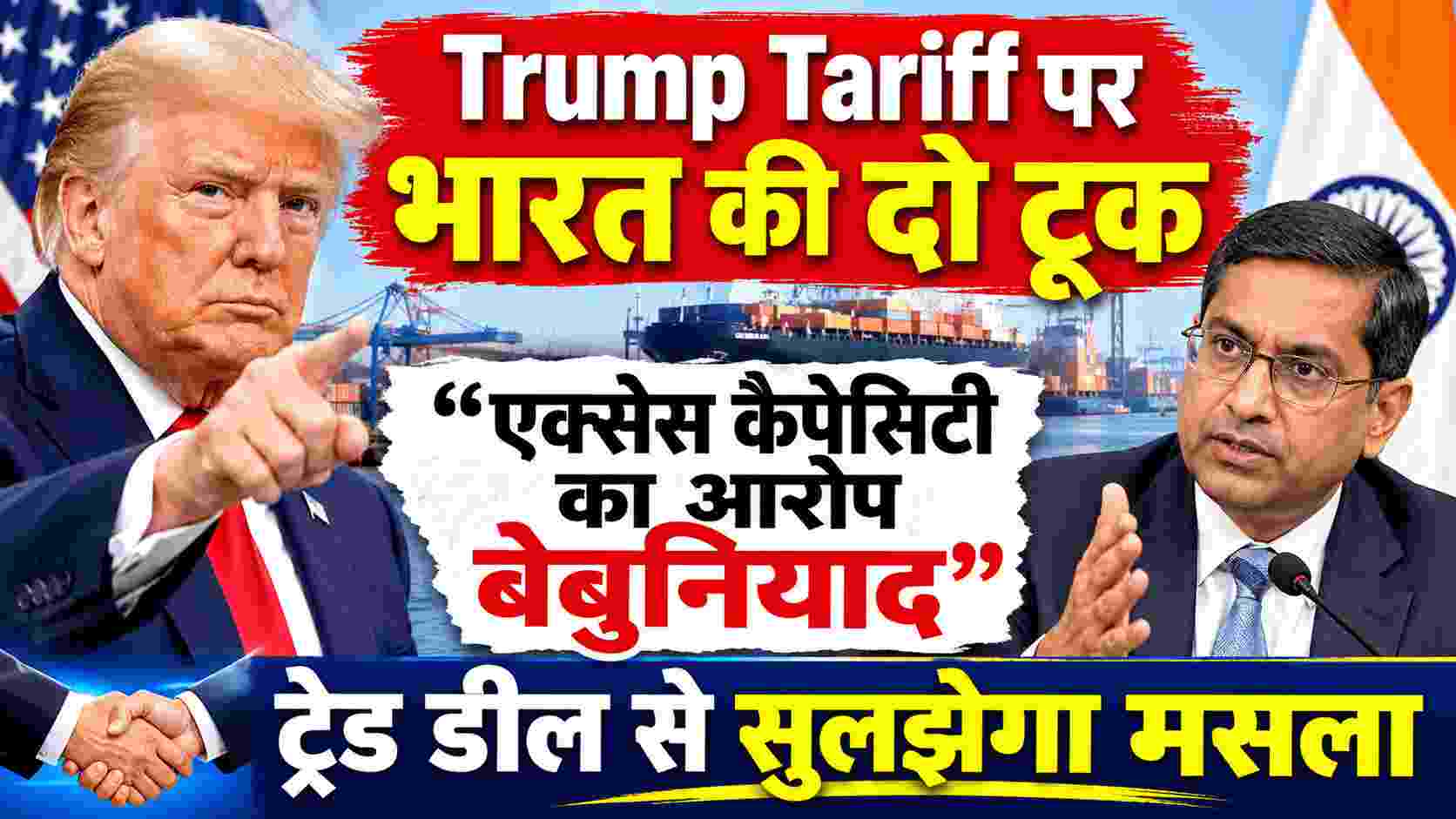
New Delhi: India has adopted a very strict and clear stand on the new proposal by US President Donald Trump’s administration to impose import duty (tariff) of up to 25 percent on Indian goods. The Union Ministry of Commerce and Industry issued an official statement on Thursday, November 26, 2026, terming the allegations of ‘Structural Excess Capacity’ made in the Section 301 investigation report of the US Trade Representative (USTR) as completely baseless and baseless. India has bluntly said that there is no such additional production capacity in any industrial or manufacturing sector of the country, which could affect the global market. Along with this, New Delhi has clarified that any trade related concern or dispute should be resolved only through the ongoing Bilateral Trade Agreement (BTA) negotiations between the two countries instead of imposing unilateral tariffs.
Actually, this entire controversy started after a notice issued by the US Trade Representative Office (USTR) on Wednesday. The US has introduced new tariff proposals under Section 301 of the Trade Act 1974 against 14 major economies, including India, China, the European Union, Japan, South Korea and Vietnam, after an eight-month-long investigation. The Trump administration alleges that India’s industrial policies like ‘Make in India’ and ‘Self-reliant India’, government subsidies and low production costs are hurting American manufacturers and workers. Washington has claimed that these countries are producing more industrial production than their domestic needs and are selling goods in the global market at cheap prices.
America has adopted a dual strategy under this new tariff structure, which trade experts are considering as a policy of creating pressure. According to the USTR proposal, if India finalizes a bilateral trade agreement (BTA) with the US, a maximum tariff of 17 percent will be imposed on Indian goods. But if a trade agreement is not reached between the two countries, this duty may increase to 25 percent. Comparatively, India’s 17 percent tariff under the proposed trade deal has been kept slightly lower than that of Bangladesh, Indonesia, Malaysia and Thailand (18 percent) and China and Vietnam (20 percent), so that India can be induced to compromise.
Responding to the US notice, the Indian Commerce Ministry said that the government is thoroughly examining this entire document. The Ministry clarified that India cooperated constructively during the entire investigation process and proved in writing that India’s manufacturing sector is primarily focused on meeting the huge domestic demand and not on disrupting the global market. India reminded Washington of the declaration of 2 February 2026 and the India-US Joint Statement issued on 7 February 2026, saying that both countries are committed to concluding a balanced and mutually beneficial bilateral trade agreement (BTA) at the earliest, and all tariff issues will be resolved within this framework.
At present, the matter of relief for Indian exporters and industry is that these new tariffs proposed by America are not being implemented with immediate effect. Under US legal procedure, USTR has invited public suggestions and objections on this proposal till 5 January 2027, after which a public hearing will be held on 25 January 2027. In such a situation, there is still at least two months for any new fee to be implemented. Meanwhile, economic think tank GTRI has advised the government to continue the talks firmly while protecting its interests instead of giving unilateral concessions under any pressure.