 look news india

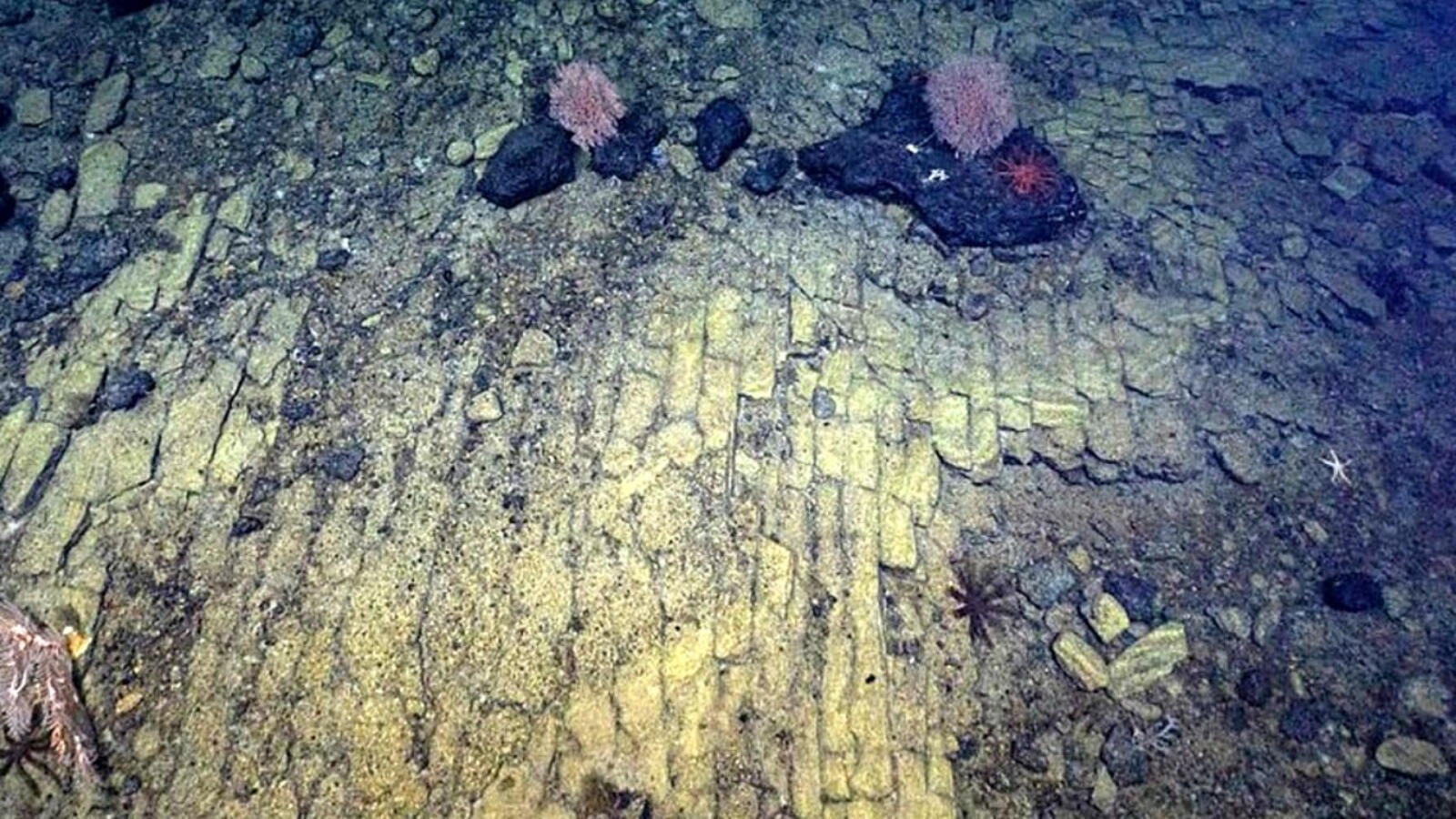
The world of oceans, miles away from the earth’s surface, surrounded by blue waters, has always been the center of human curiosity and mystery. Scientists have been running expeditions for years to find out what is hidden in the immense depths of the ocean. In this series, a discovery came to light in the Pacific Ocean which surprised scientists and social media users all over the world. Researchers found a structure on the sea floor that looks exactly like an ancient paved road. As soon as they saw this unique structure, various questions started arising in people’s minds and it started being linked to mythological stories.
This surprising incident came to light during an expedition of Ocean Exploration Trust’s research vessel ‘E/V Nautilus’. This team of scientists was mapping the seabed and studying the fauna in the Nootka Seamount area under the Papahānaumokuākea Marine National Monument located in the Pacific Ocean. Meanwhile, a scene was captured in the camera of the remote operated submarine rover (ROV), which shocked everyone. At a depth of about 1,029 meters i.e. about 3,300 feet, a path of yellow stones frozen like bricks was visible on the sandy and rocky surface of the sea. Whoever saw this scene could not believe his eyes.
As soon as the video of this discovery was live streamed on the internet and went viral on social media, a round of speculations started. Social media users started calling it the path to ‘Paatal Lok’ of mythology or the remains of ‘Atlantis’, a mysterious civilization that had disappeared in ancient times. People believed that such a geometric structure could not be formed on its own at such a depth. However, scientists rejected all these imaginary and sensational claims and presented the data of their detailed investigation. The researchers clarified that even though this sight looks like a human work or a paved road, it was not built by any human being or any ancient civilization. This is entirely the result of a natural geological phenomenon.
After in-depth study, scientists said that this structure is mainly made of a special type of volcanic rock called ‘Hyaloclastite’. This rock is formed when hot magma from an active undersea volcano comes in contact with cold water. When it comes in contact with water and cools in the form of lava and debris, it naturally begins to crack. Due to thermal pressure and cold, these cracks develop at almost right angles i.e. 90 degrees. Over time, due to constant pressure and temperature changes, these rock fragments break in such an organized manner that when seen from a distance, they begin to look like a man-made brick road or block. Apart from this, geological reasons are also responsible for the yellow color of this structure, which has emerged due to hydrothermal alteration and mineral deposits at low temperatures in the volcanic glass.
This ‘yellow brick road’-like structure may not be a human road, but such discoveries are extremely important for understanding the geological history of the Earth’s interior. This entire expedition of ‘E/V Nautilus’ was not limited to just one discovery, but it involved mapping the untouched aspects of the deep sea on a large scale. During this mission, scientists have discovered deep sea coral reefs, sponge communities, fossilized whale bones and even the tooth of the ancient shark ‘Megalodon’. Apart from this, a sea pen of the genus ‘Solumbellula’ was also recorded and collected for the first time in the Pacific Ocean. Scientists believe that as mysterious as this world of oceans is, it has the power to reveal many unresolved issues of the Earth’s environment and past. Such discoveries teach us that nature has such unique ways of art and creation that leave even human imagination behind.