 look news india

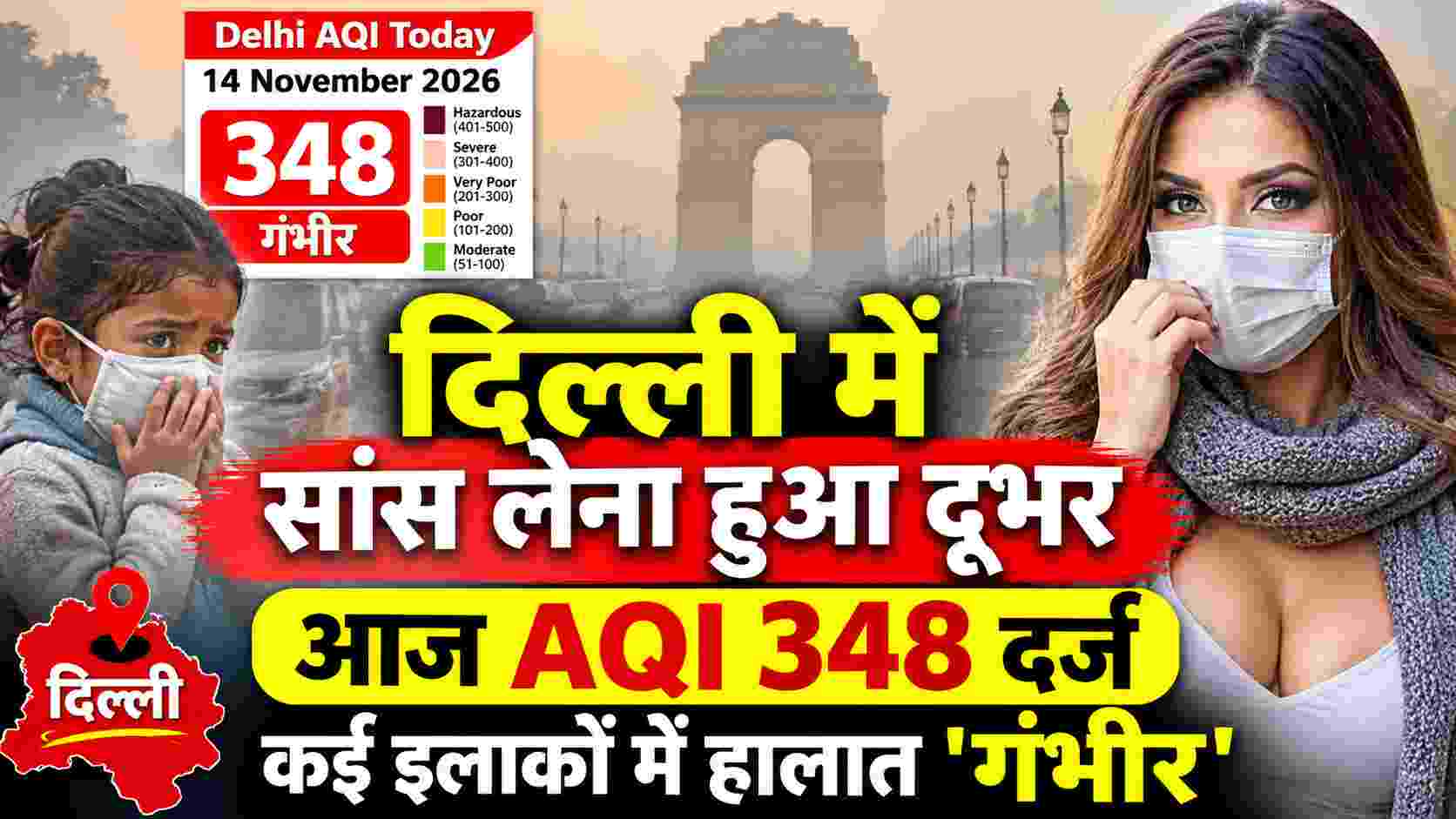
Toxic smog and air pollution continue to wreak havoc in the country’s capital Delhi and NCR. According to the latest bulletin of the Central Pollution Control Board (CPCB), despite a slight improvement compared to Friday, at 7:00 am today, Saturday, November 14, 2026, the Overall Air Quality Index (AQI) of Delhi has been recorded at 348, which falls in the ‘Very Poor’ category. Yesterday i.e. on Friday morning, the average AQI of the capital had crossed 403 and entered the ‘Severe’ category, due to which it became difficult for people to breathe in the open air and go out without irritation in the eyes. Today, the average figure has definitely declined by about 55 points, but the blanket of poisonous micro particles (PM2.5 and PM10) is still prevalent in many major areas of the capital and the air quality index there remains in the ‘severe’ category beyond 400.
If we look at the data of all 59 air quality monitoring stations of Delhi at 7:00 am, it is clear that many parts of the capital have not got any significant relief yet. Notably, NIH Narela has recorded the highest AQI of 429, while Delhi University’s North Campus (421), IIT Delhi (419), ITO (415), Pusa (415), Burari Crossing (410) and DTU (403) are in the grip of severe pollution. Apart from these, the air is also at very dangerous levels in densely populated areas like Chandni Chowk (392), JNU (390), Bawana (389), Jahangirpuri (383), Anand Vihar (379) and Rohini (366).
| Delhi’s Monitoring Station | Today’s AQI (14 November 2026) | Category of air quality | main pollutant |
| NIH Narela | 429 | Severe | PM2.5 |
| DU North Campus (North Campus, DU) | 421 | Severe | PM2.5 |
| IIT Delhi | 419 | Severe | PM10 |
| ITO (ITO Central) | 415 | Severe | PM2.5 |
| Pusa (Pusa West) | 415 | Severe | PM2.5 |
| Burari Crossing | 410 | Severe | PM2.5 |
| DTU (DTU North) | 403 | Severe | PM2.5 |
| Chandni Chowk | 392 | Very Poor | PM2.5 |
| Anand Vihar | 379 | Very Poor | PM2.5 |
| IGI Airport (IGI Airport T3) | 350 | Very Poor | PM10 |
According to environmental and meteorologists, there are two main reasons behind the persistence of pollution levels in Delhi—first, smoke from stubble burning in neighboring states and emissions from local vehicles and construction works; And second, adverse weather conditions. Due to drop in temperature in the morning and very slow wind speed, pollutant particles get trapped near the ground surface, due to which a thick layer of smog is formed. According to the forecast of the Indian Meteorological Department (IMD), Delhi’s air quality may remain in the ‘very poor’ to ‘severe’ category till November 16, 2026, after which some relief from pollution is expected as the wind speed increases.
As per Central Pollution Control Board (CPCB) standards, an AQI between zero and 50 is considered ‘good’, 51 to 100 ‘satisfactory’, 101 to 200 ‘moderate’, 201 to 300 ‘poor’, 301 to 400 ‘very poor’ and 401 to 500 ‘severe’. Currently, GRAP Stage-II restrictions are in force in Delhi-NCR, which include water sprinkling on roads, use of anti-smog guns and ban on diesel generators. Doctors have strongly advised the elderly, children, pregnant women and patients suffering from asthma or heart disease to avoid walking outside the house in the morning and evening, wear N95 masks while going out and keep the indoor air pure.