 look news india

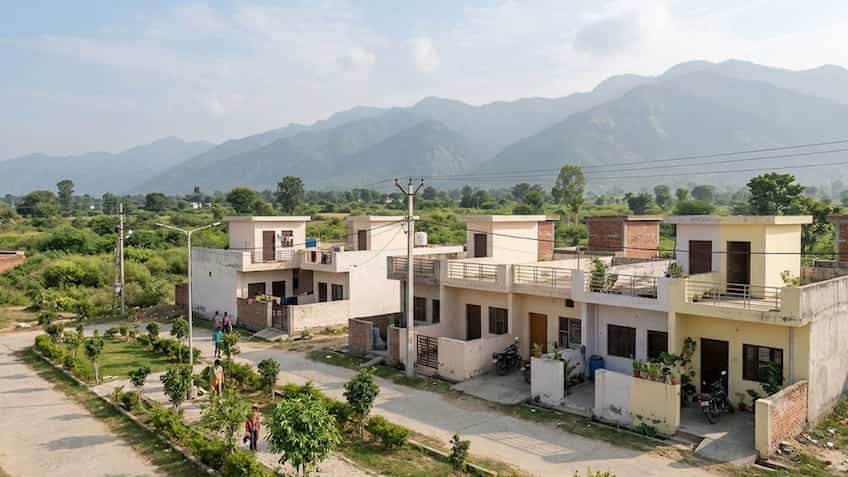
Fed up with the poisonous air, concrete jungles and everyday traffic jams of Delhi-NCR, every second person dreams of a peaceful retreat in the lap of mountains on weekends. To capitalize on this desire, a very attractive real estate offer is becoming increasingly viral these days on social media and digital platforms. It is being claimed that ready or semi-finished houses and villa plots are available at a starting price of only ₹ 13.76 lakh, located near the Shivalik hills or the serene valleys of Aravali, just three and a half hours’ drive from Delhi-NCR.
The biggest USP of this advertisement is said to be its easy payment scheme, under which booking can be done by paying only a token amount of ₹ 68,000 and the facility to repay the remaining amount in 15 years long home loan EMI. At first glance, this deal seems cheaper and attractive than a rented house, but can one really get a legal house with a beautiful view of the mountains at such a low price or are there some technical and legal complications hidden behind it? Let us understand the financial and ground mathematics of this entire project.
Real estate developers often offer the formula of low down payment and easy installments over a long period to attract customers. If we analyze the total original property cost of ₹13.76 lakh, the initial booking amount of ₹68,000 works out to be around 5 per cent of the total price. According to the rules of Reserve Bank of India (RBI) and National Housing Bank (NHB), any authorized bank or Housing Finance Company (HFC) approves loan only up to a maximum of 80 to 85 percent, that is, the buyer has to bear the margin money (down payment) of at least 15 to 20 percent (about ₹ 2.5 lakh to ₹ 2.75 lakh).
If the developer arranges a home loan for the remaining amount of ₹11 lakh to ₹12 lakh by tying up with a non-banking financial institution (NBFC) for a tenure of 15 years (180 months), the monthly EMI will come to around ₹10,800 to ₹12,300 per month at the current average interest rate of 8.5% to 9.25%. This EMI fits perfectly into the budget of the urban middle class, but buyers should understand that a loan of ₹11 lakh at 9% over 15 years will incur an additional interest of about ₹9.15 lakh, taking the cost of the original property to over ₹23 lakh.
The figure of ₹13.76 lakh seen in property advertisements is usually the ‘Base Selling Price’ (BSP). When a buyer moves towards the final agreement to sale and possession, there are several mandatory additional charges added which increase the final budget by 20 to 30 percent:
-
Stamp duty and registry charges: Stamp duty (5% to 7%) and court registration fees imposed by the revenue department of the respective state (Haryana, Uttarakhand, Rajasthan or Uttar Pradesh) together add up to an additional burden of ₹70,000 to ₹1,00,000.
-
Internal and External Development Charge (IDC/EDC): Additional charges are levied per square yard or per square foot in the name of laying roads, sewerage, street lights and water pipelines within the society.
-
Electricity-water connection and club membership: The lifetime charges for separate electricity transformer, water meter, security gate and club house go up to ₹1.5 lakh to ₹2.5 lakh.
-
Goods and Services Tax (GST): If the project is under-construction, GST of 5% without input tax credit is payable separately. After adding all these expenses, the ₹13.76 lakh house easily touches the cost of ₹17 to ₹18 lakh by the time you get the keys.
If the travel limit of three and a half hours from Delhi border is measured through Google Maps, then mainly three major routes emerge:
The first route reaches beyond Saharanpur and Roorkee to Haridwar, Rishikesh or rural areas on the outskirts of Dehradun in Uttarakhand (such as Raiwala, Bhagwanpur or the Shivalik foothills) via the Delhi-Meerut Expressway and the New Delhi-Dehradun Economic Corridor. The second route touches Panchkula, the foothills of Morni Hills or the border area of Narayangarh via the Delhi-Panipat-Ambala National Highway. The third route goes to the tranquil rural areas adjacent to the Aravalli Hills in Rajasthan around Alwar, Neemrana or Kotputli via the Delhi-Jaipur Highway or the Delhi-Mumbai Expressway.
It is very important to note that the villas or houses available in this budget are not in the main city of any major hill station (like Mussoorie, Nainital, Shimla or Kasauli), rather they are being developed in semi-urban or rural areas located at the base of the mountains i.e. foothills or 5 to 10 kilometers from the highway.
If you are planning to invest in such a project, then do not make the mistake of transferring money only after seeing attractive brochures and tempting renders. Before visiting the spot and giving token money, do the following checks:
-
RERA Registration Number Confirmation: First of all, go to the RERA portal of the concerned state (like HRERA, UKRERA or RajRERA) and check the valid registration number of the project. Investing money in a project without RERA approval can be fraught with legal risks.
-
Land Use of Land (CLU): Make sure that the land use on which the colony is being cut has been changed from agriculture to residential/commercial. Future construction without non-agricultural conversion may be declared illegal.
-
Land laws of hill states: In states like Uttarakhand, limits on purchasing land for outsiders (maximum 250 square meters or specific restrictions outside municipal limits) apply. Make sure the project is completely within legal limits.
-
Approval List of Bank Loan (APF): If established nationalized and leading private banks like SBI, PNB, HDFC or ICICI have pre-approved (issued APF Code) that project for home loan, it means that the legal documents of the project have been verified to a great extent.
-
Basic civic amenities: A weekend home is a joy only when there is 24-hour electricity, potable fresh water, mobile network connectivity and nearby emergency health centre. Before signing the contract, do a ground check of these facilities.