 look news india

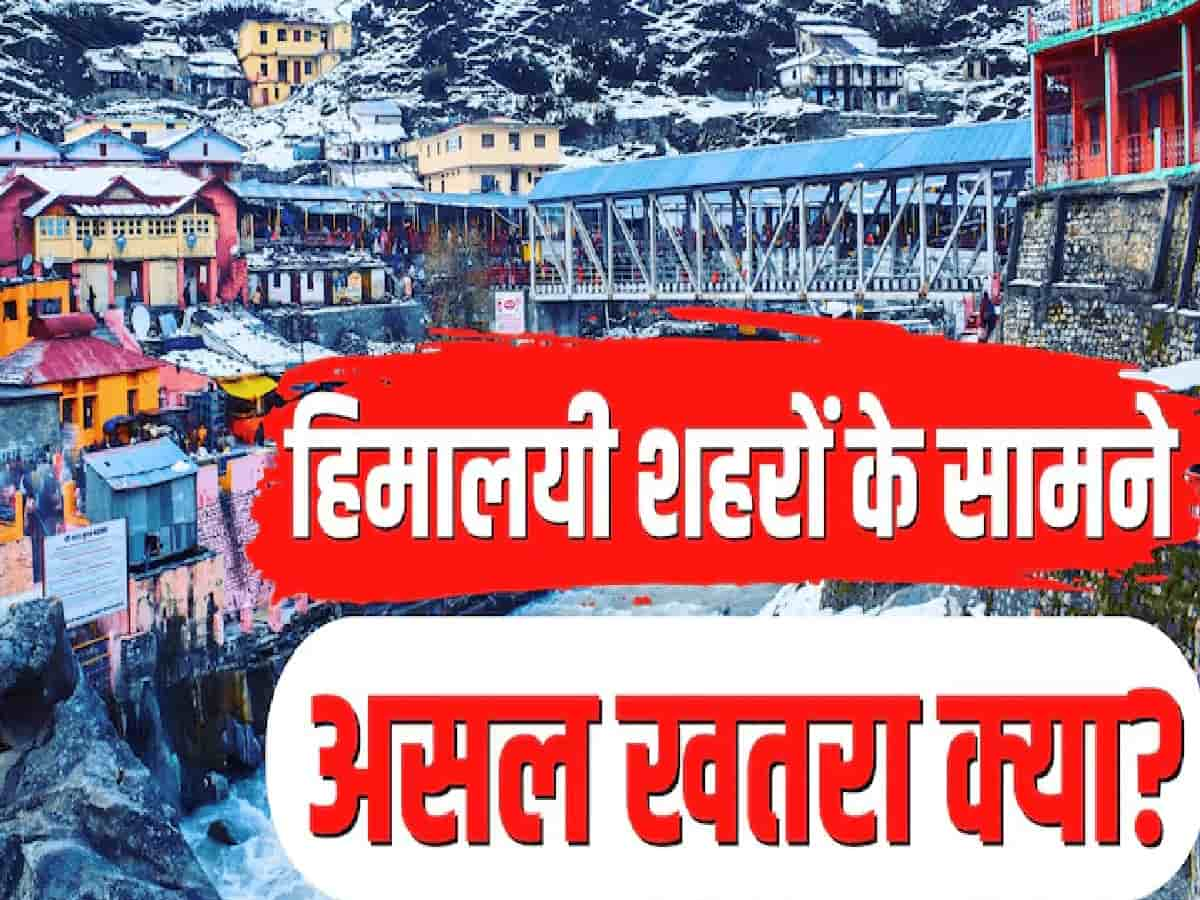
The challenge of protecting the mountain cities located in the lap of the Himalayas, the protective shield of North India and the center of natural wealth, is no longer limited to the discussions of environmental activists or researchers only. This serious issue has today taken the form of the most complex and difficult litmus test of life and existence before India’s national disaster management system, city planners and the top judiciary. The shocking figures of the much talked about ‘Landslide Atlas of India’ released by the Indian Space Research Organization (ISRO) show that between the year 1998 and 2022, about 80 thousand serious incidents of landslides were officially recorded in the hills of the Indian Himalayas and Western Ghats. Of these, 66.5 per cent of severe landslides occurred in sensitive areas of north-western Himalayan states like Uttarakhand, Himachal Pradesh and Jammu and Kashmir alone. In the early days of 2023, when the ground of the historical city of Joshimath in Uttarakhand caved in and wide cracks appeared on the walls of houses, more than 678 residential and commercial structures were declared unsafe and dangerous with immediate effect. Even after three years of that tragic incident, the process of displacement and safe rehabilitation is still incomplete and surrounded by controversies. This dire ground reality is forcing policy makers to directly confront the most bitter question: can every small or big city in the Himalayas be saved, or is there no other scientific option left other than evacuating some cities.
According to environmental scientists and geologists, three terrible threats are simultaneously attacking the existence of the sensitive cities of the Himalayas like a trident. The first and most immediate threat is landslides and ongoing ground subsidence. The basic geography of an important strategic and religious city like Joshimath is that it is not built on a solid foundational rock, but on a pile of weak debris and loose soil from ancient landslides that happened ages ago. Apart from this, this entire area falls in Seismic Zone-V with high seismic sensitivity where tectonic movements continue continuously. Modern satellite imaging and radar interferometry data have proven that many major parts of Joshimath city are sinking at an alarming rate of 94 mm per year. The second major scientific threat is continuously expanding in the form of Glacial Lake Outburst Flood i.e. GLOF. According to ISRO satellite analysis, in the decade from 1984 to 2023, the area of 676 lakes out of 2,431 glacial lakes in the Himalayan region has increased unexpectedly due to global warming and rapidly melting glaciers. These huge natural icy reservoirs have the destructive ability to wash away the cities below like straw if the natural dam breaks. The third and entirely man-made threat is uncontrolled urbanization, disregard for standards and the uncontrolled burden of mass tourism. Water supply, sewage disposal, solid waste management and traffic systems at historic hill stations like Nainital, Mussoorie, Manali and Shimla have crossed their carrying limits. The uncontrolled rush of tourists and the construction of huge multi-storey hotels have hollowed out the mountain slopes from within, due to which the discussion has now moved beyond ‘what can be saved’ to ‘which cities should be abandoned immediately’.
To overcome this deep environmental crisis and keep life safe in the mountains, the Central Government, NITI Aayog and the Central Empowered Committee (CEC) of the Supreme Court have together prepared a three-tier security framework. National Disaster Management Authority i.e. NDMA has issued strict guidelines for hill settlements. Under these strict rules, it is recommended to impose a complete ban on any new concrete construction work within a radius of 250 meters of active landslide areas and up to a distance of 50 meters on both sides of known seismic fault lines. Along with this, a rule has been set to limit the maximum height of buildings constructed on hill slopes to 7.5 meters and not allow the Floor Area Ratio (FAR) to exceed 1.7 under any circumstances so that there is no additional load on the slopes. On the other hand, the Centrally Authorized Committee of the Supreme Court issued historic guidelines for Himachal Pradesh and other hill states in October 2026. The court committee has ordered that an independent technical audit of the scientific ‘carrying capacity’ of every famous tourist destination be conducted and mandatory environmental clearance be obtained for all major roads and four-lane projects. The Court made it clear that the old and lax ‘permission-based’ system in the name of tourism must be immediately ended and ‘scientific and risk-sensitive planning’ has to be implemented legally. In this context, the Central Government is going to launch the ‘Himalayan Urban Bio-Shades’ i.e. HUBS project in the year 2026 with the framework of ‘Clean Himalayan Mountain City’. Under the HUBS project, hill cities will be seen as self-sustaining natural ecosystems rather than concrete forests, with integrated scientific management of local water sources, natural drains and solid waste disposal. Apart from this, micro level ward disaster management plan is being prepared for every civil ward of Shimla on the lines of Dharamshala and Mandi so that in case of emergency, rescue work can be started immediately at the local level.
Despite announcements of stringent regulations and relief packages, the pace of actual change on the ground remains disappointing. The most painful example of this is the displacement model of Joshimath. The central government had in November 2023 approved a massive special package of Rs 1,658.17 crore for the rehabilitation and infrastructure reconstruction of Joshimath, of which Rs 91.82 crore was earmarked only for land acquisition and compensation to the affected families. After this, in May 2025, another scheme of Rs 291 crore was approved to slow down the pace of land subsidence, the objective of which was to construct ‘toe protection’ wall on the banks of the river to stop the erosion of Alaknanda River, do scientific grouting and stabilization of weak slopes and modernize the drainage system of the entire city. But the latest ground reports of 2026 reveal that even three years after the package was approved, the complete relocation of Joshimath remains incomplete and hundreds of affected citizens are forced to live in fear in unsafe and dilapidated houses. Geologists have issued a stern warning that the ongoing landslides on the foothills of Alaknanda have not stopped completely and the cracks on the slopes may widen again in the coming monsoon. According to environmental experts, there are three biggest obstacles to saving Himalayan cities. The first hurdle is the severe lack of political will, where enforcement of stringent building bylaws is avoided due to local votes and pressure from the real estate lobby. The second major problem is the ‘circular trap’ of resettlement, which was also seen after the 2015 Nepal earthquake. People frequently return to their unsafe old villages instead of permanently settling in safe remote resettlement sites because of their ancestral livelihoods, farming and emotional attachments. The third hurdle is the lack of trust of local people in the scientific determination of carrying capacity, which the bureaucracy merely turns into a means of imposing restrictions. Amidst all these discrepancies, the experts’ conclusion is quite clear that it is geologically impossible to save every city of the Himalayas in its old condition. Some of the most fragile areas will have to be freed from human settlements and converted into safe buffer zones, while the remaining cities can be made sustainable only with strict scientific regulations, local public participation and modern slope protection techniques.