 look news india

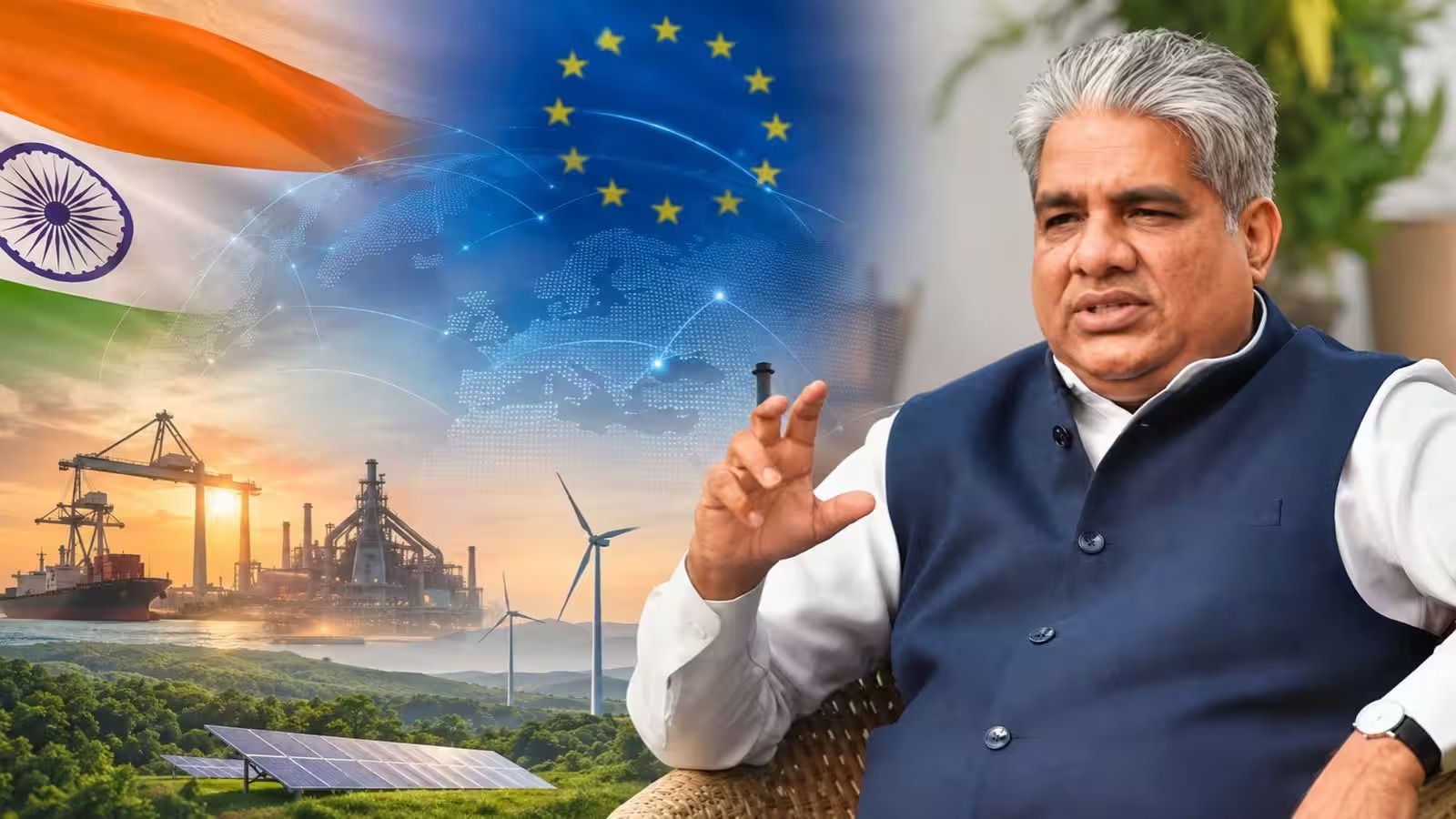
Negotiations regarding the much-awaited Free Trade Agreement (FTA) between India and the European Union (EU) are progressing in a positive direction, but India has clearly refused to make any compromise with its trade and economic interests. Just before the upcoming United Nations Climate Conference COP-31 (COP31), Union Environment, Forest and Climate Change Minister Bhupendra Yadav has made India’s stand completely clear on the European Union’s controversial Carbon Border Adjustment Mechanism (CBAM). India has bluntly said that the trade deal with the European Union is in place, but India will not accept at any cost the unilateral tariffs imposed on Indian exporters and industries under the guise of Green Tax i.e. CBAM. With this tough stance, it has become clear that India will firmly protect its sovereignty and economic interests by becoming the voice of developing countries on the global climate forum.
The EU’s Carbon Border Adjustment Mechanism (CBAM) is a type of carbon tax that the EU is implementing on imports from its carbon-intensive sectors (such as steel, aluminium, cement, fertilizers and electricity). The EU argues that the purpose of this tax is to reduce greenhouse gas emissions globally and to provide fair competition to their domestic industries. However, India believes that mechanisms like CBAM are a protective trade barrier in the name of environmental protection, which is a clear violation of World Trade Organization (WTO) rules and the principles of the Paris Agreement of the United Nations Climate Framework (UNFCCC). The Paris Agreement stipulates that each country’s responsibility to tackle climate change should be determined based on its own capabilities and historical emissions (Common But Differentiated Responsibilities – CBDR).
Ahead of the upcoming COP31 climate summit, Union Minister Bhupendra Yadav has strongly underlined India’s position and priorities on the global stage. He clarified that India has always been among the leading countries in the world in environmental protection and expansion of renewable energy, but no developed country or organization has the right to impose unfair tax system on the growth rates and industries of developing countries in the name of climate policy. According to Bhupendra Yadav, India will prominently raise the demand for climate finance, technology transfer and removing the shortcomings in the implementation of the Paris Agreement during COP31. India says developed countries should fulfill their own financing and emission reduction promises, and not impose additional taxes on the exports of developing countries.
Several rounds of talks have taken place between India and the European Union and both sides are striving towards reaching a mutually beneficial trade agreement. However, the implementation of CBAM is expected to have a deep economic impact on India’s key export sectors, especially the steel and aluminum industries. If additional carbon tax of 20% to 35% is imposed on Indian products in the European market, it may drastically reduce the competitiveness of Indian products. New Delhi has repeatedly taken the stance that climate concerns should be kept aside from trade talks and trade agreements (FTAs) should be finalized only on the basis of clean and transparent economic criteria. India clearly believes that trade deals and environmental policies should not become a means of disrupting each other.
India is not limited to mere rhetoric against CBAM, but is also making concrete strategies at the legal and diplomatic levels. The Indian government has already indicated that if the EU does not show flexibility in its stand on CBAM or does not make provision for exemptions for Indian exporters, India may challenge it before the Dispute Settlement Mechanism of the World Trade Organization (WTO). Along with this, India is rapidly promoting the use of Green Hydrogen Mission, National Solar Mission and renewable energy in the steel sector to make its domestic industries more energy-efficient and carbon-free, so that Indian MSMEs and large industries do not lag behind in competing globally.
This clear message from Bhupendra Yadav not only protects India’s business interests, but it also provides a strong voice to the concerns of the entire ‘Global South’ (developing and poor countries). Developed countries are now imposing unfair taxes on developing countries after years of industrial emissions, which is not fair. On the platform of COP31, India will corner developed countries with the demand for climate financing and adaptation. This adamant stance of New Delhi may also force the European Union to reconsider its policies, as India is the fastest growing major economy in the world and no global trade agreement can be completed by ignoring India.