 look news india

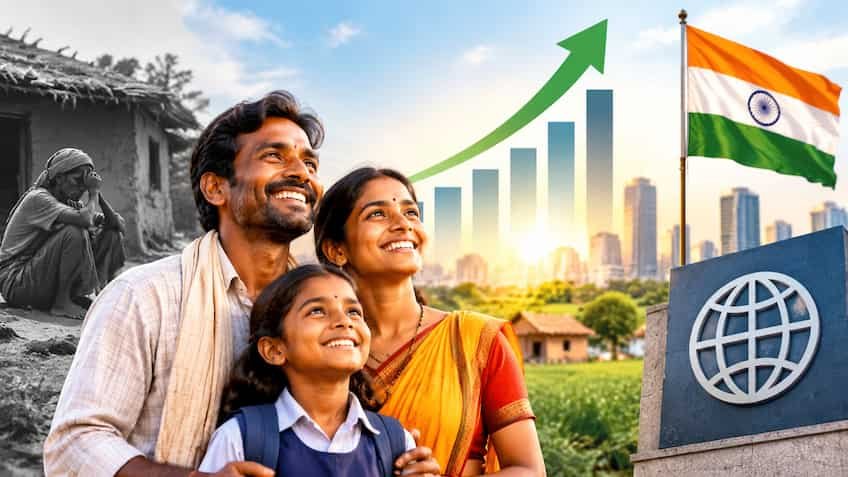
India has achieved a historic and unprecedented position on the front of global economy and social reforms. The official data of ‘Poverty and Equity Brief’ released by the World Bank has revealed that India has registered a record decline in poverty during the last 12 years (2011 to 2023). During this period, about 50 crore (estimated 49.6 crore i.e. 496 million) people of the country have been successful in rising above the poverty line. Globally, in any democratic country, it is being considered an extraordinary achievement for such a large population to come out of economic poverty in such a short time.
According to the main data of the World Bank report, there has been a revolutionary reduction in the rate of extreme poverty in India. While in the year 2011, about 27.1 percent of the country’s population was living in extreme poverty, by the year 2023 this figure has come down dramatically to only 2.6 percent. Measured by the international poverty line ($3.00 per day on a 2021 purchasing power parity basis), India has achieved decisive success in lifting millions of families out of basic poverty.
The report also presents a detailed analysis of the poverty line standard for lower-middle income countries (LMICs) of $4.20 per day (2021 PPP). In 2011, 57.7 percent of India’s population was living below this limit, which has reduced to only 16.1 percent in 2023. This simply means that about 49.6 crore citizens of the country have reached a more economically secure position and their standard of living has increased above the minimum requirements.
The main reason behind this rapid pace of poverty alleviation in India has been the unprecedented coordination of targeted welfare schemes and digital infrastructure of the central and state governments. The receipt of money from government schemes directly into the bank accounts of beneficiaries without any middleman through DBT (Direct Benefit Transfer) brought transparency in the system. Multidimensional programs like guarantee of free ration under National Food Security, pucca houses under Pradhan Mantri Awas Yojana, construction of toilets under Swachh Bharat Mission, tap water to every house, cooking gas through Ujjwala Yojana and free health care through Ayushman Bharat have reduced the personal expenses of families to a great extent.
The World Bank study also highlights that employment generation and economic participation, especially of rural women, have contributed significantly to poverty reduction. Nearly 134 crore (134 million) new people joined the workforce between 2017 and 2023, with rural women making up a significant portion of the salaried and self-employed. Expansion of roads, uninterrupted power supply to villages, mobile connectivity and encouragement to local micro industries (MSMEs) have strengthened the standard of living and sources of income even in remote areas.
After the findings of NITI Aayog’s Multidimensional Poverty Index (MPI), now these independent data from the World Bank have put a global seal on India’s economic revival. India’s progress towards the United Nations’ Sustainable Development Goal (SDG-1) i.e. ‘zero poverty’ has become a model worth studying for other developing countries of the world. Experts believe that after overcoming basic poverty, the next phase of the country will focus on ensuring high quality employment, better skill development and sustained growth in real income, so that the middle class can expand at a greater pace.