 look news india

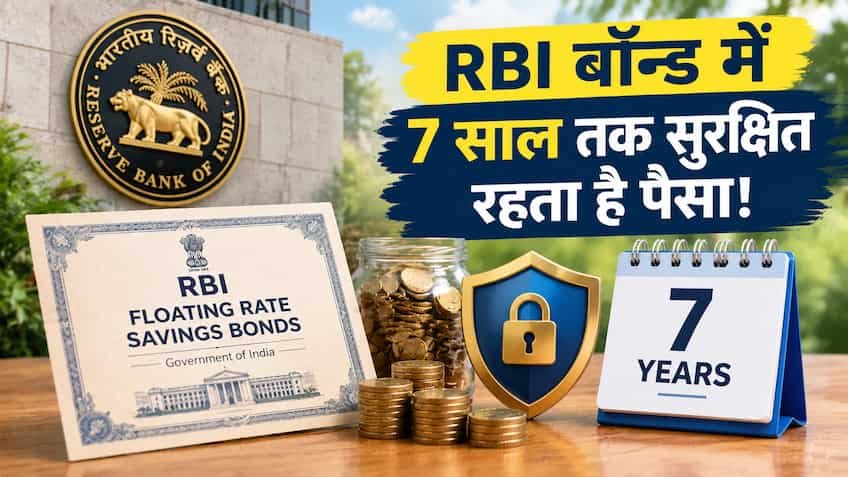
‘Floating Rate Savings Bonds’ (FRSB) issued by the Reserve Bank of India (RBI) on behalf of the Government of India are considered to be one of the most reliable options for investors looking for safe investments and regular income. This scheme is considered ideal for investors who want better returns than bank fixed deposits (FD) and seek the guarantee of 100% sovereign protection on their principal amount. In this scheme with a maturity period of 7 years, interest payment is deposited directly into the investor’s savings account every 6 months.
RBI Floating Rate Savings Bond (Taxable) is a government savings scheme, operated by the Reserve Bank on behalf of the Government of India. The maturity period of this bond is exactly 7 years from the date of issue. It does not have a fixed interest rate like a traditional FD, rather it works on a floating interest rate. There is no cumulative option in this bond, which means that the interest cannot be withheld till maturity; The interest earned is transferred to the investor’s bank account every 6 months.
The interest rate of this bond is directly linked to the interest rate of the National Savings Certificate (NSC) scheme of the post office. As per the formula prescribed by the Government of India, its interest rate is always kept 0.35% (35 basis points) higher than the NSC rate. The interest rates are reviewed and reset by the Central Government every 6 months (January 1 and July 1). If the NSC rate is 7.70%, the bond pays interest at 8.05% per annum. Interest is calculated half yearly and the interest amount is transferred electronically directly to the investor’s linked bank account twice a year—on January 1 and July 1.
Investment in this bond can be started with a minimum of ₹1,000 and thereafter investment is allowed in multiples of ₹1,000. There is no upper limit for maximum investment, that is, investors can invest as much amount as they want as per their capacity. In terms of eligibility, only Indian citizens (adults, or guardian on behalf of a minor) and Hindu Undivided Families (HUFs) can invest in it. Non-Resident Indians (NRIs) are not eligible to invest in this scheme. This bond is kept safe in the investor’s ‘Bond Ledger Account’ (BLA) in electronic form instead of any physical paper.
The full lock-in period of 7 years remains applicable for general investors and premature withdrawal of principal is not allowed. However, to facilitate liquidity to senior citizens, special relaxations based on age group have been given:
-
The lock-in period for investors aged 60 to 70 years is 6 years.
-
The lock-in period for investors aged 70 to 80 years is fixed at 5 years.
-
The lock-in period for senior citizens aged 80 years and above is 4 years. In case of premature withdrawal, 50% of the last 6 months’ interest is deducted as penalty.
The interest received from this bond is fully taxable and is added to the total income of the investor and tax is determined as per his applicable income tax slab. If the interest earned in a financial year exceeds the prescribed limit, Tax Deducted at Source (TDS) is levied by the bank or RBI. These bonds are not transferable, that is, they cannot be sold or transferred as a gift to another person (except to transfer to a nominee after the death of the account holder). Additionally, this bond cannot be traded in the stock market nor can a loan be taken by pledging it to a bank or financial institution.
Investors can purchase these bonds through two primary means:
-
RBI Retail Direct Portal: Investors can open their Retail Direct Gilt (RDG) account by visiting the Reserve Bank’s online portal (rbiretaildirect.org.in) and buy bonds directly through net banking/UPI without any brokerage or commission.
-
Bank Branch or Net Banking: Investment can also be made by filling the application form through the branches of State Bank of India (SBI), other public sector banks and authorized private banks (like HDFC, ICICI, Axis) or their authorized internet banking services. For this, the investor’s PAN card, proof of identity and address and bank passbook/cancelled check are required.