 look news india

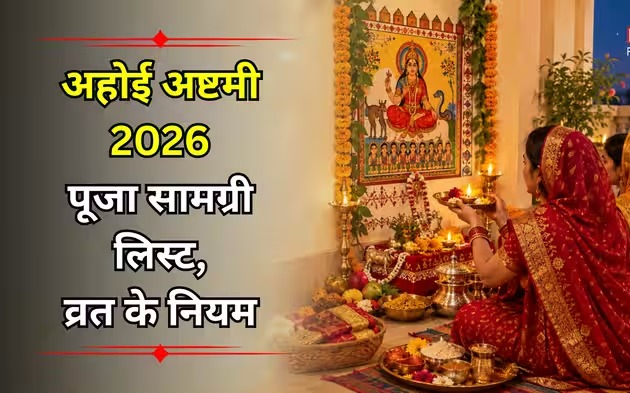
In Sanatan culture and Hindu calendar, the fast of ‘Ahoi Ashtami’ dedicated to the longevity, good health and bright future of the mother and the children is considered a very important and sacred festival. This fast, which is observed on the Ashtami Tithi of Krishna Paksha of Kartik month, is observed by mothers with complete devotion and strict fasting for the safety of their children and their happy life. On this day, women observe Nirjala fast and break their fast only after offering Arghya to the stars or the moon. In the year 2026, this holy festival of Ahoi Ashtami is being celebrated with full devotion across the country. If you are also observing the Ahoi Ashtami fast this year or are going to worship it for the first time, then it is very important for you to have complete knowledge of the correct list of puja materials and all the important rules of the fast to receive the blessings of the Mother Goddess.
On the day of Ahoi Ashtami, the pictures of Mata Ahoi and Seya (Sehi) are worshiped on the wall, which requires an organized puja material. To ensure that there is no shortage of any kind in the puja thali, collect all these sacred ingredients in advance. The puja material list should mainly include roli, akshat (rice), mauli or kalava, incense sticks, pure ghee lamp, camphor, fruits (especially water chestnuts and other fruits as per the season), sweets or halwa (for bhog), kalash filled with water (karva), raw cotton thread, silver ahoi (also known as hoi), and a picture or calendar of the goddess for the puja. Apart from this, there is a tradition of keeping wheat grains or raw rice in hand while listening to the story, which is donated to birds or the needy after the puja.
The biggest feature of the worship of Ahoi Ashtami is that a picture of Ahoi Mata and her seven sons is made with roli or ocher on the clean wall of the house. At many places, puja is also done by pasting calendars or photos on the wall. A picture of Seya (Seh) and her children is also made near the picture, because according to folk tales, Seya is considered to be the form of Mother Ahoi. After making the picture, it is kept filled with water on the wall in front of the Mother Goddess. Seven bindis are placed on the Karva with Roli and Mauli is tied. After this, after worshiping with Roli and rice, offerings are made to the Mother Goddess and the mythological story of Ahoi Mata is narrated by the elderly lady of the house or the priest.
Ahoi Ashtami fast is known for its strict rules, following which it is mandatory for every fasting woman. The most important rule of this fast is to remain hydrated, that is, not to consume even a single drop of water for the whole day during the fast. Although there is exemption for pregnant women or unwell women from eating fruits, generally women keep fast for the whole day without water. The second most important rule is that on this day one waits for the stars or the moon to rise in the sky. Water is offered only after seeing the stars or moon in the evening and only then the fast is broken. Apart from this, during this entire day one should avoid any kind of negative thoughts, anger or debate in the house and spend all the time in chanting bhajans and kirtans of the Mother Goddess.
There is a special tradition of worshiping a silver hoi (pendant) during the fast of Ahoi Ashtami. In many families, a silver Ahoi is specially made by a goldsmith, in which two silver beads or pearls are threaded. This silver garland is worn at the time of puja or kept in front of the Mother Goddess. After the puja is over, this silver garland is kept safe, and every year Ahoi Ashtami is worshiped with this garland. It is said that every year a new bead or silver grain is added to this silver rosary as a sign of success and blessings for the child. This tradition not only carries forward the family culture but is also considered a symbol of a mother’s immense love and dedication towards her children.
On the evening of Ahoi Ashtami, when the stars appear in the sky, women offer Arghya to the stars, wishing for the long life of their children. To offer Arghya, an earthen or copper vessel is used, which is filled with water and some coins or coins are kept in it. After looking at the stars through a sieve and offering Arghya, women break their fast. At the time of Parana, first of all sweet food or pudding is fed to their children with their own hands and only after that the mothers themselves consume food and water. In this way, this holy festival becomes a unique and sacred celebration of mothers’ sacrifice, penance and immense love for their children and fills every home with joy.