 look news india

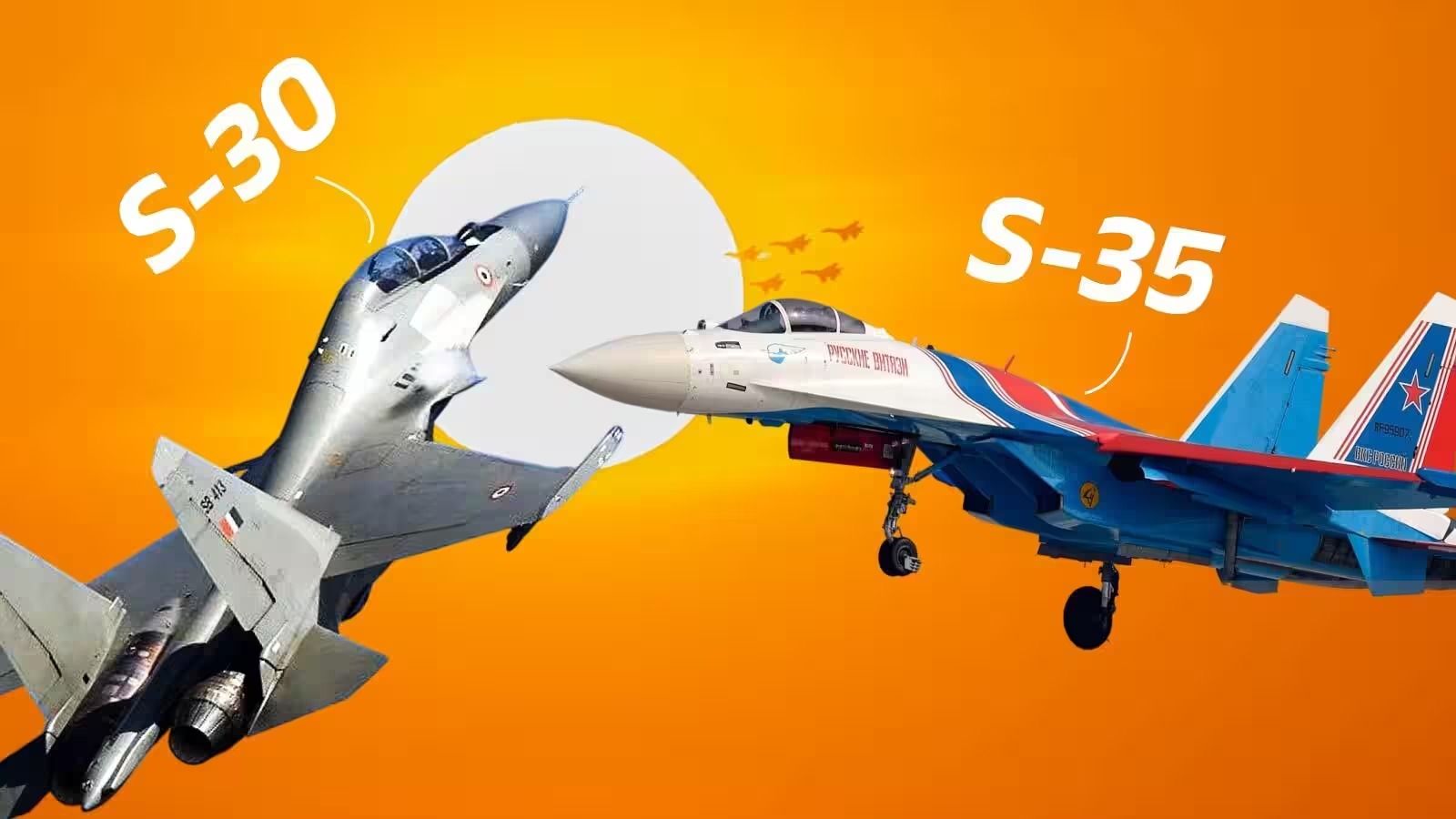
A huge change has been seen in the global defense market regarding the purchase and sale of fighter aircraft. An African country has taken a big step regarding Russia’s most dangerous and lethal 4.5 generation ‘Super Flanker’ i.e. Sukhoi Su-35 fighter jets. Ethiopia has inducted the first fleet of a dozen modern Su-35 fighter planes into its fleet under a deal with the Russian defense industry. Surprisingly, this African country already has Indian standard and leased or older version Su-30 aircraft. In such a situation, there is a strong discussion among defense experts about how much more powerful, deadly and technologically advanced Russia’s new ‘Super Flanker’ Su-35 is than the traditional Su-30.
Difference in basic technical structure of Su-30 and Su-35
When we compare these two giants of the Russian Sukhoi series, the biggest and fundamental difference is their cockpit design and airframe capability. The Su-30 (like Su-30MKI), considered the backbone of the Indian Air Force, has a two-seat (Tandem) seating arrangement for the pilot and navigator/weapon system officer (WSO). In contrast, the Su-35 is a single-seater aircraft. By eliminating the weight of the second crew member and bulky equipment, the Su-35’s airframe has been made more lightweight, flexible and more fuel efficient. Additionally, unlike the Su-30MKI, the Su-35 does not have small canard wings at the front, but instead its aerodynamic design and thrust-vectoring nozzles give it the ability to perform acrobatic maneuvers in the air.
Super-maneuverability and state-of-the-art engine power
The Su-35’s greatest strength is its two powerful Saturn AL-41F1S afterburning turbofan engines, which are equipped with 3D thrust-vectoring nozzles. The nozzles of these engines can rotate in different directions, due to which this fighter jet exhibits ‘super-maneuverability’. This aircraft can perform such dangerous and sudden aerobatics in the air (like Cobra and Kulbit maneuver), which are completely capable of dodging enemy radars and missiles. Compared to the conventional Su-30, this aircraft’s maximum speed (Mach 2.25) and combat range without refueling are also much higher, which makes it extremely dangerous in long-range operations.
Deadly radar systems and a dragnet of weapons
The Su-35’s N035 Irbis-E Passive Electronically Scanned Array (PESA) radar makes it a mobile hunter when it comes to engaging the enemy in the air. This powerful radar has the power to simultaneously track and target multiple enemy fighter aircraft from hundreds of kilometers away. Up to 8,000 kg of modern weapons, laser-guided bombs and long-range missiles (like the dreaded R-37M hypersonic air-to-air missile) can be easily loaded onto its 12 external hardpoints. Although the Su-30 is also adept at carrying heavy payloads, the Su-35’s digital avionics and advanced jamming systems make it more modern in terms of electronic warfare.
Defense strategy and global impact of African countries
This deal for Su-35 by Ethiopia comes at a time when strategic alliances in the African continent are changing rapidly. With the induction of these ‘Super Flanker’ aircraft of Russia, the firepower of the Ethiopian Air Force has increased manifold, and they are also planning to add the modern S-400 air defense system to their defense line. Defense analysts believe that the traditional Su-30 aircraft have retained their place due to their cost and two-seater utility, but the single-pilot Su-35 meets the needs of the modern battlefield where AI-assisted avionics and maneuverability in dogfighting are of paramount importance.