 look news india

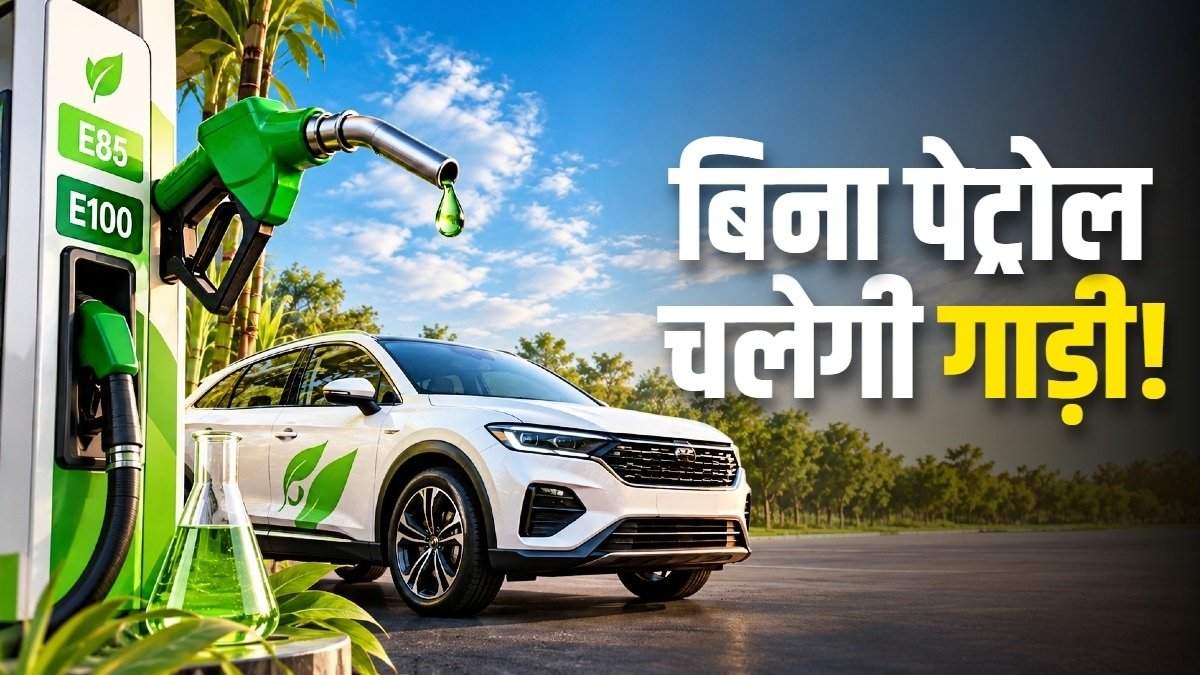
These days, a major change has taken place in the fuel stations and automobile sector across the country. The Ministry of Road Transport and Highways (MoRTH) has issued a new notification regarding the use of E100 i.e. 100 percent ethanol fuel by amending the Central Motor Vehicle Rules (CMVR). Till now, only 10 to 20 percent ethanol mixed petrol (E10 and E20) was being used on Indian roads, but now the government has cleared the way for technical and safety standards for vehicles running completely on ethanol. This simply means that the production and sale of such vehicles has now become legal in the country which will run only on pure bio-ethanol made from sugarcane, corn and agricultural waste without a drop of petrol.
This question is arising in the mind of every vehicle owner who has a normal petrol car or bike. The direct and technical answer is – absolutely not. Your existing car’s fuel injection system, rubber hoses, gaskets and engine tuning are designed to be compatible with E10 or maximum E20 (20% ethanol). The chemical structure of ethanol is different from that of petrol and it has a tendency to absorb moisture. If pure E100 is filled in a normal petrol engine, there is a risk of corrosion of sensitive parts of the engine, melting of rubber pipes and imbalance in the temperature of the combustion chamber. The purpose of the government’s new rules is not to force existing normal cars to run on E100, but to promote special ‘Flex-Fuel Vehicles (FFV) and full ethanol adapted vehicles in the market.
Flex-fuel engine technology is used in vehicles running on E100. This is a smart powertrain whose fuel system is equipped with special ‘Ethanol Sensors’. This sensor instantly scans the fuel present in the fuel tank and identifies the amount of petrol and how much ethanol in the tank. After this the electronic control unit (ECU) of the car automatically adjusts the air-fuel ratio and spark timing. The biggest advantage of this is that in a flex-fuel car, you can fill it with 100% petrol, a mixture of 50% petrol and 50% ethanol, or straight 100% pure E100 – the engine will run smoothly without any jerks. This technology has been running successfully for decades in countries like Brazil and the US, where car drivers decide which fuel to fill based on the prices of petrol and ethanol today.
‘How much does it give’ is the most important question for every Indian consumer when it comes to fuel. According to energy density, ethanol has about 30 to 33 percent less energy than petrol. Its direct effect is that the mileage of a vehicle running on E100 can reduce by about 15 to 25 percent compared to petrol. However, this is compensated by the low price of ethanol. Ethanol is produced domestically from agricultural products, hence its refining and retail costs are much lower than international crude oil. If the government and oil companies keep the pump price of E100 30 to 40 rupees cheaper per liter than petrol, then despite the slight reduction in mileage, the running cost per kilometer will be much cheaper than petrol. Also, ethanol has an octane number above 100, which gives the engine better pickup and higher compression ratio.
India imports more than 85 percent of its crude oil needs from abroad, leading to huge outflow of foreign exchange. Bringing E100 into the mainstream will drastically reduce this oil import dependence. Along with this, ethanol production will directly benefit the sugarcane and grain producing farmers of the country, as the excess stock of their produce will be purchased by the distilleries and converted into fuel. From an environmental point of view, E100 is considered a ‘carbon neutral’ option, because the carbon dioxide that plants absorb while growing is the same gas released when burned. As compared to normal petrol, combustion of 100% ethanol reduces carbon monoxide and hydrocarbon emissions from the tailpipe by 70 to 80 percent, which will directly help in improving air quality in big cities.
Major automobile companies like Toyota, Maruti Suzuki, Hyundai, TVS and Bajaj have already showcased their flex-fuel prototypes and E100 ready models at the Indian Auto Expo. TVS has also launched its Apache RTR 200 FI E100 on a limited basis. Now that the government has clarified the legal standards, it will become easier for vehicle manufacturing companies to start large-scale commercial production of these vehicles. Public sector oil marketing companies (IOCL, BPCL, HPCL) have also started the pilot of installing E100 dispensing units at major retail outlets in select cities. The signal to ordinary car buyers is clear—if you drive a normal petrol car today, there is no need to worry as normal petrol and E20 fuel will remain available, but in a few years time when you go to buy your next car, the E100 flex-fuel car will be in the showroom as a very affordable and practical option.