 look news india

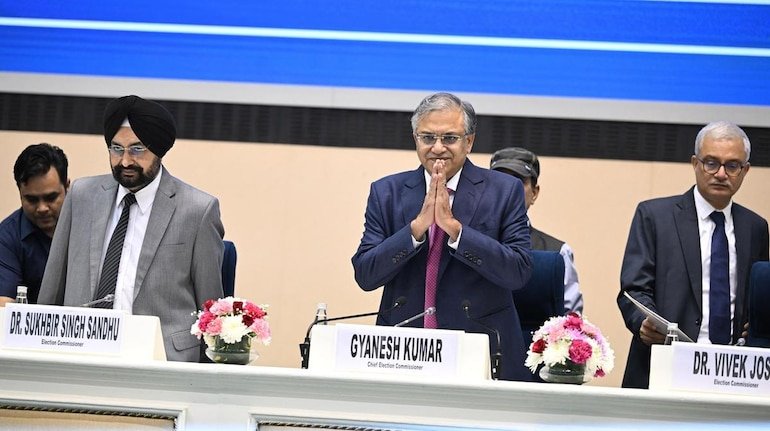
A big and shocking official revelation has come to light in the internal dispute arising within the top leadership of the Election Commission of India (ECI) regarding the working style and administrative orders of senior officials. Election Commissioners (EC) Dr. Sukhbir Singh Sandhu and Dr. Vivek Joshi had written a letter directly to Cabinet Secretary T.V. Somanathan demanding disciplinary action against a senior official of the Commission. However, the apex administrative body of the Central Government i.e. Cabinet Secretariat had completely refused to take any direct action in this entire matter. It has become clear from the internal file notings revealed under the Right to Information (RTI) Act that the Cabinet Secretariat had withdrawn its hands from intervening on the complaints of the two commissioners, considering the executive’s interference in the internal functioning of the Election Commission as unfair and unconstitutional.
This whole matter is related to retired commodore and transparency activist Lokesh K. Made public in response to an RTI application filed by Batra. According to official records and file notings accessed through RTI, on July 29, both the election commissioners—Sukhbir Singh Sandhu and Vivek Joshi—had sent separate letters to the Cabinet Secretary. In these letters, serious objections were lodged against Manish Garg, Senior Deputy Election Commissioner of the Election Commission.
The Cabinet Secretariat confirmed that both letters were filed on July 30. After this, there was an intensive discussion on this within the Secretariat on 3 and 4 August. On August 5, the Cabinet Secretary prepared a reply in this regard, in which a copy of this correspondence was sent to the office of Chief Election Commissioner (CEC) Gyanesh Kumar and the Department of Personnel and Training (DoPT) for information.
The official file noting dated August 4, released by the Cabinet Secretariat, detailed why the government did not take any punitive or administrative action as demanded by the election commissioners:
-
Autonomy of Constitutional Institution: The Secretariat underlined that the Election Commission is an independent constitutional body. Under the basic structure of the Constitution, it has been kept completely isolated and insulated from any kind of undue interference by the executive (government), so that the Election Commission can function in a fair and transparent manner.
-
Letters written in ‘personal capacity’: The Cabinet Secretariat clarified in its comment that the letters sent by both the Election Commissioners were their ‘Individual Capacity’ were written in. Since this was not a common, formal and institutional proposal from the Commission (Formal Communication from Commission as a Whole), the government taking direct action against any officer would have been considered an encroachment on the internal jurisdiction of the Election Commission.
-
Legal Principle of Multi-Member Commission: The ECI is a multi-member body under the Chief Election Commissioner and Other Election Commissioners (Appointment, Terms of Service and Tenure) Act, 2023, where institutional decisions are taken by consensus or majority. If there is any dissatisfaction within the Commission regarding the conduct of a deputation officer, it should be regulated by the Commission itself under the Election Commission’s own internal rules, service rules and guidelines and not at the level of the Cabinet Secretariat.
The crux of this entire controversy was an internal order on work-reallocation issued on July 28.
-
Actually, Deputy Election Commissioner (Administration) Bhanu Prakash Yeturi was on leave from July 27 to August 9. In his absence, Senior Deputy Election Commissioner Manish Garg (who is a senior IAS officer of Himachal Pradesh cadre) was given additional charge (Link Officer) of the Administration Division.
-
As soon as he assumed charge, Garg on July 28 issued orders for comprehensive changes in the work allocation of equivalent and senior officers of the Commission.
-
Election Commissioner Sukhbir Singh Sandhu alleged in his letter that the order was issued arbitrarily without any prior consultation, information or approval from the entire commission or the commissioners.
-
At the same time, Election Commissioner Vivek Joshi raised in his complaint that when he called for the original files and documents related to the Administration Division, those files were not provided to him by the Administration Division. The commissioners said that taking such a step despite repeated oral and written instructions was a clear violation of established administrative norms.
After the controversy became public, the Election Commission issued an official statement clarifying the situation. The Commission had said that the letter written to the Cabinet Secretary was not related to any major policy matter of the Commission or the IT Division, but was in the context of the functioning of an officer posted on deputation. The Commission had also made it clear that the disputed work-re-division order was postponed/canceled immediately after it came to the notice of both the Commissioners and was never allowed to be implemented on the ground.
This latest revelation from RTI has proved that even though differences had emerged within the Election Commission regarding administrative control and movement of files, the executive respected the constitutional Lakshman Rekha and refrained from jumping directly into the internal disciplinary dispute of the Election Commission.