 look news india

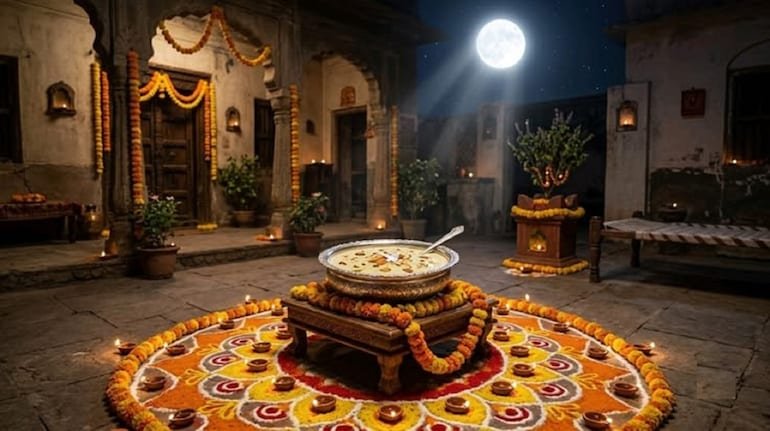
In Sanatan Dharma, the full moon of Shukla Paksha of Ashwin month is known as ‘Sharad Purnima’, which is also called Kojagari Purnima, Raas Purnima and Kaumudi Utsav at many places. From both mythological and astronomical point of view, this night is considered to be the most miraculous and divine night of the year, because only on this day the moon appears in its full glory. 16 Kalas (16 Kalas) Being full of , it is closest to the earth. There is a religious belief that on the night of Sharad Purnima, ‘nectar’ actually drips from the rays of the moon, which communicates mental peace, health and positive energy. For this reason, there is a centuries-old tradition of keeping kheer made of cow’s milk under the open sky on a moonlit night and taking its prasad the next day. There is a doubt in the minds of many devotees regarding the time of beginning and end of Purnima Tithi in the year 2026 whether the tradition of keeping fast and kheer will be observed on 25 October or 26 October. Let us know the exact date of Sharad Purnima, moonrise, Nishith Kaal and the complete auspicious time of keeping Kheer according to the Vedic calendar.
According to the calculations of Vedic calendar, the details of Ashwin Shukla Purnima date in the year 2026 are as follows:
-
Start of Purnima Tithi: Sunday, October 25, 2026 in the morning at 11:55 From.
-
Completion of Purnima Tithi: Monday, October 26, 2026 in the morning at 09:41 But.
According to the scriptures, Sindhu and Dharmasindhu, the festival of Sharad Purnima is celebrated on the night on which the Purnima Tithi falls in Pradosh Kaal and Nishith Kaal (midnight). Since Purnima Tithi will be active throughout the night of October 25 and will end shortly after sunrise on the morning of October 26, The main rituals of Sharad Purnima fast, Kojagari Lakshmi Puja and keeping kheer in moonlight will be performed on Sunday, 25 October 2026 only.. On October 26, only full moon bath and normal day worship of Lord Satyanarayan can be done.
There is a special tradition of seeing the moon and offering Arghya on the evening of Sharad Purnima. The time of moonrise in different cities of the country on Sunday, October 25, 2026 will be approximately in the evening. 04:55 pm to 05:15 pm Will be between:
-
New Delhi/NCR: Around 04:55 to 05:00 pm
-
Lucknow / Uttar Pradesh: Around 04:50 to 04:58 pm
-
Kolkata/West Bengal: around 04:42 pm
-
Mumbai/Maharashtra: around 05:32 pm
-
Chennai / South India: around 05:04 pm
(Note: Due to geographical location, there may be a slight difference of 5 to 10 minutes in the time of moonrise in local cities, so do moon darshan as per your local almanac.)
The main purpose of keeping kheer in the cool rays of the moon on Sharad Purnima is that the medicinal and nectar-like rays of the moon can be absorbed in that milk and rice kheer.
-
Kheer keeping time: After moonrise on the evening of 25th October and the Moon becoming fully visible in the sky i.e. 08:00 pm to midnight (Nishith Kaal) 12:30 am Kheer can be kept in the open terrace or balcony anytime.
-
Amrit Kaal Muhurta: From 05:05 PM to 06:36 PM.
-
Kojagari Puja and Nishith Kaal Muhurta: Night 11:39am to late 12:30am (starting October 26) till. The Moon’s energy is at its peak during this period.
It is considered mandatory to follow some precautions and rules while keeping kheer in moonshine:
-
Selection of character: Keeping kheer in a glass, clay or silver vessel is considered to be the best and purest. Avoid keeping milk kheer in brass, copper or aluminum utensils as chemical reactions may occur in them.
-
Preparation of Kheer: While making kheer, use pure cow’s milk, new rice, sugar candy and makhana. If possible, add some saffron to it also.
-
Correct way to cover: Do not completely close the kheer vessel with a heavy lid or plate, otherwise the moon’s rays will not be able to reach the kheer. Cover the vessel with a fine mesh cotton cloth or a fine sieve so that dust, insects or dew drops are protected and the moonlight falls directly on the kheer.
-
Distribution of offerings and prasad to God: Bring the kheer inside after midnight or next morning in Brahma Muhurta after taking bath, first offer it to Lord Shri Hari Vishnu and Mata Lakshmi, and then distribute it as Prasad among the entire family.
The night of Sharad Purnima is also called ‘Kojagari night’. It is believed that on this night Mother Lakshmi herself departs from Kshirsagar for Vaikuntha Loka and while roaming on the earth at night she says –“To Jagarti?” In other words “who is awake?” The person who stays awake on this night and meditates, chants mantras and bhajans and kirtans of Lord Vishnu and Mother Lakshmi, Goddess Lakshmi resides permanently in his house and destroys poverty. In Bengal, Odisha, Assam and Mithilanchal, ‘Kojagari Lakshmi Puja’ is celebrated with great pomp and splendor on this night and by decorating Alpana (Rangoli).
According to religious history, on this holy night of Sharad Purnima in Dwapar Yuga, Lord Shri Krishna had created a divine ‘Maharas’ with the Gopis in Nidhivan of Vrindavan. God, through His Yogamaya, had made that one night as long as many Kalpas.
At the same time, this night also has great importance from the point of view of Ayurveda and science. In autumn, the incidence of ‘pitta’ increases in the body. On the day of Sharad Purnima, the Moon is closest to the Earth and its cool rays are extremely intense. When these rays fall on the kheer kept in the open sky, the lactic acid and rice starch present in the milk combine with these rays and activate the cool chemical elements. Consuming this kheer calms pitta dosha, improves eyesight, makes skin glow and strengthens immunity.