 look news india

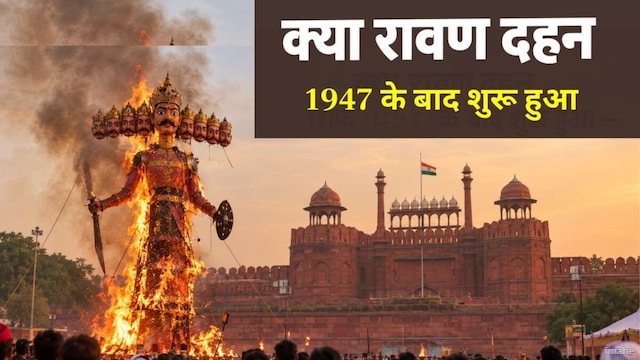
On the auspicious occasion of Vijayadashami i.e. Dussehra, huge effigies of Ravana, Kumbhakarna and Meghnad are burnt across the country. This question often floats in social media and general discussions whether there was no tradition of burning Ravana in India before independence? Many people believe that the trend of burning huge effigies by refugees started in 1948 in Ranchi or in 1953 from Ramlila Maidan in Delhi. However, historical documents and research confirm that the practice of Ravana Dahan existed in different forms in India long before independence.
According to historians and authentic records, the burning of symbolic effigies of Ravana in India dates back more than 200 years. With the increasing popularity of Shri Ramcharitmanas written by Goswami Tulsidas ji in the 16th and 17th centuries, a grand tradition of staging Ramlila was established in North India. In the 17th century Ramlilas organized by Tulsidas’ disciple Megha Bhagat in Varanasi, small effigies or figures were made and burnt in the fire to symbolically depict the killing of Ravana on the day of Vijayadashami.
There is clear evidence of Ravana Dahan even during the British rule. James Prinsep, the famous scholar and painter of the British East India Company, made a detailed sketch of the grand Dussehra festival held in Banaras in the year 1834. In this historical sketch, the giant effigy of Ravana and the huge crowd gathered around it is clearly visible. This rare picture is still preserved in the prestigious British Library in London, which is an irrefutable proof that even in the colonial period (1834), the ritual of burning Ravana was performed with full pomp and show.
Before independence, Dussehra was celebrated with great pomp in various princely states and princely states of India. In princely states like Mysore, Kota, Jaipur, Gwalior and Rewa, the kings and emperors themselves were the patrons of Ramlila events. A grand public fair and Ravana Dahan was formally started in Kota state in 1893 during the reign of the then Maharaja Umed Singh II. At that time, effigies were made of bamboo, grass, cloth and fireworks, which were burnt by the king by firing arrows.
After independence and partition of 1947, there was a widespread social change in the celebration of Ravana Dahan. Refugee families who came to India from Pakistan’s Punjab and Sindh provinces started a public practice of burning giant 50 to 100 feet high effigies to show their cultural solidarity in cities like Ranchi, Delhi, Nagpur and Ludhiana. This transformed Dussehra from a limited religious ritual to the huge public extravaganza that we see in modern India today.
According to religious texts, in Tretayuga, Lord Shri Ram had killed the unrighteous Lankan king Ravana on the tenth day of Shukla Paksha of Ashwin month. In this sacred memory, the festival of Vijayadashami is celebrated as the victory of good over evil and truth over falsehood. Ravana Dahan is not just burning an external effigy, but it provides a great spiritual message of eliminating the five vices hidden within man namely lust, anger, greed, attachment and ego.